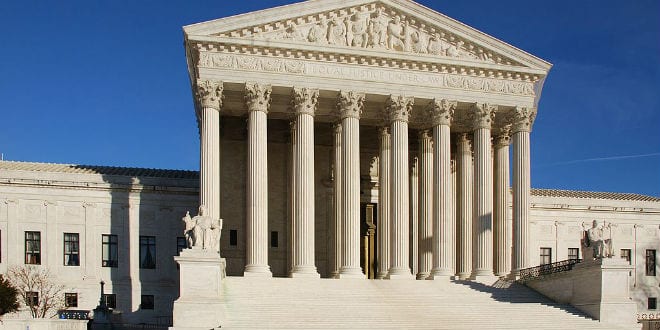
Supreme Court Justice Sonia Sotomayor denied an emergency request this week from the Palestinian Authority and Palestine Liberation Organization to freeze a $655.5 million judgment owed to American victims of terrorism carried out during the Second Intifada. She issued the denial without explanation and without referring the matter to the full Court, leaving the award in place while the Palestinian organizations pursue further appeal. The ruling is the latest turn in a legal battle that has run for more than twenty years, through two rounds of Supreme Court review, an act of Congress written specifically to keep the case alive, and a unanimous decision last year that changed the shape of what American courts can do to hold foreign entities accountable for terrorism against US citizens.
Where It Started
The case, formally known as Sokolow v. Palestine Liberation Organization, traces back to a series of shootings and bombings in and around Jerusalem between 2002 and 2004, carried out during the Second Intifada. Among the incidents underlying the eventual verdict were a 2001 shooting attack in Jerusalem, the 2002 bombing of a cafeteria at Hebrew University, and a 2004 bus bombing in the city. American victims, killed or wounded in these attacks, along with their relatives, sued the PA and PLO under the Anti-Terrorism Act, a law Congress passed in 1992 specifically to give American terrorism victims a path to sue in US courts, itself a response to the 1985 hijacking of the cruise ship Achille Lauro and the murder of American passenger Leon Klinghoffer.
The plaintiffs argued that PA and PLO employees and affiliated organizations had provided material support, money, weapons, salaries, and other assistance, to attackers linked to Hamas and the Al-Aqsa Martyrs Brigades and to their families. The Palestinian organizations denied directing the attacks, arguing at trial that they had condemned the violence and that any involvement by their employees reflected unauthorized individual conduct rather than official policy. A federal jury in Manhattan was not persuaded. In 2015, it found the PA and PLO liable for six attacks that killed 33 people and wounded more than 450 others, awarding $218.5 million in damages, a figure automatically tripled to $655.5 million under the Anti-Terrorism Act’s treble-damages provision. Attorney Nitsana Darshan-Leitner, who helped represent the victims, called the verdict a turning point at the time: “Now the PLO and the PA know there is a price for supporting terrorism.”
The Jurisdictional Fight
The victory did not hold. In 2016, the 2nd US Circuit Court of Appeals threw out the verdict entirely, ruling that American courts lacked personal jurisdiction over the PA and PLO because the attacks had occurred abroad and were not specifically directed at the United States. The Supreme Court declined to take up the victims’ appeal in 2018, leaving the reversal in place and the judgment effectively dead.
Congress moved to fix the jurisdictional problem directly. In 2019, lawmakers passed the Promoting Security and Justice for Victims of Terrorism Act, a law crafted to treat the PA and PLO as having consented to US court jurisdiction if they engaged in certain activities within the United States or made payments to attackers or their families in cases where Americans were harmed. A lower court subsequently ruled the law unconstitutional, finding that it violated the PA and PLO’s Fifth Amendment due process rights, and the 2nd Circuit affirmed that finding in 2023, once again closing the courthouse door.
The Supreme Court Steps In
That set up the case’s most consequential turn. In June 2025, the Supreme Court unanimously reversed the lower courts, upholding the 2019 law’s constitutionality in an opinion by Chief Justice John Roberts. Roberts grounded the ruling in the “sensitive foreign policy concerns” behind Congress’s decision, writing that “it is permissible for the Federal Government to craft a narrow jurisdictional provision that ensures, as part of a broader foreign policy agenda, that Americans injured or killed by acts of terror have an adequate forum in which to vindicate their right to compensation.” He was careful to frame the ruling narrowly, emphasizing that the law did not put the PA and PLO “at broad risk of being haled into U.S. courts for myriad civil liability actions,” but applied only to a specific category of terrorism-related claims brought by Americans.
The 9-0 vote crossed the Court’s usual ideological lines entirely, with all three liberal justices and three conservatives fully joining Roberts’s opinion. Justices Clarence Thomas and Neil Gorsuch reached the same result through a different route, with Thomas writing separately that “the Federal Government has always possessed the power to extend its jurisdiction beyond the Nation’s borders.” Thomas went further still in a portion of his concurrence Gorsuch did not join, questioning whether the PA and PLO hold any constitutional rights at all: “I am skeptical that entities such as the Palestine Liberation Organization and the Palestinian Authority enjoy any constitutional rights at all.”
The ruling revived not just the original Sokolow judgment but a related suit brought by the family of a US-born settler stabbed to death outside a shopping center in Gush Etzion in 2018, extending the law’s reach beyond the original Second Intifada-era attacks.
Back to the 2nd Circuit, and Sotomayor’s Denial
With the constitutional question resolved, the 2nd Circuit reconsidered the Sokolow case in light of the Supreme Court’s ruling and reinstated the original $655.5 million judgment on March 30, 2026. “We conclude that the original judgment for the plaintiffs should be reinstated,” the appeals court wrote, calling that outcome “consistent with the plain import of the Supreme Court’s decision.” Kent Yalowitz, an attorney for the victims’ families, welcomed the decision: “They have been waiting for a very long time for justice to be done.”
The PA and PLO responded by asking Sotomayor, who handles emergency applications arising from the 2nd Circuit, to freeze enforcement while they sought full Supreme Court review of the reinstatement itself. Their filing warned that paying the judgment now would “destabilize critical government services Petitioners provide” in Judea and Samaria, “injure innocent citizens, and jeopardize regional security,” and specifically flagged that victims could seek to collect the award from Palestinian tax revenues transferred through Israel, funds the PA relies on heavily to operate. Their lawyers also argued, separately from the hardship claim, that the original 2015 judgment had become “a legal nullity” once the earlier round of appeals concluded in 2018 and could not simply be revived years later. Sotomayor rejected the request outright, without offering reasoning and without sending the question to the full Court, a decision that leaves the award enforceable while the PA and PLO’s broader appeal continues.
The case arrives against a backdrop of related US pressure on the PA’s own payment practices. In February 2026, the PA announced it would end its long-standing system of payments to the families of Palestinians killed by Israeli forces or held in Israeli prisons, a practice critics call “pay-for-slay” and one Washington had pressed Ramallah to end for years. That framework traces back to Trump’s first term, when he signed legislation in 2018 suspending US financial assistance to the PA for as long as it continued making those payments to individuals linked to terrorism under Israeli government criteria.
Two decades after the underlying attacks, the case remains unresolved in the fullest sense, the PA and PLO can still seek complete Supreme Court review of the reinstated judgment, and payment has not been collected. But with the constitutional question settled 9-0 and Sotomayor’s refusal to pause enforcement in the meantime, the practical balance of power in the case has shifted decisively toward the American families who have spent more than twenty years pursuing it.