




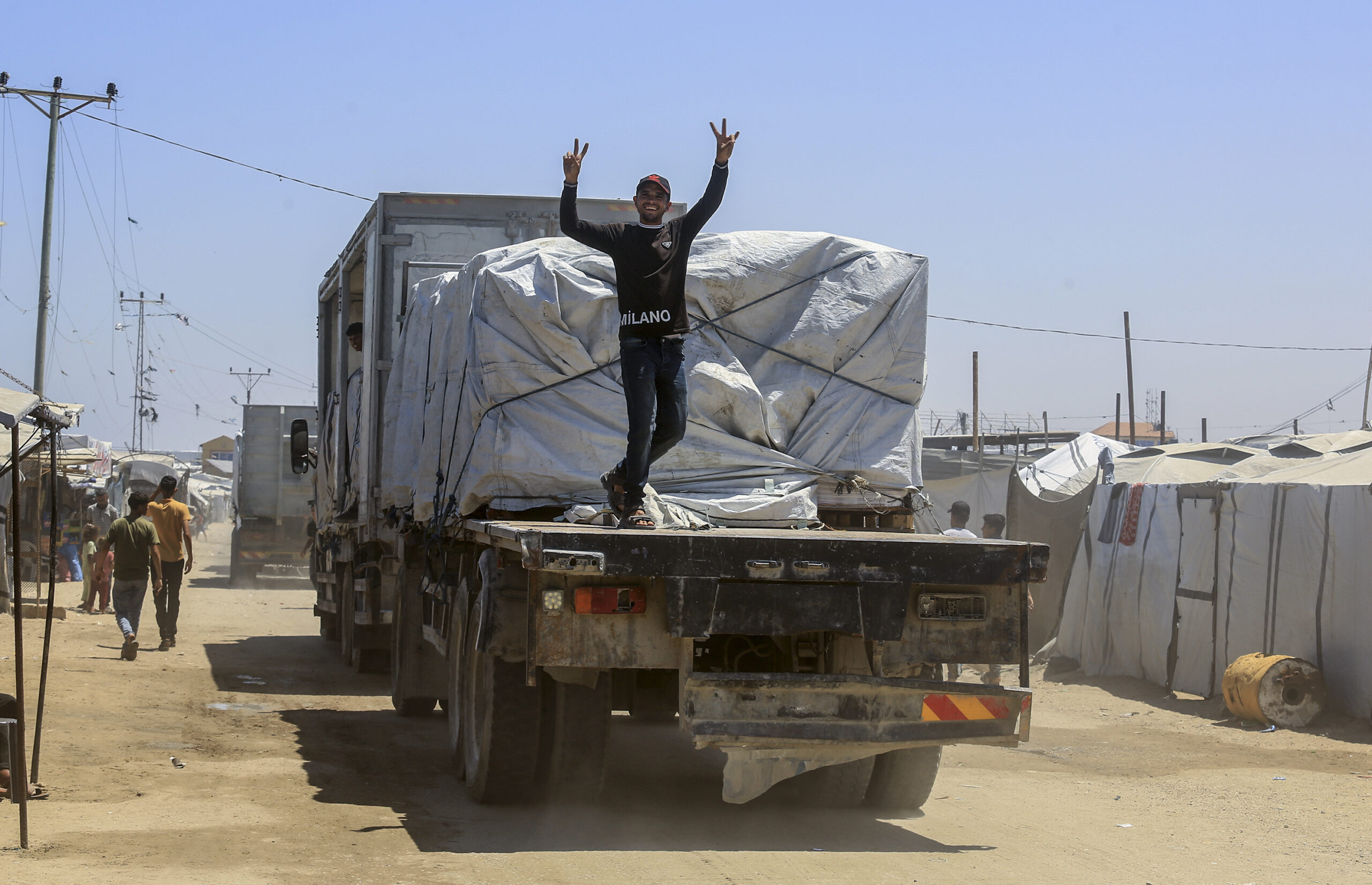
A new nutrition survey coordinated through the UN’s own Nutrition Cluster, using UNICEF and World Health Organization SMART methodology, has found acute malnutrition rates across Gaza ranging from just 0.2% to 0.8% by weight-for-height, the specific measure used to define a nutrition emergency. Israeli Ambassador to the UN Danny Danon called the findings proof that the international narrative accusing Israel of deliberately starving Gazan children has collapsed under its own data. “Once again, facts prevail over fiction,” Danon said. “Israel is not starving children. Israel is fighting Hamas terrorism, while Hamas uses civilians in Gaza as human shields. Those who rushed to accuse Israel must now be held accountable for spreading lies.”
The underlying presentation, delivered to the National Nutrition Cluster Coordination Meeting on July 22, 2026, backs up the range Danon cited precisely. Acute malnutrition by weight-for-height came in at 0.8% in Gaza City and North Gaza, 0.5% in Deir al-Balah, and 0.2% in Khan Younis and Rafah, with a Gaza Strip-wide figure of 0.5%. A second measure, mid-upper-arm circumference, which tends to catch a slightly wider group of at-risk children, put the combined Gaza Strip rate at 1.3%, still far under the roughly 15% threshold the WHO uses to classify a nutrition emergency, and consistent with the Integrated Food Security Phase Classification’s own July 2026 finding that Gaza sits in Phase One on its acute malnutrition scale, meaning fewer than five percent of children are acutely malnourished. The survey itself was substantial: 147 of 150 planned clusters were completed across the three governorate zones, household response rates exceeded 91% in every zone, and 1,335 children aged 0 to 59 months were measured directly.
One limitation in the source data is worth stating plainly rather than leaving out. The survey’s own methodology section notes it excluded roughly 358,244 people, 17% of Gaza’s population, from its sampling frame entirely, due to access and security constraints: a militarized “No Go Zone” (3%), a humanitarian buffer zone (4%), a security buffer specific to the SMART survey itself (8%), and the Netzarim Corridor (1%). The survey’s own authors caution that its findings “should therefore be interpreted as representative of populations residing in accessible areas,” not of Gaza as a whole. That does not undermine the low rates found within the 83% of the population the survey did reach, but it does mean the figures Danon cited describe the accessible population specifically, not areas cut off from the survey entirely.
Danon’s additional claim, that current levels are comparable to or below Gaza’s prewar rates and below figures in Egypt and Jordan, does not appear in the Nutrition Cluster presentation itself; that specific comparison came from Israel’s Foreign Ministry in its own separate public statement, not from the underlying UN-coordinated survey. The survey document supports the malnutrition rates themselves in detail. It does not independently verify the prewar or regional comparison Israeli officials layered on top of it.
A new study commissioned by UNICEF shows that the nutritional situation in Gaza – contrary to all propaganda – is today better than in all neighboring Arab states and even better than in some European countries.
— Israel Foreign Ministry (@IsraelMFA) August 6, 2026
The proportion of acute malnutrition among children under five… pic.twitter.com/eiIoaeqNip
The survey did flag genuine nutritional concerns worth taking seriously rather than dismissing alongside the exaggerated famine claims. Stunting, reflecting long-term nutritional stress rather than acute crisis, affects 12.2% of Gazan children Strip-wide, close to one in eight, and reaches 13.5% in Gaza City and North Gaza specifically. The survey also recorded overweight and obesity present alongside that stunting, at 4.0% Strip-wide and as high as 4.8% in Khan Younis and Rafah, a combination the presentation’s own authors say points to a problem of diet quality rather than sheer food quantity. That diagnosis is borne out in the diet data itself: unhealthy food consumption reached 73% Strip-wide and 78% in Khan Younis and Rafah, minimum acceptable diet stood at just 22.4% Strip-wide, and minimum dietary diversity was only 30.3%. None of that pattern is consistent with a population being deliberately starved. It is consistent with a population whose food supply, while no longer producing an acute malnutrition emergency, remains poor in nutritional composition, a very different and far less inflammatory problem than the one Israel has been accused of.
The Evidence Behind the Other Claim
Danon’s statement paired the malnutrition findings with a second, related claim: that Hamas has been diverting humanitarian aid intended for Gazan civilians. That claim has become genuinely contested territory over the past year, and it is worth laying out what actually supports it rather than treating it as self-evident.
The case for Hamas diversion rests on several independent strands of evidence. Israeli intelligence has intercepted communications documenting the practice directly; in September 2024, Israeli broadcaster N12 aired a recording of a Hamas operative discussing stockpiled aid, telling an associate, “At this point, we have everything… The warehouse is at full capacity.” Video footage from Deir al-Balah in July 2025 showed armed men, identified by eyewitnesses as Hamas-affiliated, firing into the air to disperse crowds of civilians near aid convoys, part of a broader pattern of documented interference with distribution. According to figures reported by The Jerusalem Post, Hamas diverted roughly 25% of incoming UN aid during the initial stage of the war in October 2023, with later accounting splitting a redistributed share between the group’s Izz ad-Din al-Qassam Brigades, its civil administration, and its political leadership. Palestinian Authority President Mahmoud Abbas, no ally of Israel’s, himself blamed Hamas for aid diversion in April 2025. The Gaza Humanitarian Foundation, established specifically to distribute aid outside Hamas’s control, reported that twelve of its local staff were murdered and others tortured by June 2025, a retaliation pattern consistent with a group actively working to protect a diversion pipeline rather than tolerate a competing one.
That evidence has not gone unchallenged. An internal USAID review, examining 156 reported incidents of aid theft or loss between October 2023 and May 2025, found no confirmed affiliation between the missing aid and Hamas or other sanctioned groups, and attributed 28% of those incidents to Israeli military actions instead. USAID’s own analysts cautioned that the review could not vet aid recipients, meaning aid could plausibly have reached Hamas-linked officials without appearing in the data at all, and noted that aid organizations operating under Hamas’s practical control in Gaza have strong incentives not to report theft to begin with, given the risk facing anyone who publicly implicates the group. Israel’s own military rejected the USAID conclusions outright, saying they ignored “clear and explicit evidence that Hamas exploits humanitarian aid to sustain its fighting capabilities.”
What can be said with confidence is this: the specific claim Danon and Israeli officials were addressing this week, that Israel deliberately starved Gaza’s children as a matter of policy, is now difficult to sustain against a UN-coordinated nutrition survey using the UN’s own methodology, showing malnutrition rates below prewar levels and below several neighboring countries. The separate and more contested claim, that Hamas has systematically diverted aid meant for civilians, is supported by intercepted communications, documented video, a Palestinian Authority president’s own accusation, and Hamas’s violent retaliation against a rival distribution system, even as one major US government review reached a more cautious conclusion. The two claims are often treated by critics as a single package to be believed or dismissed together. The nutrition data suggests they should not be.


