

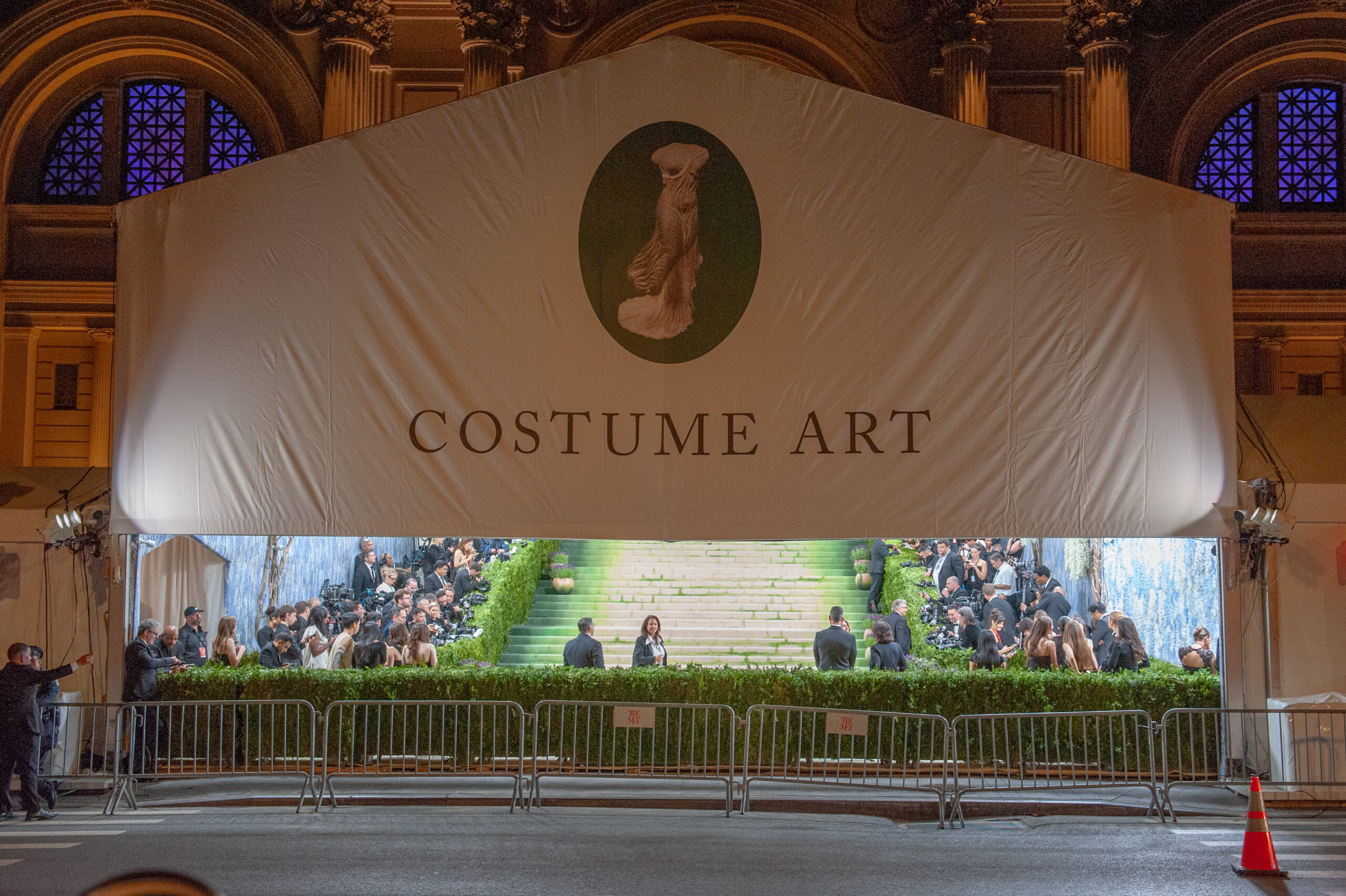
The Metropolitan Museum of Art and Vogue announced on July 31 that the Costume Institute’s spring 2027 exhibition, “John Galliano: Horizons,” will be devoted entirely to the British designer’s career, opening with next May’s Met Gala and running through January 2028. The choice makes Galliano only the third living designer ever given a solo show at the museum, following Yves Saint Laurent in 1983 and Rei Kawakubo of Comme des Garçons in 2017. It has also reopened a controversy the fashion world has spent more than a decade trying to move past.
Galliano built his reputation as one of the most visionary designers of his era, first at Givenchy starting in 1995, then at Dior beginning the following year, where his theatrical, technically ambitious runway shows helped define the house for a generation. His designs became closely associated with Nicole Kidman, Kate Moss, Naomi Campbell, and Princess Diana, whose lace-embroidered slip dress at the 1996 Met Gala remains one of the event’s most referenced looks. That run ended in 2011, when video surfaced of Galliano, drunk at a Paris bar, telling other patrons he loved Hitler. Dior fired him immediately, and a Paris court later convicted him on two separate hate crime charges tied to antisemitic and racist remarks, imposing a suspended fine. Galliano testified that he had no memory of the incidents due to a combined addiction to alcohol, Valium, and sleeping pills, and entered rehabilitation shortly after.
He returned to fashion in 2014 as creative director of Maison Margiela, a role he held for a decade, closing it out with a widely acclaimed spring 2024 couture collection before stepping down. Zara announced a two-year creative partnership with him in March, and he has since reappeared as a front-row guest at Dior itself.
The Met’s own leadership has treated the selection as a genuine risk rather than a settled question. According to reporting from The New York Times, Vogue editorial director and Met trustee Anna Wintour, Costume Institute curator Andrew Bolton, and Galliano himself met privately over the past year with a number of influential New York rabbis and Jewish communal leaders to discuss the planned exhibition directly. Rabbi Rick Jacobs, president of the Union for Reform Judaism, was among them, and described Galliano’s demeanor in those meetings as sincere rather than rehearsed. “He was open. He looked right at us and spoke in a clear way, not as if he had memorized talking points,” Jacobs told the Times. Jonathan Greenblatt, CEO of the Anti-Defamation League, offered a formal endorsement of Galliano’s rehabilitation in a statement to the paper, saying the ADL has “long since accepted his apology” and that his efforts to learn from the incident “should be applauded.”
Bolton has said the exhibition will not sand down that history. An opening “orientation gallery” is expected to directly address what he calls “the rupture” in Galliano’s career, and Bolton told the Times the museum’s obligation is to “establish the record honestly, provide context, and create the conditions for visitors to make an informed judgment.” Wintour struck a similar note in comments to Vogue: “The exhibition won’t shy away from any of the darkness in John’s past. It’s part of what has shaped him. The show will take in the full arc of his career and grapple with all of it.”
Not everyone is convinced that context is enough. Reaction online after the announcement was sharply divided, with one widely shared Threads post arguing the theme was “not just… out of touch and tone deaf, it’s also racist and antisemitic,” and another questioning why, in an industry full of talent, “this is who we’re putting on one of the biggest pedestals.”
A Gala With a Habit of Contradicting Itself
The Galliano backlash is only the latest instance of the Met Gala colliding with its own image, and it fits a broader pattern the event has struggled to shake for years, particularly when it comes to the gap between the political messaging of its progressive attendees and the extreme exclusivity of the room they’re delivering that messaging in.
The clearest example remains Alexandria Ocasio-Cortez’s appearance at the 2021 Met Gala, held that year under the theme “In America: A Lexicon of Fashion.” Ocasio-Cortez arrived in a white gown, designed by Brother Vellies founder Aurora James, with “Tax the Rich” printed across the back in red lettering, and used the moment to argue for higher marginal tax rates on the wealthy. The problem critics seized on was immediate and obvious: tickets to the Met Gala start at roughly $30,000 to $35,000, and the room she delivered that message in was filled with precisely the wealth she was proposing to tax more heavily. Erielle Davidson, a senior policy analyst at the Jewish Institute for National Security of America, captured the reaction that spread across social media at the time: “Nothing captures the hypocrisy of our ruling class more than wearing a dress that says ‘tax the rich’ at a gala whose ticket price is $35K for the uninvited.” Donald Trump Jr. called her a “fraud” for wearing the message “while she’s hanging out with a bunch of wealthy leftwing elites.” Actor Michael Rapaport was similarly pointed, posting that a sitting member of Congress, who he argued should be focused on public service, was instead “hobnobbing with the glitterati” in a custom dress at “the most elitist event in the world.”
Ocasio-Cortez’s defenders countered that she attended on a complimentary ticket and did not personally pay for the dress, and that delivering the message inside the room itself, in front of the donor class the policy would actually affect, was the entire point rather than a contradiction of it. She described her goal in similar terms afterward, saying she wanted to bring the message “in front of the very people who lobby against it.” Media reaction split along predictable lines: a CNN panel praised the moment as a savvy use of the spotlight, while conservative commentators treated it as a defining example of progressive politics performed for applause rather than practiced with consistency.
That same tension, a room built entirely around extreme wealth and exclusivity, hosting guests who use it as a stage for populist or social-justice messaging, has resurfaced in various forms at nearly every Gala since, from debates over which celebrities’ causes get amplified on the red carpet to recurring criticism that the event’s charitable framing does little to offset an evening whose sheer cost could fund enormous direct relief on its own. The Galliano exhibition adds a different kind of contradiction to that same stage: an institution that has spent recent years increasingly willing to foreground social conscience in its programming and its guest list is now devoting its single biggest platform of the year to a designer whose career was upended by an antisemitic and racist outburst, banking on a carefully managed reconciliation process, rabbinic meetings, an ADL endorsement, and an “honest” orientation gallery, to hold the same room’s goodwill that a single dress nearly lost four years earlier over a much smaller offense.