



The Plan, and the Court That Froze It
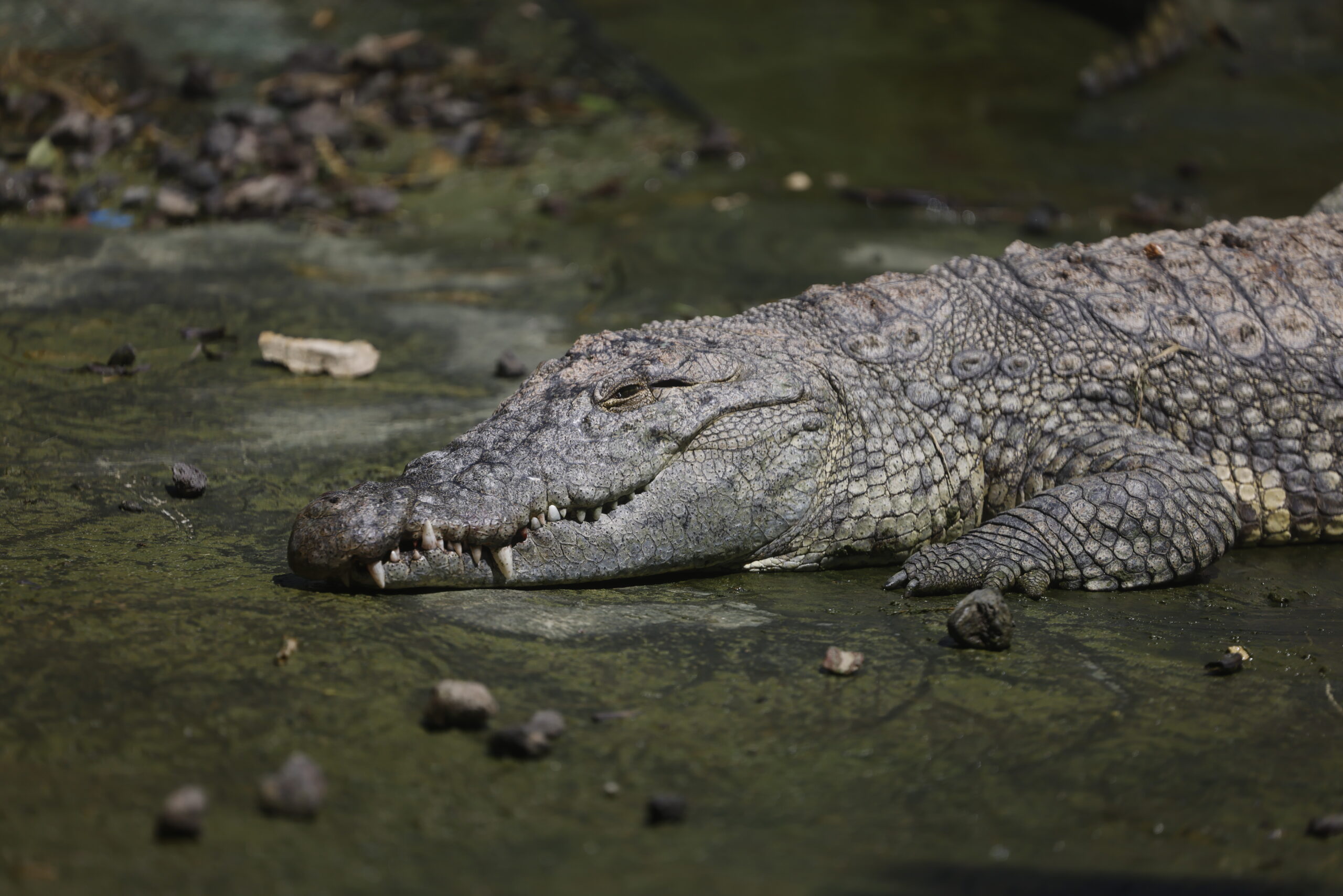
The Jerusalem District Court issued a temporary injunction Sunday freezing National Security Minister Itamar Ben Gvir’s plan to surround Ketziot Prison with a moat of live crocodiles, halting the project just as physical digging was already underway at the southern facility, which holds detained Hamas terrorists and other Palestinian security prisoners.
The order came after the animal welfare group Let the Animals Live petitioned the court, arguing that Environmental Protection Minister Idit Silman had ignored her own ministry’s legal advisers and the Nature and Parks Authority when she reclassified the Nile crocodile last month from a protected species to a “tended” wild animal. This was the legal maneuver that cleared the way for crocodiles to be held outside licensed zoos and sanctuaries. Judge Avraham Rubin wrote that the claims about expected harm to the crocodiles themselves “merit investigation” and justified freezing any transfer or preparation of crocodiles until a final ruling, giving Silman, Ben Gvir, and the Israel Prison Service until Wednesday to respond.
The moat itself, roughly 170 meters long and invisible from outside the prison walls, has already been dug around one of Ketziot’s special wings, according to a source in the Ramat Hanegev Regional Council. The National Security Ministry has budgeted NIS 21 million, about $7 million, for construction. Ben Gvir’s office was unambiguous about the seriousness of the plan. “Whoever thought this was a gimmick was mistaken,” the office said in a statement, adding that the Prison Service has worked out the plan “in the finest detail, from the maintenance and care of the crocodiles to the crocodiles’ resting cells.”
The Nature and Parks Authority has opposed the plan from the start, telling The Times of Israel it found “no professional or scientific basis anywhere in the world for bringing crocodiles into a detention facility for use as a security measure,” and warning that introducing “a large, longevous, non-native predator into the ecosystem” carries risks to Israel’s environment, prisoners, and staff alike. One agency official put it more bluntly to the two ministers, according to Ynet: “We need to protect them; they don’t need to protect us. This isn’t the spirit of the law.”
Silman defended the decision on 103FM radio, tying it directly to the surge in security prisoners since October 7, 2023. “At the end of the day, we must remember that as a result of October 7, the number of security prisoners increased considerably, and there is a real need to reckon with means of deterrence,” she said, adding that Ben Gvir and prison officials told her crocodiles would provide “major deterrence” simply by surrounding the facility. “We are speaking a language our enemies know,” she said.
להלן התמונות של סיור התנינים בחמת גדר לקראת כלא הבטחוני מוקף בתנינים https://t.co/d7xibhHry8 pic.twitter.com/cF70orE7UC
— Yossi Eli (@Yossi_eli) January 1, 2026
The idea traces back to a December meeting between Ben Gvir and Prison Service chief Kobi Yaakobi, and in January, Prison Service officials toured the Hamat Gader crocodile farm in northern Israel, home to roughly 200 crocodiles and the largest such facility in the Middle East, to study their upkeep. Hamat Gader’s CEO, Yosi Mousanejad, said the delegation asked basic zoological questions and did not confirm the farm would supply the animals, but described the officials as doing “serious work” on the proposal. The plan has drawn open comparisons to the “Alligator Alcatraz” migrant detention facility the Trump administration opened in Florida’s alligator-infested Everglades in July, a facility that has itself faced complaints over conditions and lawsuits from environmental and Indigenous groups.
Trump’s Moat
According to reporting from The New York Times in 2019, based on the book Border Wars by Julie Hirschfeld Davis and Michael Shear, President Trump privately floated the idea of digging a water-filled trench along the southern border and stocking it with snakes or alligators as a deterrent to migrants, alongside a separate suggestion to top the border wall with spikes sharp enough to pierce human flesh. The White House and Trump himself denied the reports at the time, calling them fabricated. Whether or not the idea was ever seriously considered, the parallel to Ben Gvir’s plan is hard to miss. Both proposals reflected the same instinct: to deploy a lethal, non-native predator as a living deterrent at a facility meant to hold people the state considers dangerous. Both also drew the same criticism: using an animal as a psychological or physical deterrent crosses a line, regardless of how effective it might be. The difference is that Ben Gvir’s crocodiles have already cleared a ministerial reclassification and broken ground, a step Trump’s alleged trench never came close to reaching.
A Creature Jewish Tradition Has Seen Before
Whatever the court ultimately decides, the choice of animal has specific and unusually dark significance in the biblical and mystical tradition, one that reaches back to Egypt itself.
The second plague of Egypt is usually translated as frogs, but some commentators follow a different interpretation. The fifteenth-century Portuguese scholar Rabbi Isaac Abarbanel argued that the plague called tzfardeya was, in fact, caused by crocodiles, not frogs, for two reasons. The Egyptians worshipped a crocodile deity, and the plagues were understood not merely as punishment but as a deliberate assault on Egyptian idolatry, making a strike against their own god a fitting instrument. Abarbanel also pointed to a verse in Psalms describing the tzfardeya as an instrument of destruction: He sent among them swarms of flies, which devoured them, and frogs, which destroyed them. (Psalms 78:45) Ordinary frogs, he noted, are an odd fit for a verb meaning to destroy. Crocodiles are not.
The Midrash Hagadol, citing Rabbi Yitzchak, adds a detail that only makes sense if the plague was more dangerous than hopping amphibians. When Moses prayed for the plague to end, he specifically asked that the creatures return to the waters of the Nile rather than disappear from the world entirely, “for every year these beasts emerge and kill people,” a line describing a real, ongoing danger rather than a nuisance.
The Zohar takes the crocodile further still, into the realm of cosmic symbolism. It teaches that nine rivers descend from the heavens into the world, each governed by its own ruling crocodile, with a tenth and greatest crocodile presiding over all of them. These are not literal reptiles, but the pathways through which the forces of impurity and darkness enter the world, and the Zohar adds that these ministering powers “shake their flippers” once every seventy years, generating an earthquake in whatever region they govern.
The clearest statement of all identifies the crocodile with evil at its source. Ezekiel’s prophecy against Pharaoh calls him directly by this image: Behold, I am against thee, Pharaoh king of Egypt, the great crocodile that lieth in the midst of his rivers, which hath said: My river is mine own, and I have made it for myself. (Ezekiel 29:3) The Zohar, expounding on this verse, teaches that Pharaoh himself was the outermost manifestation of the kelipot, the spiritual husks that seal the world off from holiness, and that this level of impurity ran so deep that God alone, not an angel or a messenger, could confront it directly. Moses himself, the Zohar says, feared approaching too closely to the Nile’s deeper waters, sensing the presence of the Great Crocodile lurking at their source.
The Plague, Redirected
Set against that tradition, Ben Gvir’s plan reads less like a novelty and more like an inversion of the original story. The crocodile that Jewish sources identify as an instrument God once used against Egypt, and as the very symbol of Pharaoh’s own spiritual corruption, is now being positioned by an Israeli government minister as a wall between Hamas terrorists and the outside world. Silman’s own language, that the plan speaks “a language our enemies know,” lands very differently once the tradition behind that creature is on the table. A modern government is proposing to surround the heirs of Pharaoh’s cruelty with the same beast the tradition uses to describe Pharaoh at his most impure, not as a plague sent against Israel, but as a wall built by Israel.
Jewish tradition holds that the plagues of Egypt are not a closed chapter of ancient history. The prophet Micah describes the final redemption in terms that point directly back to the Exodus itself: As in the days of thy coming out of the land of Egypt will I shew unto him marvelous things. (Micah 7:15) Chazal read this verse as a promise that the wonders and plagues of the Exodus will recur before the final redemption, this time directed against Israel’s enemies rather than against Israel itself.
None of this proves that a moat outside a desert prison carries messianic significance, and the court has not, as of late, even allowed the plan to proceed. But a government minister choosing, of all possible deterrents, the one creature Jewish tradition ties to Pharaoh’s own impurity, and proposing to use it to contain the modern successors of Pharaoh’s cruelty, sits squarely inside a pattern the tradition has been describing for a very long time: the same forces once unleashed against Israel, in the end, will turn back against those who tried to destroy her.
