

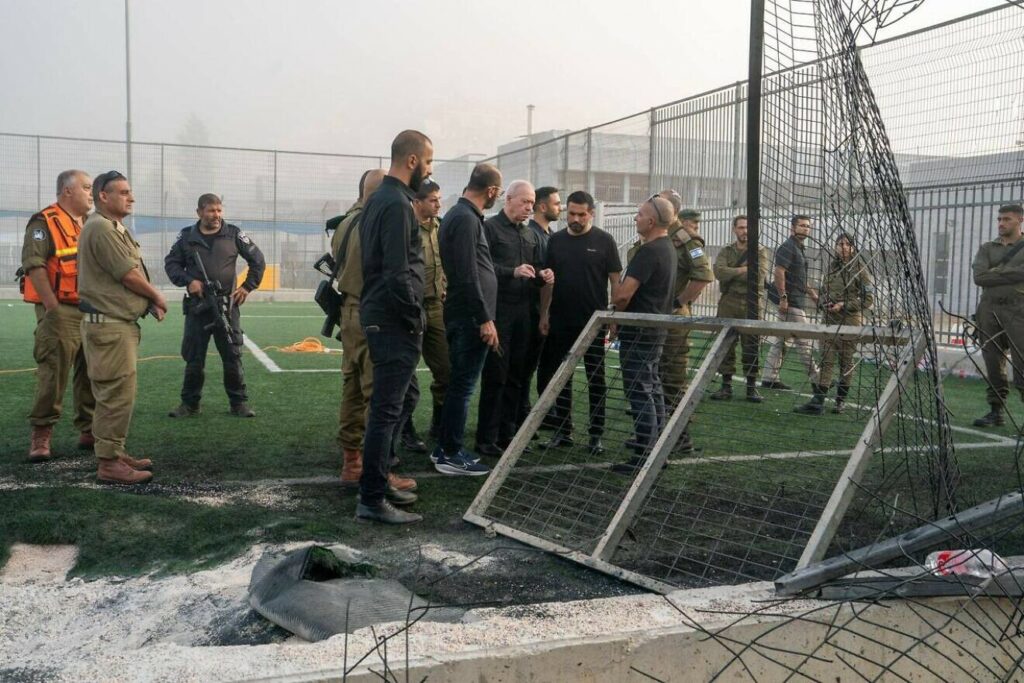
Exactly two years after a Hezbollah rocket killed 12 children on a soccer field in Majdal Shams, the Druze village in Israel’s northernmost reaches is receiving eight therapeutic gardens, funded by a donation from the David and Meredith Kaplan Foundation through the Birthright Israel Foundation.
The July 27, 2024 attack devastated the close-knit Druze community, striking a local field and leaving a mark on its schools and families that has not faded. In the two years since, residents have turned to gardening and contact with nature as tools for collective healing, and the new project will build eight therapeutic educational gardens across four local schools and institutions.
The Birthright Israel Volunteer Program, run jointly with the Jewish Federations of North America, is bringing roughly 1,000 volunteers to Majdal Shams over the coming months to build the gardens. Work began in early July, and by July 17 a mission group was welcomed at Elementary School B by Dolan Abu Saleh, head of the Majdal Shams Municipality. Audible booms across the border in Syria sounded during his remarks, a reminder of how close the village sits to an active front. Jihan Safdi, the school’s principal, addressed the group as well, speaking about the aftermath of an attack in which she personally lost six of her own students, and about how nature-based programming has become central to the community’s recovery. Volunteers then joined 25 Birthright Israel Excel participants planting greenery, laying paving stones, and building planters at the Resilience Center, which borders the very field where the attack took place.
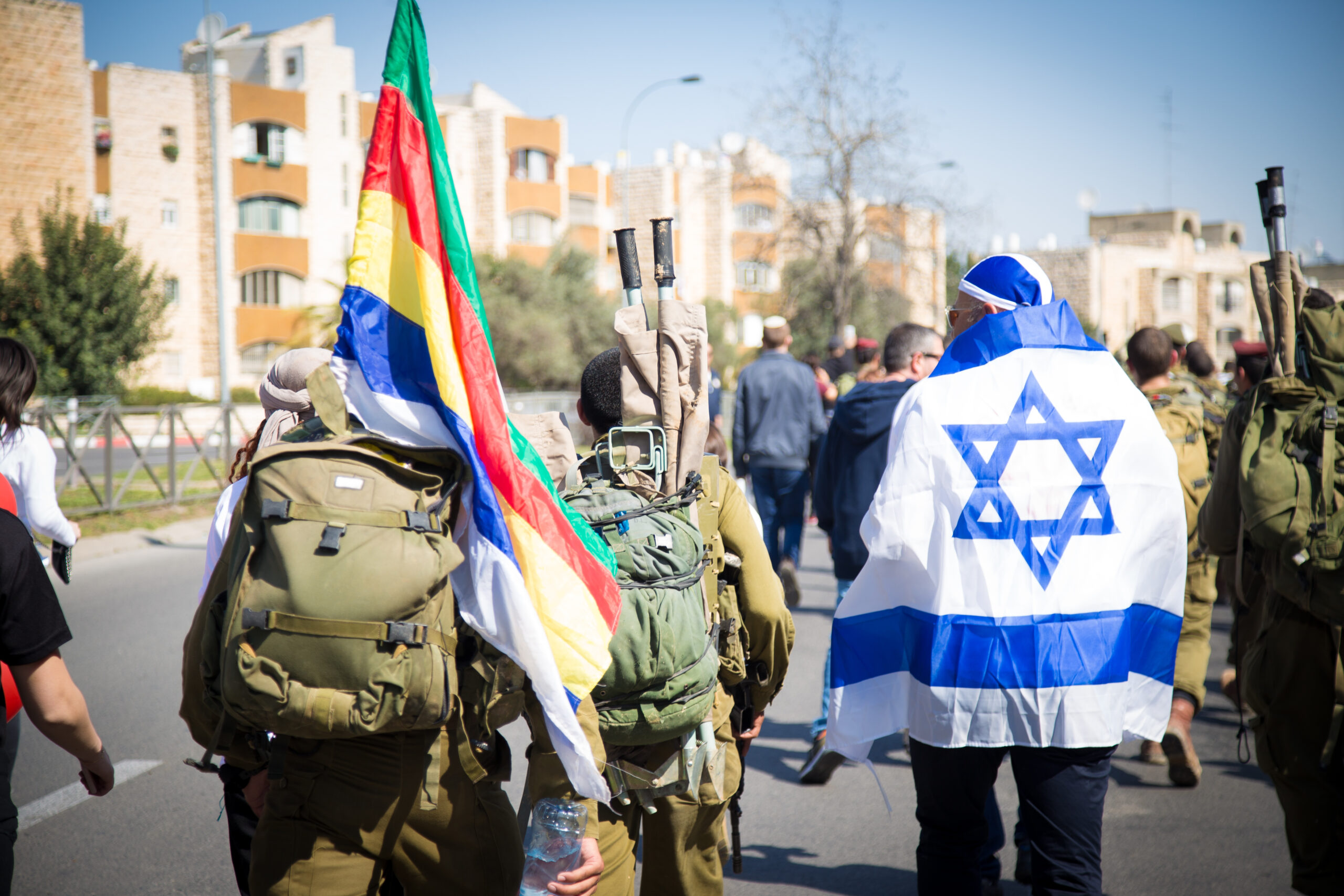
Abu Saleh framed the project as part of a broader shift in the Golan Druze community since October 7, 2023, one he described as a “dual realization”: that Druze security is inseparable from the State of Israel, and a definitive break from any affinity with fundamentalist Islam. “The turning point for the Golan Druze began on October 8, 2023,” he said. “On October 8, we accepted the Jews and Israelis as our home. Now, the Jews finally accepted us. We arrived first; you met us there.”
Elias Saratovsky, President and CEO of the Birthright Israel Foundation, said the program plans to keep expanding. “The demand from diaspora Jews to serve in Israel keeps growing,” he said, adding that the organization wants to bring tens of thousands more volunteers to Israel in the coming years. Launched in November 2023, the volunteer program has already brought some 30,000 Jewish adults to Israel, logging more than 60,000 volunteer days across nearly 100 communities.
The Golan Druze occupy an unusual position in the region. Roughly 25,000 of them live across four villages, Majdal Shams, Buq’ata, Mas’ade, and Ein Qiniyye, with a presence in the area predating both the modern State of Israel and the modern Syrian state. After Israel captured the Golan Heights in the 1967 Six-Day War and formally annexed it in 1981, most Golan Druze retained Syrian family and cultural ties and, for decades, declined Israeli citizenship. October 7 reshaped those calculations for much of the community, and Majdal Shams’s gardens are one visible marker of that shift.
A Connection That Predates the Modern State
The bond between the Druze and the Jewish people did not begin in 2023. It runs back to the Bible itself.
Druze tradition holds that the community descends from Yitro, known to the Druze as Shu’eib, the Midianite priest who became Moses’ father-in-law and one of the Bible’s most consequential outsiders. Yitro appears in Exodus, advising Moses to establish a tiered system of judges to handle the people’s disputes, a structural reform that shaped how Israelite justice functioned thereafter. To the Druze, Shu’eib is not merely a background biblical figure. He is one of their most revered prophets.
Nachmanides, the medieval Jewish commentator, taught that the descendants of Yitro received a portion of the land of Israel alongside the tribes of Jacob, specifically the fertile territory surrounding Jericho, and that they assisted the Israelites in conquering the land forty years after Sinai. Jewish tradition adds a further link: Yitro’s granddaughter married Pinchas, son of Elazar and grandson of Aaron the High Priest, weaving the two lineages together directly within the biblical narrative itself.
That ancient connection has an unusually direct echo in Druze religious belief about the End of Days. An anonymous Druze religious leader told Breaking Israel News that one condition tied to the Druze concept of Geula, redemption, is that the entire Jewish people ultimately be gathered in the land of Israel, a belief that lines up with the Jewish tradition holding that the majority of the Jewish people will live in the land of Israel in the end of days, a reality already largely underway today.
The Druze faith itself emerged in the early 11th century, tracing to 1017 CE and the rule of the Fatimid Caliph al-Hakim bi-Amr Allah in Egypt. After roughly 26 years, the faith permanently closed its doors to new converts, making it one of the most closed religious traditions in the world today. Druze refer to themselves as al-muwahhidun, believers in the One God, and their theology remains closely guarded, revealed to members of the community only once they reach adulthood.
Loyalty to the state in which they live is a foundational Druze religious principle, and in Israel, that loyalty has translated into military service at rates exceeding those of the Jewish population itself. Since 1956, following an agreement between the state and Druze community leadership, Druze men have been subject to the same conscription laws as Jewish citizens. Today, roughly 83 percent of Druze men serve in the IDF, and about 60 percent of those serve in combat units. More than 500 Druze soldiers have died defending Israel since 1948, including Lieutenant Colonel Salman Habaka, who fell in Gaza after leading his battalion into Kibbutz Be’eri on October 7. He was one of the highest-ranking officers killed in the war.
The two communities share a history of persecution and a common ancestry. Druze communities faced conversion pressure under Islamic rule going back to the Mamluk and Ottoman periods, and were targeted directly by ISIS in Iraq and Syria in recent years. Jewish communities across the same region faced parallel treatment for centuries, paying the jizya tax imposed on non-Muslims under Islamic rule, and enduring expulsions and massacres across Yemen, Syria, Lebanon, Egypt, Iraq, Iran, and pre-1948 Palestine.
The gardens now rising in Majdal Shams sit at the intersection of all of this: a community bound to the Jewish people by a shared biblical figure, a shared pattern of persecution, and, since October 2023, a shared war. Abu Saleh’s own words captured what the project represents to his village better than any donor announcement could. The Druze, in his telling, were there first. It has taken the rest of the country this long to fully meet them there.