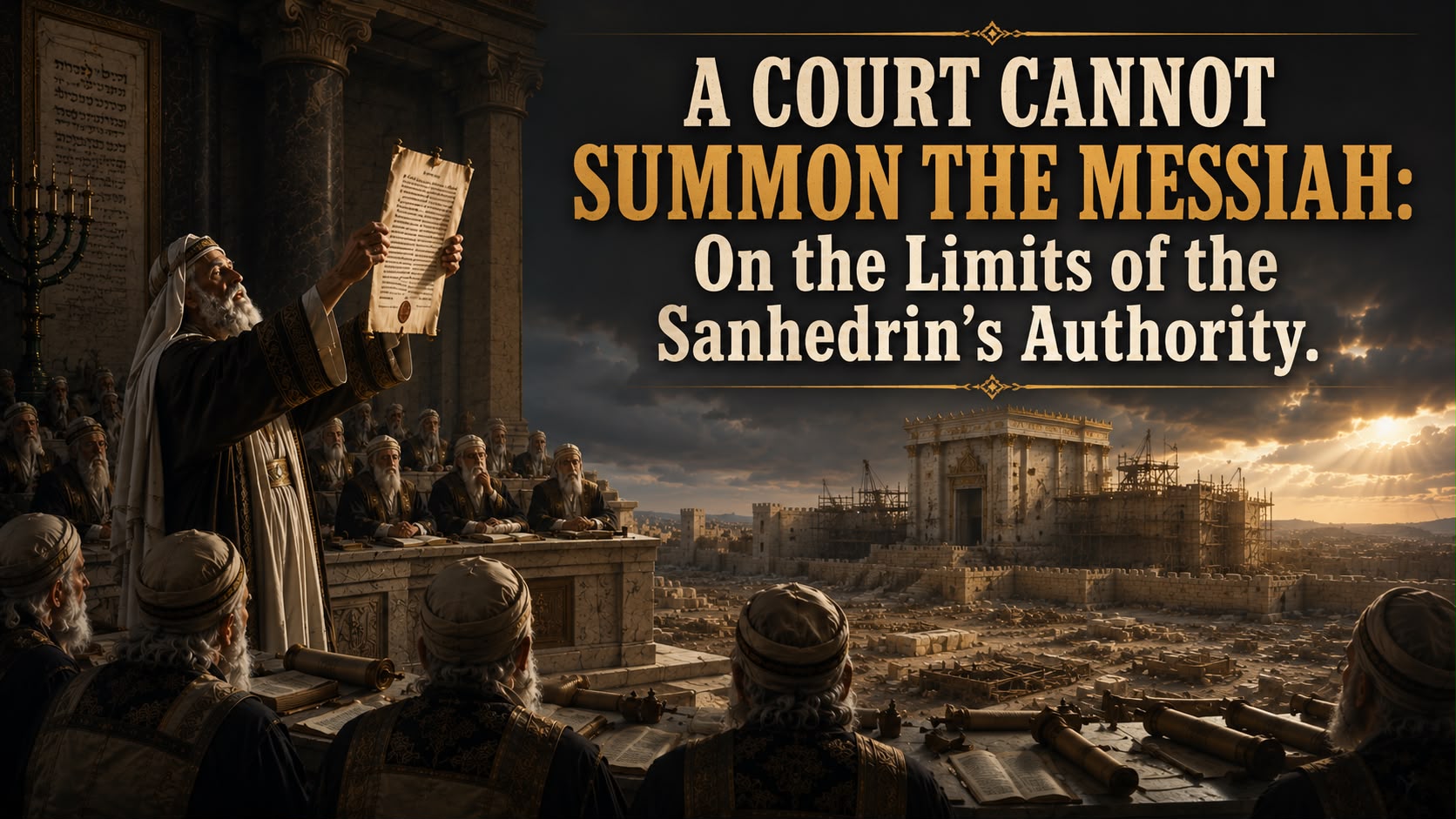
A reconstituted Sanhedrin has issued a ruling asking Heaven to reveal the Mashiach and rebuild the Temple. But the classical sources draw a sharp line the court has crossed.
When a reconstituted Sanhedrin issues a formal ruling that asks Heaven to reveal the Mashiach (Messiah), clear every obstacle to the Beit HaMikdash (Holy Temple), restore prophecy, and remove every hostile force from the Land of Israel, the first question is whether the court has stayed within the boundaries the Torah and the Sages set for it. The answer determines everything else: whether the ruling carries the weight of halakhah (Jewish law), or whether it has stepped into territory no court was ever authorized to enter.
What the Sources Actually Assign to the Court
The classical sources are not vague on this point. Mishnah Sanhedrin 1:5 lists the matters that belong exclusively to the Great Sanhedrin of seventy-one judges. The court judges an entire tribe that has sinned. It judges a false prophet. It judges a High Priest in a capital case. It authorizes an optional war. It expands the boundaries of Jerusalem or the Temple courtyards. It appoints lesser courts for the tribes. It declares a city an ir hanidachat (idolatrous city). It intercalates the year and thereby fixes the calendar.
These are concrete judicial and national functions. They concern law, judgment, and the ordered life of the people under the Torah. Nowhere in that list, nor in the Rambam’s codification of it, does the court receive authority to issue a psak (binding ruling) that obligates Heaven to bring the Mashiach or to rebuild the Temple.
The “It Is Not in Heaven” Argument, and Its Real Scope
The ruling rests its claim on a different foundation: the principle that a court below binds the court above, drawn primarily from the story of the Oven of Achnai in Bava Metzia 59b. There, Rabbi Eliezer and the majority of the Sages dispute a point of ritual law. Miracles occur. A heavenly voice declares that the halakhah follows Rabbi Eliezer. Rabbi Yehoshua rises and declares Lo bashamayim hi, “It is not in Heaven” (Deuteronomy 30:12). The Gemara explains that once the Torah was given at Sinai, the determination of halakhah belongs to the majority of the human court, and Heaven does not override it. Elijah later reports that God laughed and said Nitzchuni banai, “My children have defeated Me.”
The principle is true and foundational. It protects the integrity of the received Torah against any claim that miracles or heavenly voices can rewrite the law. But its scope is precise. The story concerns the adjudication of halakhah. It does not authorize a court to decree redemptive events and then treat Heaven as obligated to perform them. When the Sanhedrin transfers this language to the revelation of the Mashiach and the building of the Beit HaMikdash, it carries the principle outside the domain in which the Sages established it.
The Supporting Passages Prove Less Than Claimed
Two other passages are sometimes cited for a broader reading. In Rosh Hashanah 25a, Rabban Gamliel fixes the calendar against Rabbi Yehoshua’s calculation and requires public submission to the court’s declaration. The episode shows that the court’s determination of the sacred times binds the people. It does not show that the court can compel Heaven to alter the course of history.
In Taanit 23a, Honi HaMe’agel draws a circle during a drought and refuses to move until rain falls, and God responds. From this and similar accounts, the Sages formulate the maxim tzaddik gozer veHaKadosh Baruch Hu mekayem, “a righteous person decrees and the Holy One fulfills,” linking it to the verse “You will decree a matter, and it will be established for you” (Iyov 22:28). These narratives illustrate the efficacy of a righteous person’s plea. They do not create a judicial procedure by which a beit din (rabbinical court) can bind Heaven to eschatological outcomes.
The Torah’s Own Pattern: God Acts, Man Obeys
Even the strongest form of the maxim must be read against the Torah’s own pattern. Moses was the most faithful servant in the house of God, yet when the sea split, the text is unambiguous: “Moses stretched out his hand over the sea, and the Lord drove the sea back with a strong east wind all night and made the sea dry land” (Shemot 14:21). The agency remains with God. Moses obeys; he does not decree the miracle and thereby compel it. This reservation of divine initiative runs throughout the Exodus narrative. Righteousness and prophetic stature never transfer to any human being the power to force God’s hand.
The Rambam’s framework in Hilchot Melachim confirms the same order. The King Mashiach arises, restores the Davidic monarchy, rebuilds the Temple, and gathers the dispersed. A candidate is presumed to be the Mashiach when he studies Torah, strengthens Israel in observance, and fights the wars of God; he is confirmed only when he succeeds in building the Temple and gathering the exiles. The entire process unfolds inside the ordinary course of nature: “One should not entertain the notion that in the Messianic age any facet of the world’s nature will change or there will be innovations in the work of creation. Rather, the world will continue according to its pattern.” Prophecy returns after the kingdom is established, not as an independent outcome summoned by court decree. The Rambam assigns no role to a psak that obliges Heaven to begin the process.
A Ruling With No One to Obey It
A further difficulty follows from the nature of halakhah itself. A binding court ruling addresses human beings, who are commanded to follow the determination of the law. A person may hold a private disagreement, but he may not publicly teach others to reject or disobey the court’s decision. That limitation is precisely what preserves the practical authority of the beit din.
The present ruling points in the opposite direction. It asks Heaven to act. No parallel mechanism of enforcement exists; one cannot speak of Heaven obeying under threat of consequence. The ordinary force of a psak therefore has nothing to attach to. The ruling cannot function as a practical halakhic decision governing human conduct. It remains a petition dressed in the language of judicial authority.
The difficulty was felt even inside the session. Two judges initially dissented, judging that accelerating the process could intensify suffering, and joined only after the phrase berachamim (“with mercy”) was inserted. The concession shows that the court recognized the potential for harsh consequences, but it did not change the structure of the request. The resolutions still present the revelation of the Mashiach, the clearing of obstacles, and the return of prophecy as outcomes the court can decree, and Heaven is expected to implement.
The Order the Torah Maintains
The Torah already provides the appointed channels. The people are commanded to pursue the mitzvot that prepare the ground. The daily Amidah (standing prayer) already contains the petitions for the ingathering of the exiles, the rebuilding of Jerusalem and the Temple, the restoration of the Davidic kingdom, and the return of the service. Human initiative and prayer are the prior requirements. The consistent pattern is that Israel acts and Heaven then assists. A court that reverses that order, treating a formal ruling as the instrument that forces the outcome, steps outside its assigned role.
What would have fallen inside the court’s proper authority is a ruling directed at the people themselves. In the days of the Temple, when drought struck, the ma’amadot (standing delegations of Israelites) fasted in rotation, each group representing its portion of the nation so that, by proxy, all Israel shared in the affliction and the plea. A court today could call the nation to coordinated teshuva (repentance); to fasting and prayer in that same representative spirit; to concrete acts of preparation for the Temple service; to the removal of internal corruption through established legal and communal means; and to the strengthening of Torah observance as the measurable groundwork the Rambam requires. Such a psak would bind those actually subject to the court’s authority. It would encourage the willing and challenge the complacent. And it would keep the order the Torah maintains: the people act, and Heaven responds.
The principle lo bashamayim hi stands. A miracle or a heavenly voice does not define halakhah or change the Torah; that truth is secure. But it does not follow that a human court can decree the arrival of the Mashiach and bind Heaven to perform it. The Sanhedrin’s ruling makes exactly that additional claim. The classical sources do not sustain it.