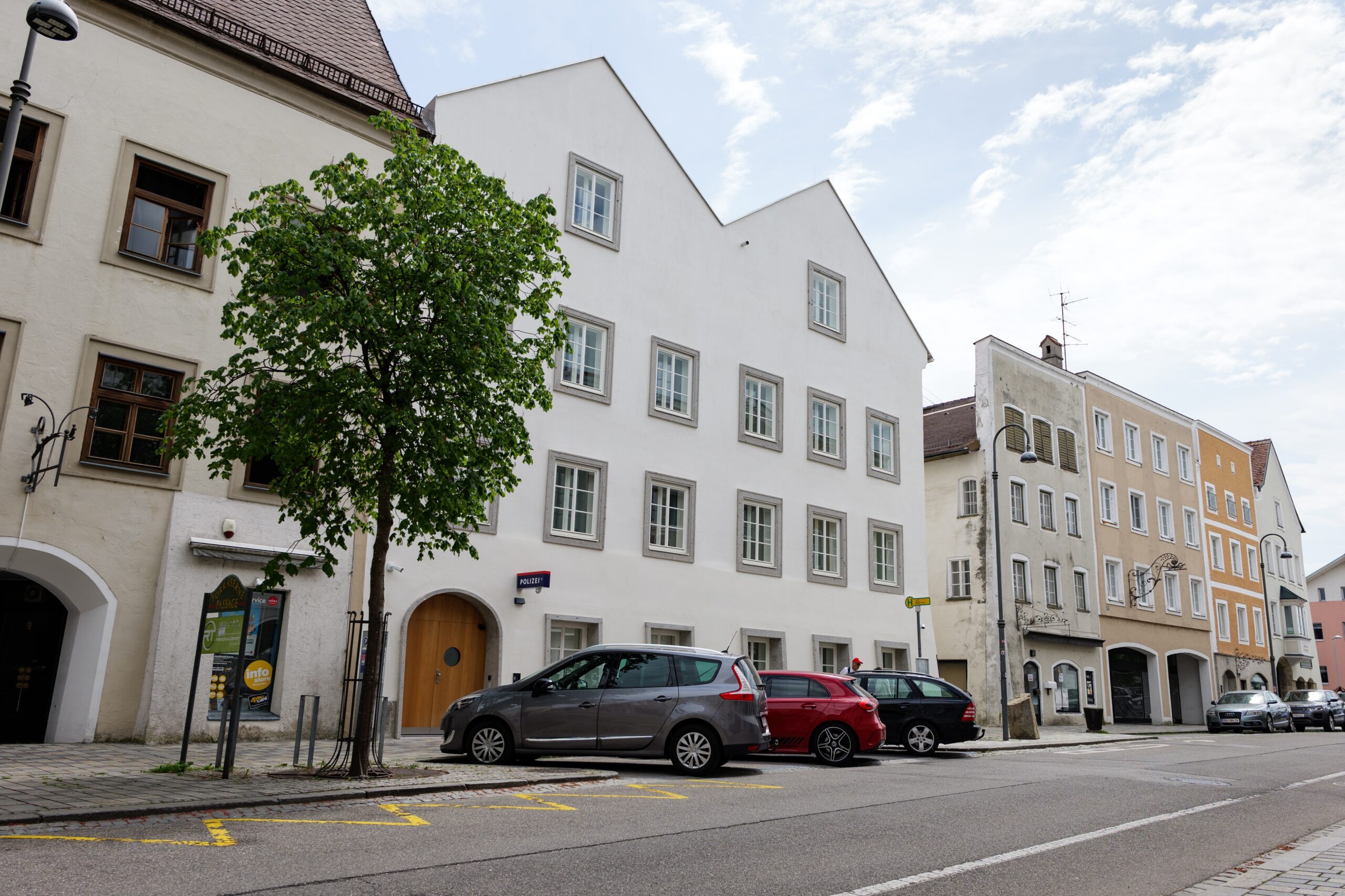
The Austrian government has remodeled a modest inn in Austria in an attempt to discourage sick and twisted pilgrims from paying homage to the infamous man born there more than 130 years ago. But despite the attempt to give a new face to Hitler’s birthplace, the horrifying ideology is experiencing a resurgence.
Adolf Hitler was born in a modest guesthouse in Braunau am Inn, Austria, on April 20, 1889. On July 22, 2026, after three years of construction and a cost of 20 million euros, the building reopened as a police station. The facade was stripped of its arched windows and painted white. Fifty officers now report for duty where the future architect of the Holocaust took his first breath. Austrian Interior Minister Gerhard Karner told the crowd at the inauguration that the police stationed there stand for democracy and the rule of law.
The Austrian government’s message was clear: change the appearance, erase the mystique, deny future neo-Nazi pilgrims their shrine. For decades, admirers of Hitler have traveled to that address to photograph themselves at the birthplace of the man responsible for the murder of six million Jews. Some have posed there, giving the Nazi salute. The government’s answer was architecture: a new roofline, rectangular windows, and a coat of white paint.
The Austrian government was unwittingly caught in a Biblical paradox regarding how to handle evil incarnate. In a command Moses gave the Israelites just before they entered the land, the Bible wrote: “Remember what Amalek did to you on the way, when you came out of Egypt” (Deuteronomy 25:17). Amalek attacked Israel from behind, striking the stragglers, the weak, and the exhausted, “and he did not fear God” (Deuteronomy 25:18). In an apparent contradiction, the Bible does not ask Israel to merely remember an event. It also commands timche, “you shall blot out” the memory of Amalek, and in the same breath warns, “you shall not forget” (Deuteronomy 25:19).
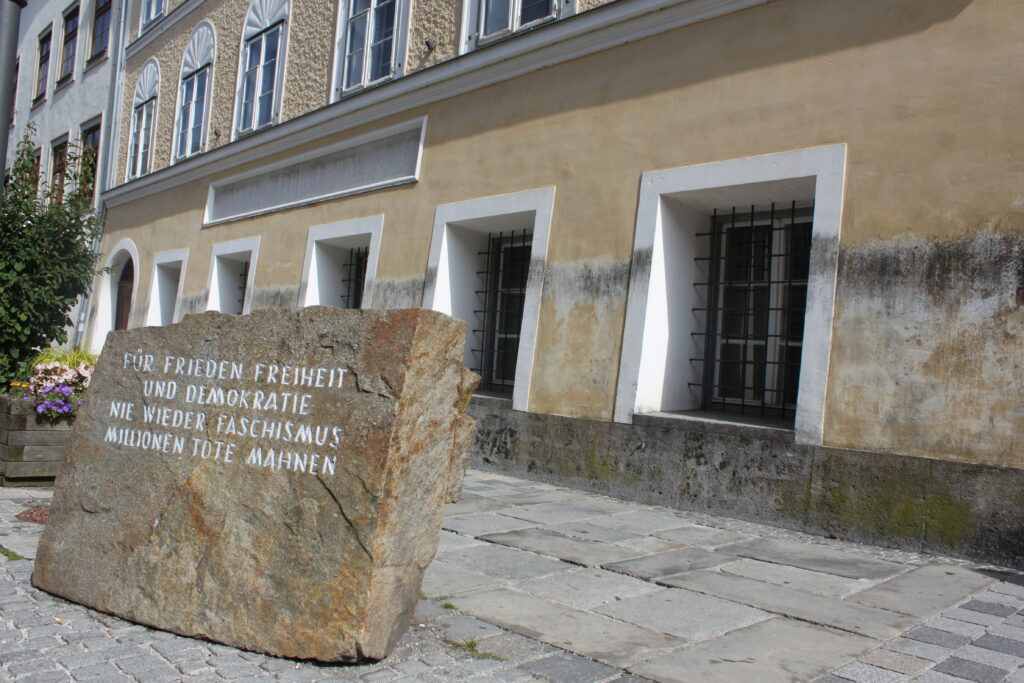
The Sages read Amalek as more than a single tribe erased from history. Amalek is the name the Bible gives to an ideology: hatred of Israel and hatred of God, appearing generation after generation under different names and different flags. Haman the Agagite, whom the Book of Esther identifies as a descendant of Amalek’s royal line, tried to annihilate every Jew in the Persian Empire. The Sages of the Talmud and Midrash traced a direct line from Amalek to Haman, and Jewish tradition has never stopped tracing that line forward. Adolf Hitler is its clearest modern expression.
The Austrian government retains the building as a warning against the Nazi ideology that once took root in much of Europe. At the same time, they are reluctant to leave the site as a pilgrimage destination for a new generation of twisted advocates.
It must be remembered that Hitler and his ideology found eager partners far beyond Germany, some of whom have found a new wave of adherents in today’s politics under the guise of the “pro-Palestine” movement sweeping the West.
Haj Amin al-Husseini, the Grand Mufti of Jerusalem and the man historians credit as the founder of modern Palestinian nationalism, spent the war years in Berlin as a guest of the Nazi regime. He met Hitler in person on November 28, 1941, and pressed the Führer to block any Jewish homeland in Palestine. According to the Holocaust Encyclopedia of the United States Holocaust Memorial Museum, Hitler assured him that the fight against a Jewish homeland in Palestine was part of the same fight against the Jews everywhere. Husseini used his access to Nazi officials, including Adolf Eichmann, to help block rescue negotiations that could have saved Jewish lives, and he personally lobbied to prevent thousands of Jewish refugee children from reaching Palestine. After the war, he evaded prosecution and spent the rest of his life building the Palestinian national movement on the same foundation of hatred he had brought to Berlin.
That foundation did not stay buried in the twentieth century. It surfaces today on American university campuses, where slogans calling for Israel’s destruction have become common at rallies organized in the name of Palestinian rights. The Anti-Defamation League’s 2025 audit recorded 6,274 antisemitic incidents across the United States, and physical assaults on Jews rose four percent even as overall incidents declined, with three Jews murdered in antisemitic attacks that year alone. Nearly half of all reported incidents were tied directly to Israel or Zionism. Europe tells a similar story. Far-right and neo-Nazi movements have moved from the fringes into parliaments in Slovakia, Germany, and Greece, and police in Germany have uncovered Nazi sympathies inside their own security services. Amalek has never required a single uniform. It borrows whichever one is available.
Austria’s government believes it has solved a problem with paint and a new roofline. It has not. The building in Braunau am Inn was never the source of the danger. The ideology that man carried into that house, and carried out of it into the world, is the danger, and ideologies do not live in buildings. They live in minds, in movements, and in slogans chanted a world away from Austria by people who may never have heard of Braunau at all.
The Bible’s command was never satisfied by silence, nor by forgetting. Israel is commanded to blot out Amalek’s name and to remember Amalek’s deeds, both at once. That is not a contradiction. It is a strategy. The nation that forgets its enemy’s history repeats its enemy’s tragedy. The nation that remembers and acts on that memory is the nation still standing three thousand years after Amalek first raised its hand against the weary and the weak. Hitler is dead. Husseini is dead. Amalek is not. It is still out there, still nameless until it acts, and the only defense the Bible offers is the same one it offered at the foot of Sinai: remember, and do not forget.