




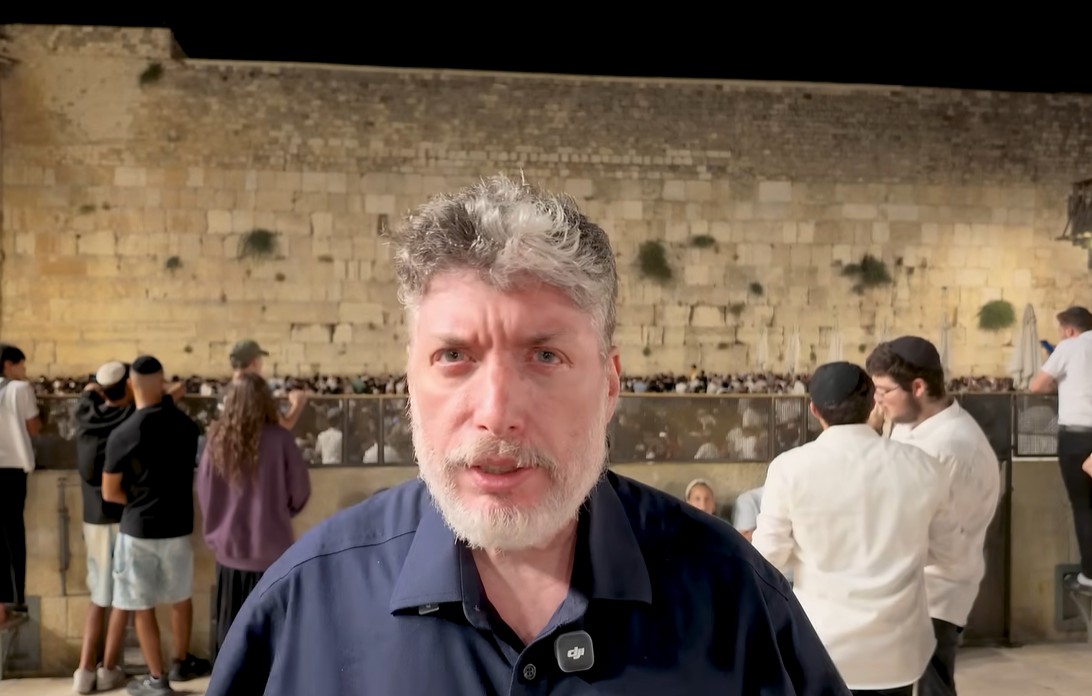
Rabbi Tovia Singer used a Tisha B’Av address filmed at the Western Wall, posted to YouTube on July 23, 2026, to argue that the Kotel is not only a relic of the Temple’s destruction but the first wall of the Temple still to come. “It’s here for Mashiach,” Singer said, standing before the stones. “So this is our future.”
Singer is the founder and director of Outreach Judaism and lectures more than 100 times annually worldwide. Singer moved to Jerusalem in 2019 after five years running Outreach Judaism’s programming in Indonesia, and now lives in the Jewish Quarter of the Old City, not far from where he filmed this talk.
The Wall That Never Moved
Singer opened by pointing to the region’s seismic history to underscore the Kotel’s survival. “The geological fault is by the Dead Sea, about 25 kilometers from here,” he said. “There have been many, many earthquakes here, and all the other religions’ holy places collapsed — the Dome of the Rock, the church, all the churches, they all collapsed. But this, the Western Wall, never went anywhere. This doesn’t move.” He tied the wall’s endurance to a rabbinic teaching that the Divine Presence has never departed from it. “As the Midrash teaches, the Shechinah never left the Western Wall and never will,” he said.
Zechariah and the Question the Jews of Babylon Asked
Singer built the heart of his talk around the prophet Zechariah, who prophesied during the Persian Empire while the Second Temple was under construction. “People came to him with questions in halachah, in Jewish law. Imagine that,” Singer said. The Jews of Babylon wanted to know something specific: with the Second Temple now being rebuilt, were they still obligated to fast on Tisha B’Av? “Can you imagine that question?” Singer asked. “And can you imagine how happy Zechariah was to hear it? He wasn’t happy at all.” Instead, Singer said, the prophet answered with a challenge of his own: “Do you really think God needs your stomach to be empty? Do you think you’re fasting for God, or is the fast meant to remind you to draw closer to God?”
From there, Singer said, Zechariah moves into a prophecy that “explodes” in chapter 8, opening with a vision familiar to most Jews: a day when old men and women will again walk the streets of Jerusalem leaning on their canes, and children will play in its streets. Singer read the prophecy further, to a verse he said is often overlooked: “In those days, ten men from all the nations will grab the corner, the kanaf, of a Jew’s garment, and say, ‘Let us go with you, for we have heard that God is with you'” (Zechariah 8:23). He offered Rashi’s explanation for the image. “Why do they have to grab our corner? Because until that moment, they believed they were the true Jews, the new Israel,” Singer said. “When the true Mashiach comes, those who denied that the Jewish people are the heirs to the promise of the Tanakh will finally say, ‘Now I recognize that you are the rightful heirs. It was never us. You were always meant to lead.'”
The Cardo, Justinian, and Julian the Apostate
Singer turned next to the Cardo, the Roman-Byzantine market street running through today’s Jewish Quarter, to make his case from history rather than prophecy. The Cardo was built under the Byzantine Empire, founded in the year 330, and expanded under Emperor Justinian in the sixth century. “Justinian hated Jews,” Singer said. “He issued a decree that no Jew was even permitted to pray in Hebrew. The people who built that Cardo assumed no Jew would ever walk down that street again.” Jews were barred from Jerusalem for most of the Byzantine era, Singer noted, with one exception: a 19-month window under the emperor Julian, who took power in 361 and rejected Christianity, earning him the title Julian the Apostate. “He let the Jews back into Jerusalem and told them, ‘ Go establish a Sanhedrin, go build a Temple, do what you want, I don’t care, I’m not a Christian, it doesn’t bother me,” Singer said. Julian was killed in a war shortly after, the empire reverted to Christianity, and the Jews were expelled again — with Justinian later decreeing that Jews could not celebrate Pesach even when it fell before Easter.
Singer pointed to a detail from daily life in the Jewish Quarter today as a quiet rebuttal to that history. “Children who live in the area have a game: they throw pebbles up to see which one will land and stay balanced on top of one of the pillars,” he said, “unknowingly fulfilling the very prophecy that children would one day play again in the streets of Jerusalem. Whoever built those pillars thought no Jew would ever come back. We’re here.”
“We Defeated the Roman Empire”
Singer closed by returning to the moment of the Old City’s liberation in 1967. “You know the story: when the Old City was liberated, an Israeli soldier climbed up and raised an Israeli flag, and said, ‘Today we defeated Titus,'” he said, referring to the Roman general who destroyed the Second Temple. “People who don’t understand think we defeated the Arabs. We defeated the Roman Empire.” He invoked the prophet Hosea’s warning that the exile would be long, and said the wait had ended in Israel’s favor. “We came back. Not the Arabs, not anyone else. We came back.”
Even so, Singer said, the Wall’s dual nature as both wound and promise is what should define how Jews relate to it. “When Mashiach comes, we’ll look at the Western Wall, and we’ll probably still tear our clothes in mourning, because this is what survived the destruction,” he said. “But there’s something special here, too: this is set to become the first wall of the Messianic Temple. So it isn’t only a zikaron, a memorial, of a painful past — it also points the way to a promised, glorious future.” He ended on Jeremiah’s language for exile and return: “Jeremiah calls this ‘a time of trouble for Jacob,’ from which we will be delivered” (Jeremiah 30:7). “We are so close to the redemption now,” Singer said. “We are living through a time of redemption unfolding in real time. And we welcome the coming of the Mashiach.”