




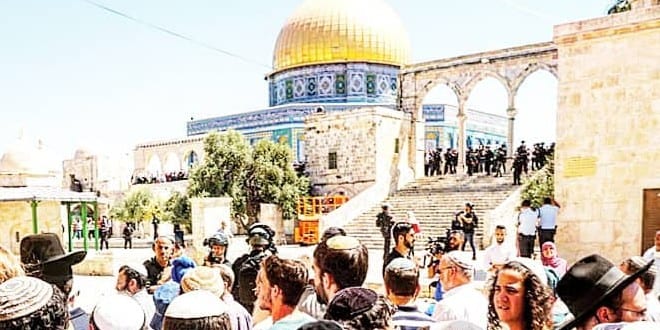
A new record was set Thursday for the number of Jews ascending the Temple Mount on Tisha B’Av, with final figures from the religious rights group Beyadenu — Returning to the Temple Mount putting the total at 3,703 visitors, edging past preliminary same-day counts of 3,698. The group said 61,238 Jews have ascended the site so far this Hebrew year. Last Tisha B’Av, by the same count, drew 3,527 visitors.
Jewish worshipers ascend Temple Mount on Tisha B'Av, pray and seen here performing the priestly blessing in massive departure from the status quo w/ Jordan, which ostensibly administers the site pic.twitter.com/PkQkuUpkr9
— charlie summers (@cbsu03) July 23, 2026
Beyond marking the destruction of both the First and Second Temples, Tisha B’Av is traditionally tied to a string of other calamities said to have befallen the Jewish people on or near the same date throughout history.
Rabbi Elisha Wolfson, Rosh Yeshiva of the Temple Mount Yeshiva, called the turnout a milestone. “It is moving to see the masses of the House of Israel coming to visit the site of the Temple,” Wolfson said. “Thank God, we were privileged to pray on the Mount using Tisha B’Av prayer booklets and beneath shade canopies in the eastern section. There is no doubt that the process of returning to Zion is making groundbreaking progress year after year.” Wolfson said the change has been especially sharp over the past two years, since National Security Minister Itamar Ben Gvir took office, contrasting it with the yeshiva’s early years roughly six years ago, when he said even silent prayer could lead to a visitor’s detention by police. “Today there are songs, prayers, and prostration on the Temple Mount,” he said. “And starting today, there are also shade canopies and Tisha B’Av prayer booklets.”
Itamar Ben-Gvir, the minister of national security, visited the site Thursday morning and pointed to the crowd as evidence of a shift in who controls the Mount day to day. “Look at what is happening here — Jews praying and feeling that they are the ones in charge here. This has never happened before,” he said in Hebrew remarks posted to his X account. “We have reduced terrorist attacks by 85%. Everywhere, people understand that the State of Israel is in charge. There is still more to do, and, God willing, we will continue to make progress.” Also present were Minister Yitzhak Wasserlauf, MK Amit Halevi and MK Sharren Haskel. Ben Gvir has ascended the site more than a dozen times since taking office, and has previously used Tisha B’Av gatherings there to call for tougher action against Palestinians in Gaza and Judea and Samaria.
יום תשעה באב מציינים את החורבן. אבל אנחנו רואים התקדמות ענקית גם בהר הבית. תראו מה קורה כאן – יהודים שמתפללים, מרגישים כאן בעלי הבית. זה לא היה כאן אף פעם. ככה בעוד ועוד מקומות. הורדנו ב-85% את הפיגועים. בכל המקומות מבינים שמדינת ישראל היא בעלת הבית. יש עוד מה לעשות, ואנחנו,… pic.twitter.com/P15jWbEpvQ
— איתמר בן גביר (@itamarbengvir) July 23, 2026
There was no immediate comment on Thursday’s visits from Netanyahu’s office.
The Beyadenu NGO also used its summary of the day to criticize the police response to the crowds, describing what it called “a serious organizational failure.” The group said thousands of fasting visitors were left waiting for hours in the summer heat because of how the entrance was managed, with at least one person fainting, and that some visitors were rushed through the site after the long wait. It also said visitors were detained or removed over infractions such as putting on tefillin or straying slightly from the designated route, and that one group was pepper-sprayed at the Iron Gate “for no apparent reason.” Israel Police told the public broadcaster Kan, that Thursday’s prayer service took place along the authorized visiting route and that officers seen in footage of the event were instructing worshippers to keep moving.
Jordan and the PA Object: “a place of worship exclusively for Muslims”
Jordan strongly condemned the visits, with a spokesman for Amman’s foreign ministry calling them “a flagrant violation of the historical and legal status quo” at the site. The ministry slammed what it called “continued, unacceptable incursions by ministers, Knesset members and extremist settlers,” and criticized Israeli police for “facilitating these actions.” It described the compound as “a place of worship exclusively for Muslims” and called on the international community “to adopt a firm position” compelling Israel to halt the visits. The office of Palestinian Authority President Mahmoud Abbas issued a similarly worded condemnation.
A Steady Climb Since 2015
Jewish visitation on Tisha B’Av has grown by orders of magnitude over the past decade, according to figures reported over the years by activist groups including Yeraeh, the Temple Mount Administration and Beyadenu, though exact tallies vary somewhat by organization. Visitor numbers stood at roughly 300 in 2015 and 400 in 2016, climbed to about 1,400 in 2018, then collapsed to a mere dozen or so in 2019 after police barred Jewish entry over Arab rioting. Numbers hovered around 1,000 in 2020 under COVID-era restrictions before climbing past 1,600 in 2021 and into the low thousands by the early 2020s. Since 2022, the figure has consistently run in the thousands, reaching well over 3,500 last Tisha B’Av and continuing to climb this year. Annual totals have followed the same trajectory: Beyadenu recorded roughly 44,000 total Jewish ascents in the Hebrew year 5783, more than 51,000 the following year, and a record 68,429 in the year just concluded, 5785.
The Legal Backdrop
Jewish access to the Temple Mount sits at the intersection of Israeli law and an unwritten political arrangement that has never been fully reconciled with it. Israel’s 1948 Declaration of Independence guarantees freedom of religion to all residents of the state, and the Knesset’s 1967 Protection of Holy Places Law goes further, guaranteeing “freedom of access of the members of the different religions to the places sacred to them.” No statute anywhere bars Jewish or Christian prayer at the site.
The restriction instead traces back to an informal understanding struck by Defense Minister Moshe Dayan just weeks after the Six-Day War, under which Israel left day-to-day management of the compound to the Jordanian-run Islamic Waqf and instructed police to prevent organized non-Muslim prayer there, a policy enforced ever since not by legislation but by police discretion. That discretion has been tested repeatedly in court. A 2015 Jerusalem Magistrate’s Court ruling upheld the right of Jews to pray silently at the site. In 2022, a magistrate court lifted a police-imposed ban on three teenagers who had prayed there, only for a district court to overturn that decision on appeal and reaffirm the ban, with the judge writing that the “special sensitivity of the Temple Mount” meant Jewish worship there “should be superseded by other interests, among them the safeguarding of public order.” A shift began in 2018, when police started quietly permitting Jews to pray without ritual items along a path near the eastern wall, the same policy Wolfson said his yeshiva now relies on.
Christian visitors face parallel restrictions. Entry for both Jews and Christians is limited to fixed morning visiting hours through a single access point, the Mughrabi Gate, and both groups are barred from praying aloud, forming prayer groups, or bringing in prayer books or Bibles, which security checkpoints have at times confiscated. Israel’s government has left that arrangement in place for more than half a century in the name of preserving calm at one of the most contested religious sites on earth, even as the law on its books promises free access to people of every faith.

