




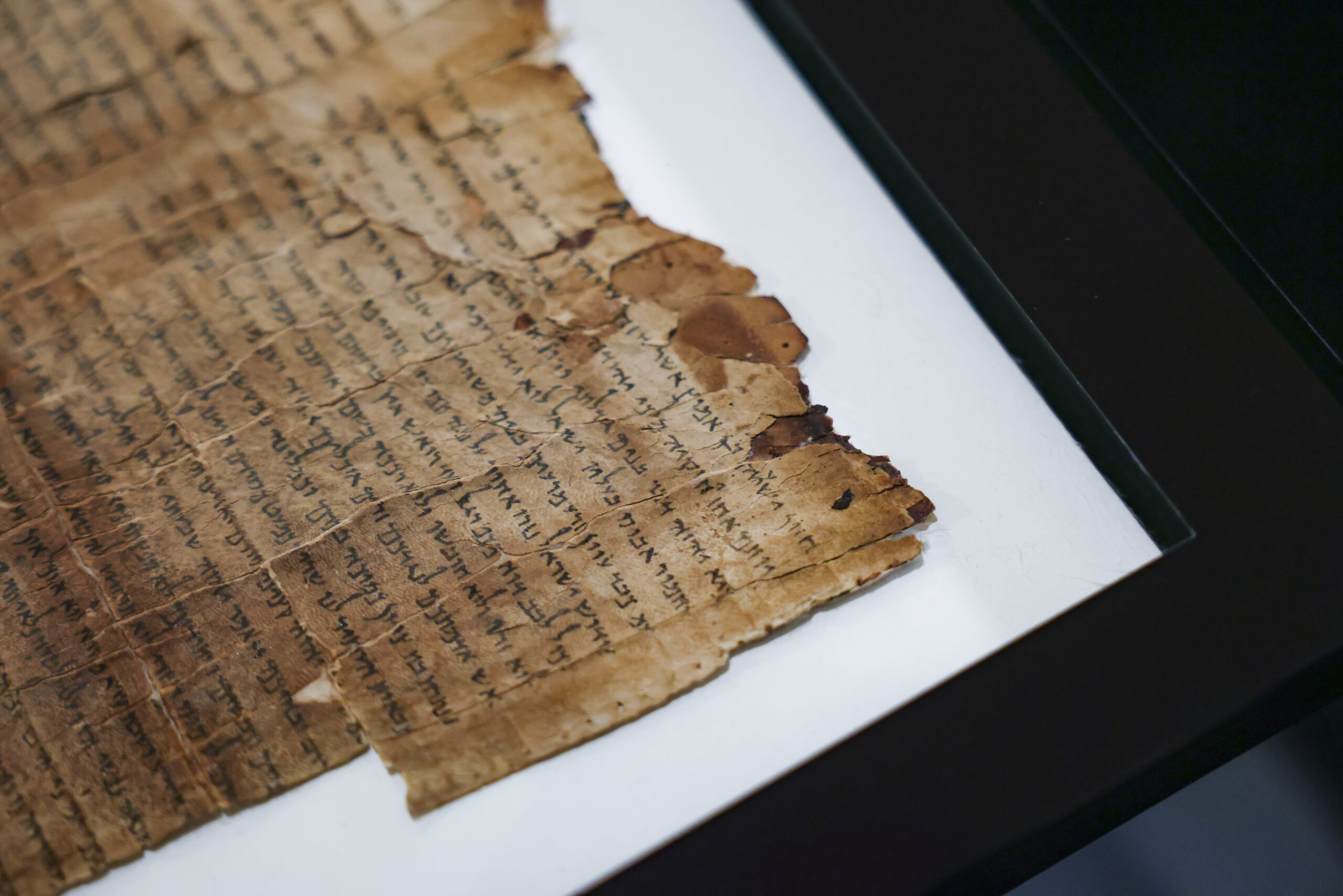
For decades, scholars have argued over one of the strangest details in the Dead Sea Scrolls: a 364-day calendar that governed the Qumran sect’s religious life but was mathematically guaranteed to fall apart. Now, new research from Tel Aviv University proposes that the calendar was not merely a theological abstraction. It was used, in practice, by a community willing to base its entire religious identity on a system it must have known would eventually collapse.
The study, conducted by Prof. Eshbal Ratzon of the Department of Jewish Philosophy and the Cohn Institute for the History and Philosophy of Science and Ideas at Tel Aviv University, was published in the Tarbiz Quarterly for Jewish Studies. Her conclusion resolves a dispute that has divided Qumran scholars since the 1950s, and it does so by taking seriously something earlier researchers dismissed: the calendar broke down, and the sect had to live with the consequences.
Who has the authority to fix the calendar of God?
That is the question buried inside the mathematics. The mainstream Jewish community during the Second Temple period followed a lunisolar calendar, with months tracking the moon and an occasional thirteenth month added to keep festivals aligned with the seasons. The Qumran sect, widely identified with the Essenes, rejected that system outright. Its calendar ran exactly 364 days, a number divisible by seven, so that every festival fell on the same day of the week, year after year. Passover, by this reckoning, always arrived on a Wednesday.
For the men who settled at Qumran, this was not a convenience. It was a claim about the order God had built into creation itself, one they believed the priestly establishment in Jerusalem had corrupted. “There were several halachic disputes between the two sides at that time, including issues related to purity in the Temple, but most likely, they were all built around political and personal rivalries,” Ratzon said. “Many arguments can be resolved when there are good intentions, but in this case, they clearly wanted to split, and these issues were framed as the cause for separation.”
The Book of Jubilees, central to the Qumran library, attacks the lunar calendar directly and presents the 364-day system as the original calendar given to Moses at Sinai. Nearly twenty scrolls found at Qumran deal with calendars and astronomy, a volume of material that signals how much weight the community placed on the question.
The trouble is arithmetic. A solar year runs roughly 365 and a quarter days. A 364-day calendar sheds about a day and a quarter every year, and that gap compounds. After two decades, festivals would drift by nearly four weeks against the seasons. After a few generations, a spring festival tied to the barley harvest could land in the dead of winter. For a community whose holy days marked first fruits, harvests, and agricultural cycles, this was not a minor inconvenience. It was a structural failure built into the system from the start.
Two competing theories have dominated the scholarship. Hebrew University’s Shemaryahu Talmon argued in the 1950s that adopting the 364-day calendar was a deliberate act of rebellion against the Temple leadership, a way to sever the sect entirely from the Jerusalem establishment. University College London’s Sacha Stern took the opposite position: given how unworkable the calendar became over time and its near-total absence from sources outside the Qumran library, he argued it was never used at all, existing only as a theoretical ideal.
Ratzon rejects Stern’s approach. She points to the Pesher Habakkuk scroll, which describes a “wicked priest” from the Temple leadership persecuting an early Qumran leader for observing Yom Kippur on a different date than the one Jerusalem recognized. “I think this approach contradicts the evidence,” Ratzon said. “If that was the case, why would the priest in the story have been persecuted?”
Her own reconstruction charts a middle path. The calendar was adopted and actively used when the community first settled at Qumran in the mid-second century BCE. It held for roughly fifty years, until the drift became impossible to ignore and, just as significantly, until the political climate shifted. Hasmonean king Alexander Jannaeus, who ruled from 103 to 76 BCE, favored legal positions closer to those of the Qumran sect and opposed the Pharisaic leadership in Jerusalem. A Qumran hymn praising Jannaeus survives among the scrolls, evidence of a genuine, if temporary, thaw. “We have evidence that there was some sort of rapprochement at that time, which would have created a setting that allowed them to stop using their calendar and get closer to the Jerusalemite leadership,” Ratzon said.
At that point, Ratzon argues, the sect quietly abandoned the calendar as a working system and returned to the lunar calendar used at the Temple. But it never discarded the 364-day model entirely. It survived instead as doctrine, an ideal calendar fixed at Creation, one the community expected would govern time again in the End of Days. No scroll admits the calendar failed. No later source, not Josephus, not Philo, not the rabbinic tradition, records the crisis of its abandonment. The break was absorbed quietly, and the ideal was preserved undisturbed.
The Bible itself locates the authority over sacred time in a single place. “Speak unto the children of Israel, and say unto them: The appointed seasons of the LORD, which ye shall proclaim to be holy convocations, even these are My appointed seasons” (Leviticus 23:2). The verse does not divide that authority between rival factions or competing systems. It assigns it to God, transmitted through the leadership He established. The Qumran sect understood this. Its error was not in caring who controlled the calendar. Its error was concluding that the answer justified fracturing the nation to defend it.
Two thousand years later, the scrolls preserve both the calendar and the silence that followed its collapse. A system built for mathematical perfection could not survive contact with the actual sun, and a community built around defying the Temple’s authority could not, in the end, defy the seasons either. What endured was not the 364-day year. What endured was the conviction that sacred time belongs to God alone, and that no human faction, however righteous it believes itself to be, gets to fracture Israel over the calendar it keeps.
