

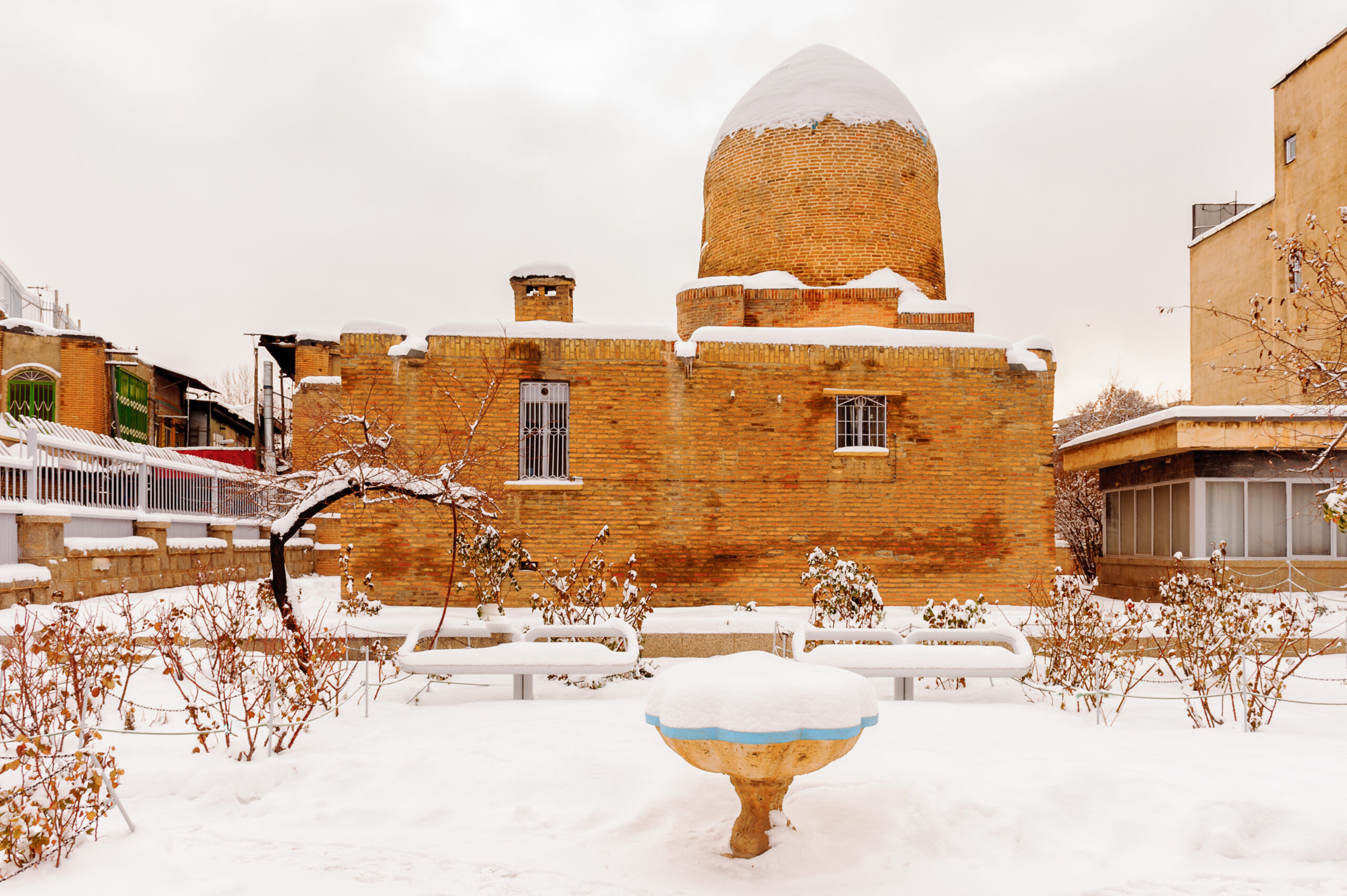
The Jewish Association of Tehran issued an unusual public notice this week, instructing every Jew in Iran to stay away from Hamadan, the city Persian tradition holds to be the biblical Shushan itself. The notice named a single cause: ongoing repairs at the tomb complex believed to hold the remains of Mordechai and Esther. Sources familiar with the situation tell a different story, one involving threats from extremist elements inside Iran serious enough that the community has suspended a coordination process it maintained for years.
The Notice Itself
The statement, distributed through the community’s official channels, read: “To the members of our community: Due to ongoing repairs and improvements at the Tomb of Esther and Mordechai in Hamadan, visits to this holy site will not be possible until further notice.” Until this week, Iranian Jews wishing to visit the tomb needed only to coordinate the trip in advance with Tehran’s Jewish association. The new notice closes that option entirely, stating that “under the current circumstances, even such coordination is not possible until further notice.”
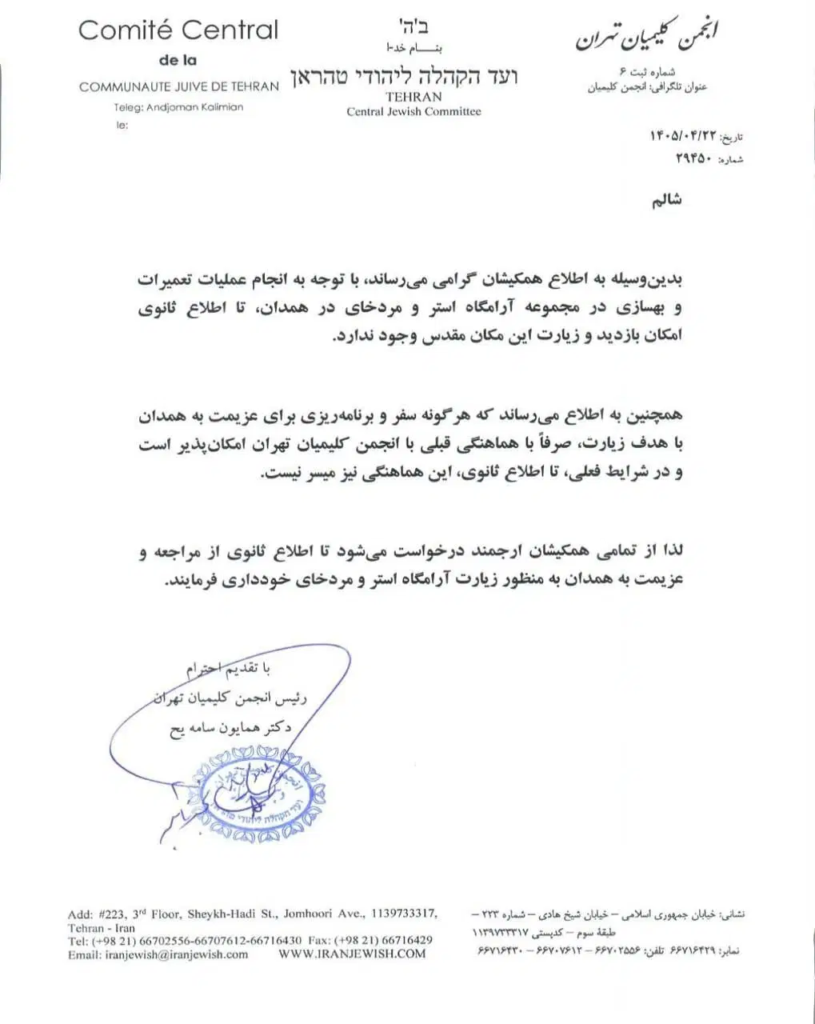
Sources close to the matter, cited by the Israeli outlet Kikar HaShabbat, dispute the renovation explanation outright, attributing the closure instead to specific threats from extremist factions inside Iran. The complete suspension of visitation, rather than a tightened approval process, is what these sources point to as evidence the decision has nothing to do with construction.
A Site With a History of Being Targeted
The tomb has been targeted by organized hostility. In 2011, anti-Israel protesters surrounded the complex and threatened to tear it down, only a year after Iran had placed the site on its National Heritage list. The government removed that protected status soon after, with the state news agency explaining the decision by describing Purim as a Jewish celebration of a massacre of Iranians. The tomb was set on fire by unidentified assailants in 2020, and hand grenades were thrown at the structure in 2013, though neither attack caused major damage at the time. Two weeks after the outbreak of the Israel-Hamas war in October 2023, demonstrators gathered at the site to burn Israeli flags. In April 2024, extremists were filmed throwing Molotov cocktails at the compound while flying a Palestinian flag over it.
A Community Living Under Suspicion
Iran’s Jewish community remains the largest in the Middle East outside Israel, though its numbers tell their own story of decline. More than 100,000 Jews lived in the country in 1970. Fewer than 30,000 remain today, the bulk of them having left in the mass exodus that followed Iran’s 1979 revolution and the founding of the Islamic Republic. Those who stayed live under constant scrutiny of any perceived tie to Israel or the United States. Amid the recent escalation in Israel-Iran tensions, opposition sources have reported arrests of rabbis and community leaders in Tehran and Shiraz on suspicion of collaborating with Israel, in some cases detaining family members alongside them, though these reports have not been independently verified.
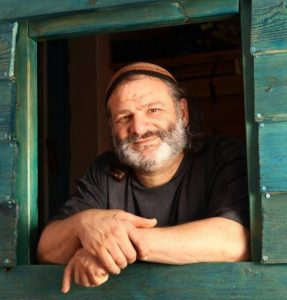
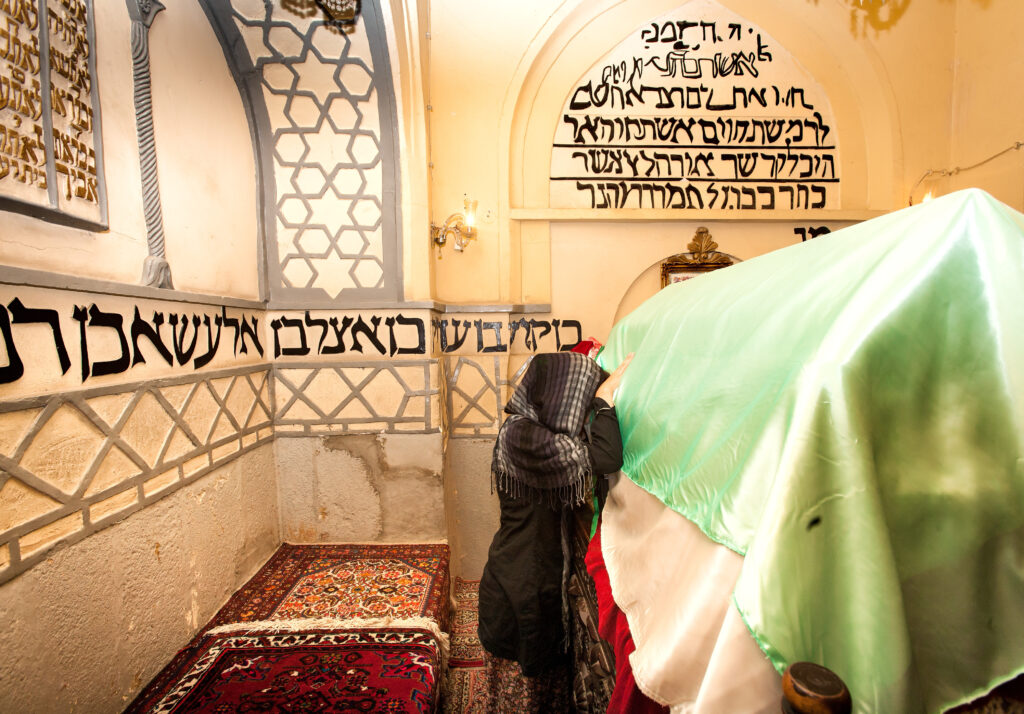
Despite the pressure, the tomb has also seen moments of open, undisturbed Jewish life within living memory. Last year, Iran’s Chief Rabbi, Yehuda Gerami, led afternoon prayers and danced with his students at the tomb on the eve of Purim, then read the Scroll of Esther at a nearby synagogue before returning for the evening holiday prayers. That single image, a rabbi dancing at Esther’s own grave in the city that claims to be her capital, captures the contradiction Iranian Jewry has lived inside for decades: a community permitted to celebrate its deliverance at the very site where that deliverance is said to have happened, while its leaders now face arrest for the suspicion of loyalty to the state that deliverance eventually produced.
An Old Story, Still Being Told
The Book of Esther never once mentions God’s name, a fact the Sages have long understood as the text’s central teaching: providence works through the ordinary decisions of kings, ministers, and threatened communities, long after the miracles of Egypt and Sinai ceased to reveal God’s hand openly. Hamadan’s Jews are now living through a modern chapter of that same pattern. No angel is sealing the tomb this week. Instead, officials are closing it under the bureaucratic language of renovations, while the true reason remains unspoken, just as a queen in that same city once concealed her identity until the moment demanded that she reveal it.
It remains unclear when the ban will lift, and Iran’s Jewish community has given no indication that it intends to say anything more than it already has.
