
The US House of Representatives adopted an amendment this week from Rep. Claudia Tenney (R-NY) directing American diplomatic attention toward one of the starkest double standards in the Middle East: Jews are barred from praying at their own holiest site while Muslims worship there freely. The measure, Amendment No. 28 to the FY2027 State Department appropriations bill, passed by voice vote with no recorded opposition.
“It is unconscionable that Jews do not enjoy the same access rights to visit and pray at their holiest site that other religions do,” Tenney told the House ahead of the vote. She described a staffer’s visit to the Temple Mount the previous year as illustrative of the problem. “When one of my staffers ascended the Temple Mount last year, he was harassed by Muslim onlookers, restricted from visiting most of the site, and was only allowed to be upon the Temple Mount for a very short duration of time, Madam Chair,” she said. “This is a basic tenet and principle of religious freedom, and the US must do more on this issue.”
The amendment increases and decreases funding for the US Commission on International Religious Freedom by $1 million, a mechanism Tenney said is meant to force the commission’s attention onto the issue rather than let it sit unaddressed. “That is why my amendment would emphasize the need for the US Commission on International Religious Freedom to work to ensure religious freedom and equal access for all with respect to the Temple Mount,” she said.
Amendment 28 builds directly on a standalone resolution, H.Res.852, which Tenney introduced in October 2025. That resolution places the House on record affirming that Jerusalem is the undivided capital of Israel and that Israel holds sole sovereignty over the Temple Mount, while also recognizing the site’s centrality to Jewish history and heritage. Tenney has described the two measures as a coordinated effort during the current Congress to move the House toward formal recognition of full Israeli sovereignty and expanded religious rights at the site. Announcing the resolution in October, she pointed to Jewish presence in the land spanning more than 3,000 years, backed by what she called extensive archaeological and historical evidence, and said that record has been the target of “repeated international efforts to downplay Jewish ties to Jerusalem and restrict access to the Temple Mount.”
The same appropriations sitting saw the House reject the Massie Amendment, which would have stripped $3.3 billion in annual US security assistance to Israel from the bill. Tenney voted against it.
What the restrictions actually look like
Tenney’s amendment names the disparity that has existed since Israel captured the Temple Mount in 1967 and immediately handed day-to-day management of the compound to the Jordanian-run Islamic Waqf. Under the arrangement that has governed the site ever since, Muslims may enter through eleven separate gates. Jews and Christians are confined to a single entrance, the Mughrabi Gate, accessible only during a narrow daily window and subject to search and screening well beyond what Muslim worshippers face.
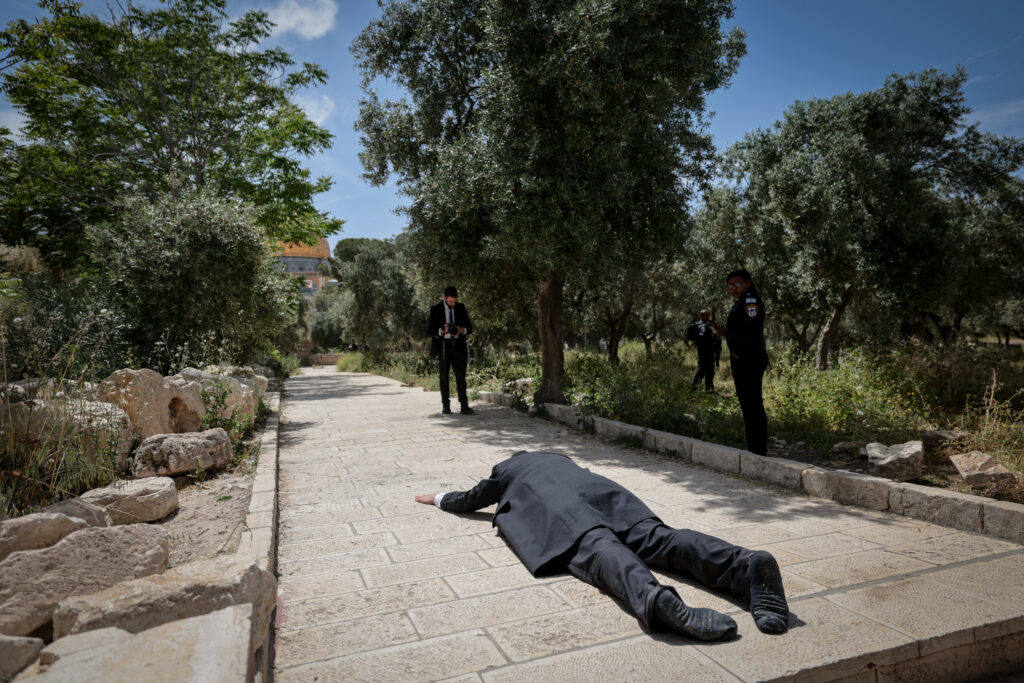
For decades, non-Muslims were barred from bringing prayer books, prayer shawls, or other religious articles onto the Mount, and any visible act of Jewish prayer, such as a bowed head, moving lips, or a whispered verse of Tehillim (Psalms), could result in immediate removal and a multi-day ban from the site, enforced by Israeli police acting on Waqf objections.
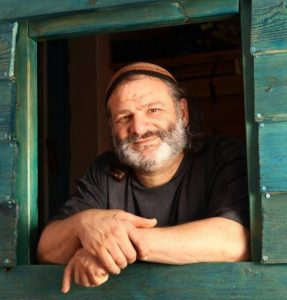
Former MK Rabbi Yehudah Glick, one of the leading advocates for Jewish prayer on the Temple Mount, says the situation has improved significantly over the past decade. Jewish prayer, once grounds for immediate arrest, now takes place daily, and Jews ascend the Mount in numbers that would have been unimaginable a generation ago.
But the restrictions remain severe. A Jew may still not bring a Bible or prayer book onto the Mount. Tallit and tefillin remain forbidden, as do the lulav on Sukkot and the shofar on Rosh Hashanah. Christian pilgrims face an even more complete prohibition: they may ascend the Mount but may not utter a word of prayer.
Non-Muslims are prohibited on Friday, Saturday, and Muslim holidays. Non-Muslim religious articles, prayer books, and symbols are prohibited, as are Israeli flags.
A right on paper, a veto in practice
Israel’s own courts have repeatedly acknowledged that this arrangement is at odds with Israeli law. In the case brought by Temple Mount activist Rabbi Yehuda Glick, the Supreme Court held plainly that “every Jew has the right to pray on the Temple Mount, as part of the freedom of religion and expression.” But the same ruling immediately rendered the right nearly meaningless: “these rights are not absolute, and can be limited to take into account the public interest.” In practice, “public interest” has meant one thing: the likelihood that Muslim worshippers or the Waqf will riot in response. Police have cited Supreme Court language warning that visitors “must not be allowed to enter the Temple Mount and pray there any time they want, out of a fear of harming the public order or public welfare,” and have argued in court filings that a single incident at the site could ignite unrest reaching “outside the borders of the country and the region.”
Strip away the legal language, and the mechanism is straightforward: the right to Jewish prayer exists in principle and remains heavily restricted in practice, and the party whose reaction determines whether it is exercised is not the Jew praying but the crowd threatening to riot over it. Every ruling in Glick’s favor has been narrow and conditional — quiet prayer, a corner of the plaza, no crowd gathered — and police have on multiple occasions simply continued enforcing restrictions after courts ordered them to stop. Rabbi Glick himself has made the point directly: the courts consistently affirm that Jews hold equal religious freedom at the site, and just as consistently decline to make Israel’s own police fully enforce it.
Rabbi Glick: Freedom remains half-realized
In a statement following the adoption of Tenney’s amendment, Glick praised the congresswoman for bringing the issue to the floor of the US House of Representatives and placing it on the international stage.
“The Temple Mount should not be the last place on earth where freedom of worship is denied; it should be the first place on earth to embody it, to allow and actively promote freedom of prayer for every human being who comes to seek God,” he said.
Glick described religious freedom as both a foundational American value and a universal human right. He said Amendment 28 and H.Res.852 send a long-overdue message that “the world is watching, and the double standard on the Temple Mount is no longer acceptable.”
At the same time, he stressed that the progress of the past decade should not be ignored. Jews now ascend the Mount in unprecedented numbers, and Jewish prayer takes place daily.
“But the road ahead remains long,” Glick said. “Freedom of prayer without the freedom to carry a prayer book is a freedom still half-realized.”
He also highlighted the prohibition against Christian prayer, an issue that receives far less public attention.
“Millions of Christians who love Jerusalem ascend the Mount and are forbidden to utter a single word of prayer,” Glick said. “This is an injustice that contradicts the very essence of Isaiah’s vision [of] a house of prayer for all nations, and it must be dealt with immediately.”
Is the Temple Mount even Islam’s third-holiest site? Dr. Mordechai Kedar says the premise is false
Underneath the access dispute sits a claim so widely repeated that it is rarely examined: that the Temple Mount is Islam’s third-holiest site, after Mecca and Medina. Dr. Mordechai Kedar, a senior lecturer in Arabic at Bar-Ilan University, has spent years calling that claim “fake news,” and his argument rests on the Quran’s own text rather than on polemics. Jerusalem, Kedar notes, is never mentioned in the Quran. Al-Aqsa, “the farther mosque,” is mentioned exactly once, in a verse describing a night journey, with no stated location.
Kedar’s explanation for how a nameless, undescribed “farther mosque” became Jerusalem centers on the Umayyad dynasty. The pilgrimage to Mecca, the hajj, is one of Islam’s five foundational obligations, and the Umayyads, according to Kedar, needed an alternative site of pilgrimage and religious weight to anchor their own legitimacy. Jerusalem was chosen, he argues, and the Quranic story was read backward onto the city to justify the choice, with the legend of Muhammad’s night journey to “al-Aqsa” attached to it after the fact. That, Kedar says, is the actual origin of Jerusalem’s status as Sunni Islam’s third-holiest city, a political decision retrofitted with scripture, not an original religious claim. He points to Shiite Islam as corroborating evidence: Shiite Muslims, persecuted by the Umayyad Caliphate rather than served by it, never adopted the Jerusalem tradition, which is why Najaf in Iraq, not Jerusalem, ranks as Shiite Islam’s second-holiest city. Iranian and Hezbollah figures, Kedar notes, only began describing Jerusalem as holy after Iran’s 1979 revolution, largely to avoid Sunni accusations of indifference toward the Palestinian cause.
The gold dome is not al-Aqsa
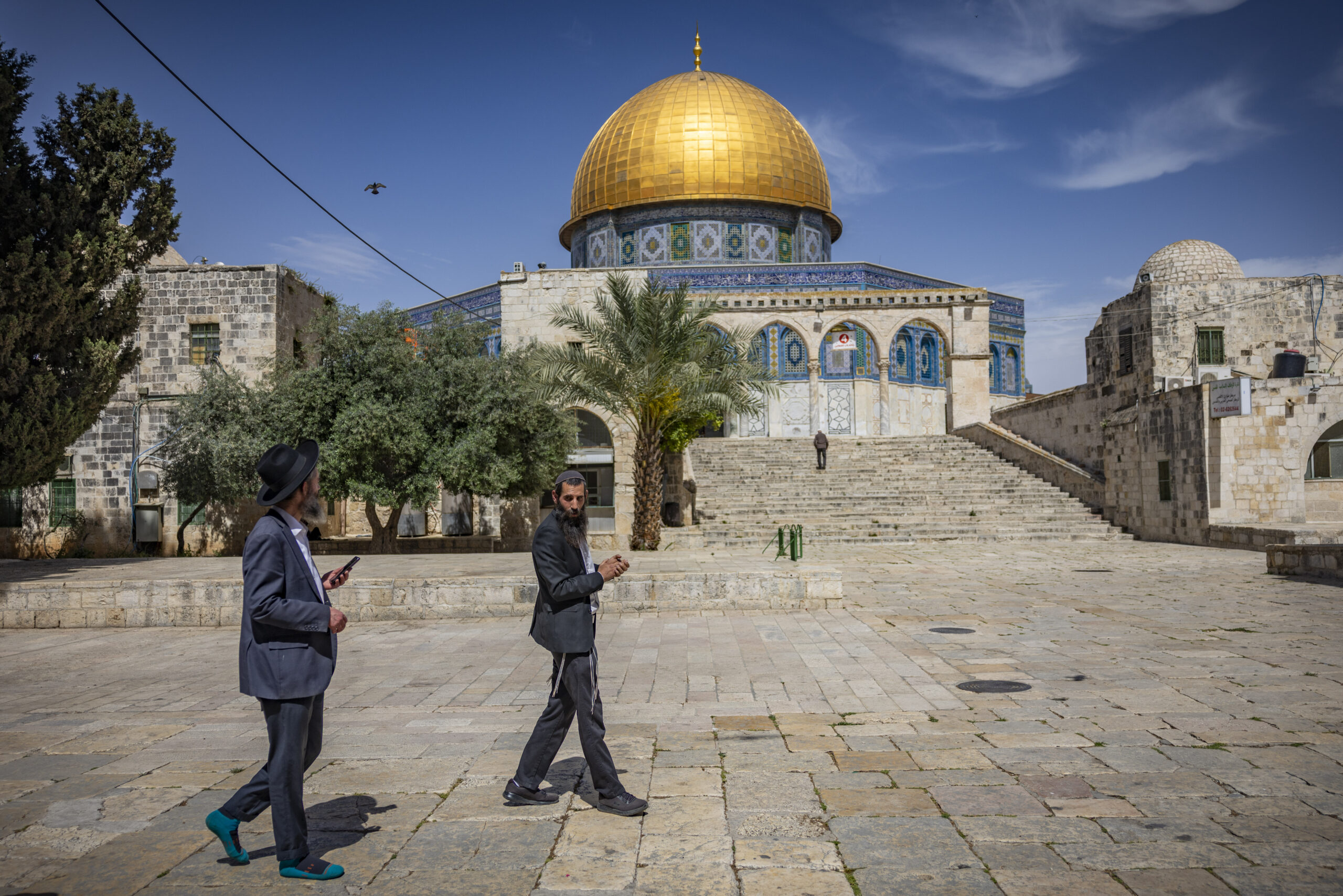
A second layer of confusion, Kedar and other researchers argue, is architectural rather than textual, and it is visible in a single image reproduced constantly in Western and Arab media alike: the golden dome that has become shorthand for “al-Aqsa Mosque” in headlines, protest banners, and, notably, Hamas’s own emblem. That gold-covered structure is not al-Aqsa Mosque. It is the Dome of the Rock, Qubbat as-Sakhra, a shrine built by the Umayyad caliph Abd al-Malik around 691 CE to enclose the Foundation Stone, not a mosque and not a site of regular congregational prayer. The actual al-Aqsa Mosque is a separate building, a much plainer structure with a silver-grey dome standing at the southern end of the same plateau, where Muslim prayer services are actually held. The gold dome’s constant substitution for the mosque itself is not a minor error; it is the same expansive, after-the-fact claim Kedar describes, stretched now from a single unnamed “farther mosque” to the entire 35-acre plateau Jews call the Temple Mount.
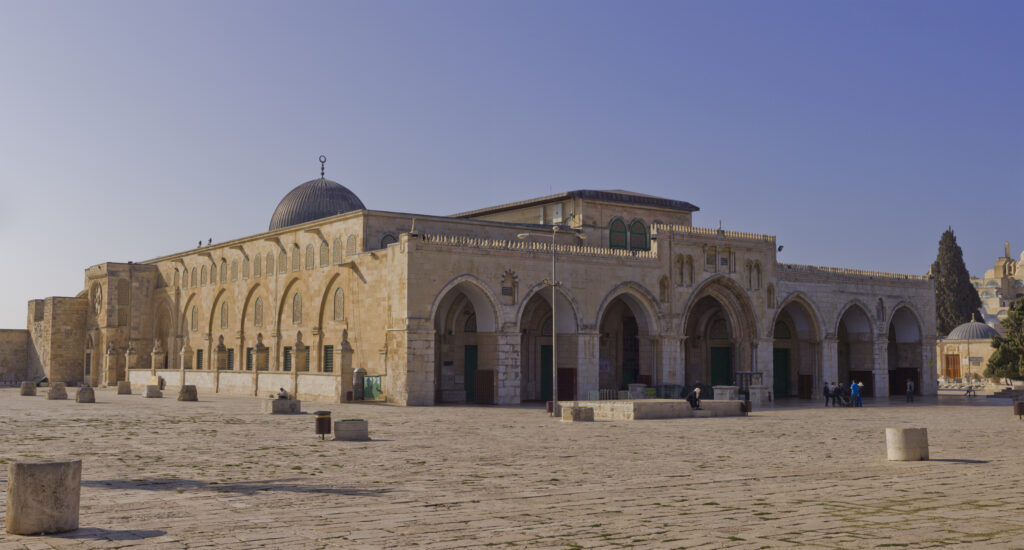
A site the Muslim world ignored until Israel took it
The intensity of that claim is also a relatively recent development. From 1948 to 1967, Jordan controlled the Temple Mount and Jerusalem’s Old City. During those nineteen years, Jews sites were destroyed rather than protected; Jordanian authorities barred Jews from the Western Wall and demolished or repurposed thirty-five synagogues in the Old City, some as animal shelters or garbage sites. The compound itself drew comparatively little religious investment or international attention during those nineteen years. It was only after Israel captured the Old City in June 1967 that the Temple Mount became the object of the sustained religious and political urgency now attached to it, with the Waqf handed administrative control by Defense Minister Moshe Dayan in a gesture of restraint that has since hardened into a one-sided status quo. The site the world is now told Muslims cannot live without is the same site the Muslim world largely left alone for nineteen years, until Jewish sovereignty returned to Jerusalem and gave it a reason to care.