




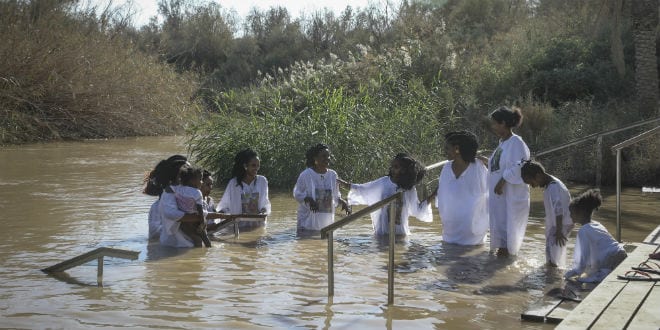
Israel’s Ministry of Foreign Affairs has begun preparing for 2030, when Christians across the globe will mark 2,000 years since the baptism of Jesus in the Jordan River, one of the defining events in Christian tradition. Minister of Foreign Affairs Gideon Sa’ar has ordered the creation of a dedicated working group, led by Ambassador George Deek, Israel’s Special Envoy to the Christian World, to coordinate with churches worldwide and prepare the country to host what officials expect will be millions of Christian pilgrims.
Where and when the baptism took place
Christian tradition places the baptism of Jesus at a site along the Jordan River near Jericho, where John the Baptist was preaching and immersing followers as a rite of repentance. The location has been venerated by Christian pilgrims since antiquity and is identified today with Qasr al-Yahud on the Israeli side of the river, directly across from the site known as Al-Maghtas, or Bethany Beyond the Jordan, on the Jordanian bank. Al-Maghtas was inscribed as a UNESCO World Heritage Site in 2015. Byzantine-era churches, monasteries and baptismal pools have been excavated on both banks, confirming the site’s standing as a place of Christian worship for over 1,500 years.
Christian scholars generally date the baptism to around 29 CE, based on the Gospel of Luke’s placement of John the Baptist’s ministry in the fifteenth year of the reign of the Roman emperor Tiberius and its description of Jesus as approximately thirty years old at the time. The event is understood in Christian tradition as the beginning of Jesus’s public ministry. For Christians, the anniversary carries significance well beyond a historical date. It is treated as one of the foundational moments of their faith, and 2030 is being positioned by both Israeli and Jordanian officials as the first in a series of millennial commemorations expected to culminate in 2033, when Christians will mark 2,000 years since the crucifixion.
Working group to coordinate with churches worldwide
The Israeli working group will maintain ongoing contact with churches, Christian communities and religious leaders internationally, while running a parallel inter-ministerial process with government agencies to prepare Israel’s infrastructure, security apparatus and tourism sector for the scale of pilgrimage expected around the anniversary. Deek, an Israeli Arab Christian who previously served as Israel’s ambassador to Azerbaijan before his appointment this year as special envoy to the Christian world, will lead the effort.
Sa’ar framed the initiative as both a religious and diplomatic priority. “The year 2030 will be a unique milestone for the Christian world, and Israel is beginning its preparations now,” he said. “Strengthening our relationship with the Christian world and ensuring that the Holy Land remains accessible to the millions of believers who wish to visit are among Israel’s highest priorities.” He added: “Israel will continue to safeguard freedom of worship and access to holy sites for members of all faiths. We believe that the year 2030 will be an opportunity for Christians from all over the world to come to the Holy Land, connect with the roots of their faith, and experience the place where the history of Christianity began.”
Jordan is mounting its own preparations for the same anniversary at Al-Maghtas, on its side of the river. Jordanian officials, including Minister of Tourism and Antiquities Emad Hijazin, have said the Baptism Site Commission and the Royal Court will soon announce a full program for the commemoration. With both governments developing plans around the same river and the same anniversary, 2030 is shaping up as a rare case where Israel and Jordan will be coordinating, whether formally or in parallel, to host what is expected to be one of the largest waves of Christian pilgrimage to the Jordan Valley in modern history.

