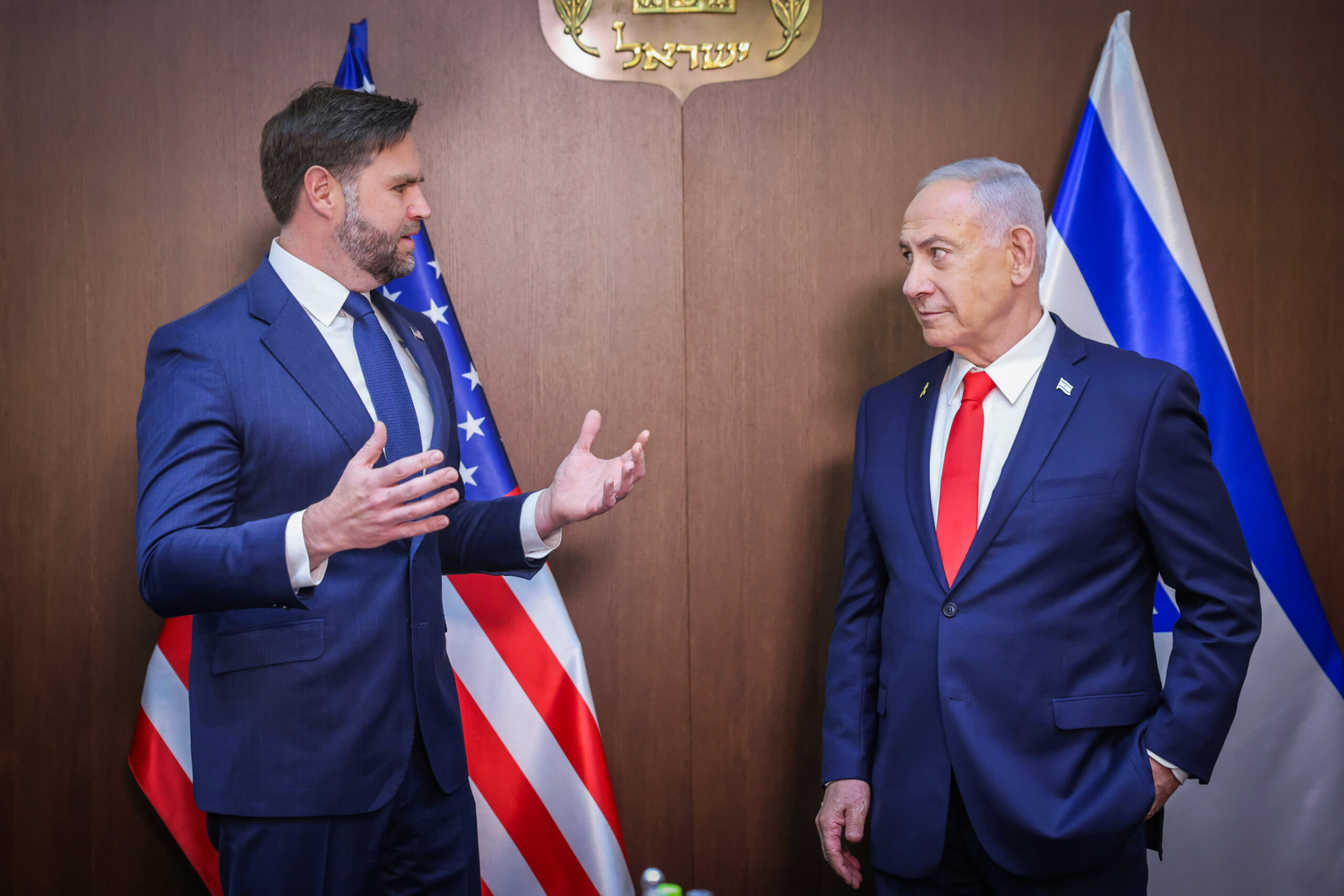
US Vice President JD Vance used a three-hour interview with podcaster Joe Rogan this week to accuse elements within the Israeli government of funding a campaign to derail his negotiations with Iran, telling those he said were behind it to “go to hell.” The interview, released Wednesday, also saw Vance revive unproven claims tying Jeffrey Epstein to Israeli intelligence, remarks that mark one of the most prominent embraces yet by a sitting administration official of a theory that has circulated for years without evidence and has often shaded into antisemitism.
Vance’s comments on Israel came unprompted, tied to a Time magazine report published Tuesday that found Trump’s former campaign manager, Brad Parscale, and his company Clock Tower X had been running an Israeli government-funded influence campaign targeting young Americans inside Trump’s base. According to Time, which cited Foreign Agents Registration Act filings, an ad agency retained Parscale last September for a campaign officially aimed at combating online antisemitism. Time reported that an Israeli Foreign Ministry official familiar with the effort described its real purpose as “preventing young conservatives from turning against Israel,” and that the Trump administration had identified a wave of coordinated posts from conservative influencers criticizing last month’s memorandum of understanding to end the Iran war as part of the campaign. Parscale has denied that his work extended to attacking the administration’s diplomacy, writing that “there isn’t a single shred of evidence” he acted against it.
Vance did not accept that denial. “There was this Time article that came out yesterday. It lists a bunch of people who have been paid by a former Trump campaign person who was himself paid by certain elements within the Israeli government, and those people are attacking me viciously for trying to accomplish the negotiation objective that the president set for the country,” he told Rogan, calling it a “very discreet, extremely well-funded campaign to try to derail the negotiations.” He said he had been accused of taking direction from Qatar and from commentator Tucker Carlson, adding, “there’s just so much bulls**t out there.”
Vance drew a distinction between foreign lobbying, which he said he takes for granted, and Americans he accused of taking Israeli money while attacking him. “Foreign governments try to influence the United States all the time. Israel does it. Other countries do it. What bothers me is when American leadership allows that influence to affect their judgment and to affect what they are advocating for,” he said. “When I open up the pages of Time magazine, and I see that there’s a foreign influence campaign being funded to tank the very deal that I was pursuing, and many of the people who were receiving that money were attacking me in completely dishonest ways, my response to that is, go to hell. I’m going to do what I have to do for the American people. I represent Americans first.”
The campaign itself rests on documented ground: Time’s report cited specific FARA filings and named the firm, Clock Tower X, and its principal, Parscale. Vance’s next claim goes beyond that documentation. He told Rogan he knows “beyond a shadow of a doubt” that people inside the Israeli government are working to keep the war with Iran going indefinitely, and said Israel is “losing the public-opinion battle in the United States.” That is Vance’s own reading of the campaign’s ultimate strategic intent, not a conclusion Time’s reporting itself drew, and he offered no evidence beyond the existence of the funding arrangement to support it.
Iran talks in limbo as fighting resumes
Vance argued that Iran’s leadership is split between pragmatists open to a deal and hardliners who panicked after last month’s memorandum of understanding, once they saw how much oil the US extracted from the Strait of Hormuz, and responded by targeting ships there. “They’ve basically said, ‘We’re going to try to shut this thing down. We’re scared about losing our leverage.’ The pragmatists in their system are saying, ‘This was a mistake. Let’s keep on talking,'” he said. He described the administration’s approach as “a delicate diplomatic dance” using “carrots and sticks” while responding militarily whenever Iran commits acts of violence. Asked directly whether the US would have gone to war with Iran absent Israeli influence, Vance said Trump holds the position “completely separate from any influence from Israel” that Iran must not be allowed a nuclear weapon.
The MOU Vance negotiated, criticized for the concessions it gave Iran over Lebanon and the Strait of Hormuz, has since collapsed, with Iran resuming attacks on commercial shipping and the US restoring its blockade and resuming strikes this week. The deal has drawn criticism from multiple directions. Vance made headlines last month for a public clash with far-right members of Prime Minister Benjamin Netanyahu’s governing coalition, who blasted the administration over the concessions in the agreement; Vance told them they needed to “wake up” and recognize that Trump is the last world leader still favorably disposed toward Israel. Hawkish American conservatives have pushed the opposite critique, arguing the administration should abandon negotiations altogether and continue the military campaign indefinitely, a position Vance said was partly amplified by the Israeli-funded influencer campaign Time identified. Vance said his own enthusiasm for the initial war against Iran, which began on February 28, was lower than that of some others in the administration, but said his role was to support the president rather than serve as a “public commentator.” He also took aim at the hawkish American critics directly, saying their approach of trying to “bomb Iran into oblivion” and topple the regime would require a large deployment of ground troops with a poor American track record.
Epstein remarks cross into conspiracy theory
Much of the coverage of the interview centered on Vance’s answers about Jeffrey Epstein. Vance said the administration was “guilty” of mishandling the release of Epstein-related files while maintaining Trump was not implicated in wrongdoing, and said he did not believe former Attorney General Pam Bondi acted in bad faith, saying “she overstated what we had and what we didn’t have.”
What followed was an explicit conspiracy theory, one Vance himself labeled as such. Describing himself as “one of the O.G. Epstein conspiracy theorists,” he asserted that Epstein “clearly had connections to the highest levels of Israeli intelligence,” pointing only to Epstein’s documented friendship with former Israeli prime minister Ehud Barak, a single individual, as evidence of a supposed institutional tie. “Epstein seemed to be connected to the elements of the Israeli deep state that were left of center,” Vance said, adding he found it “fascinating” that Epstein’s Israeli ties skewed toward the political left rather than the right. No evidence supports a connection between Epstein and Israeli intelligence. Naftali Bennett, Israel’s former prime minister, publicly denied last year that Epstein worked for Israel or the Mossad, and Barak, who has acknowledged the friendship and denied any wrongdoing, said he regrets the relationship. The claim meets the definition of a conspiracy theory on its own terms: an allegation of secret coordination by a foreign intelligence service, offered without evidence, and directly denied by a former head of the government in question.
Vance floated a second unproven theory alongside it, calling it “underreported”: that Epstein served as a “tax guy” for Jewish billionaire philanthropist Les Wexner, and suggesting improper tax activity could have been a separate avenue of blackmail alongside the sexual abuse for which Epstein was convicted. Vance offered this explicitly as speculation, saying only that it was “one way in which he gained blackmail,” not as an established fact. Wexner’s decades-long relationship with Epstein has been extensively documented; Wexner has denied wrongdoing and said he severed ties with Epstein after learning of his conduct.
The vice president has flirted with Epstein-related conspiracy theories before, telling hosts on “The View” last month that he considers himself “kind of a conspiracy theory” on the matter. His remarks to Rogan go further than previous public comments, giving fresh, high-profile circulation to unsubstantiated claims about Epstein and Israeli intelligence that have circulated online since Epstein’s death despite the absence of supporting evidence.