
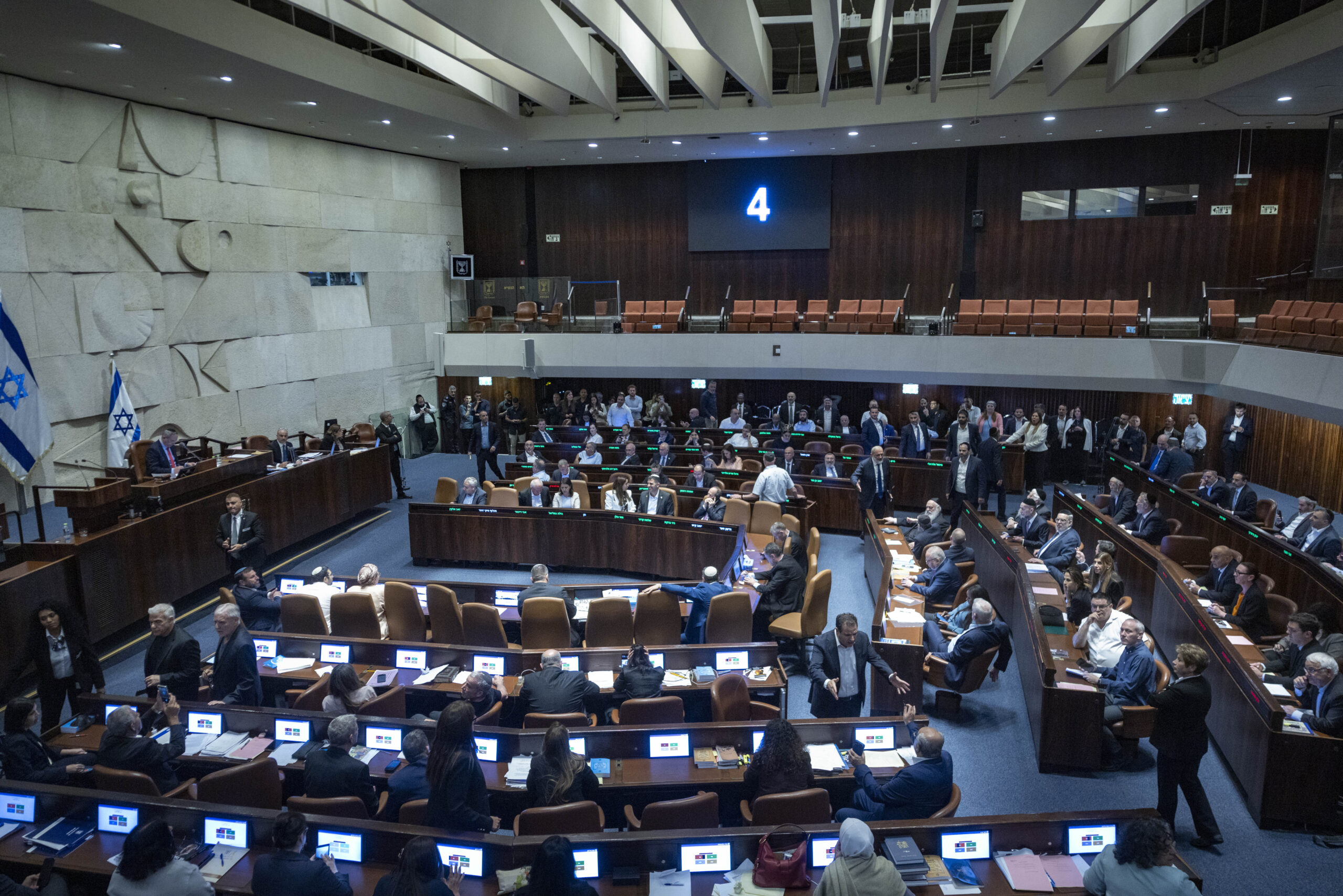
The Knesset voted 63-52 late Monday night to pass Basic Law: Torah Study, granting Torah study quasi-constitutional status as the only value explicitly enshrined in one of Israel’s twelve Basic Laws. The vote came after ten hours of speeches and opposition filibustering, and it lands the country squarely back inside a fight over military conscription that has simmered since the state’s founding in 1948.
The law states that Torah study is a foundational value in the heritage of the Jewish people and the State of Israel. Haredi coalition partners United Torah Judaism and Shas pushed it through as the centerpiece of a broader campaign to preserve blanket military exemptions for yeshiva students, a practice the High Court of Justice ruled illegal in 2024 for lacking a legal framework to sustain it.
United Torah Judaism MK Moshe Gafni, who co-sponsored the bill, called Monday “a historic step” and said the law “will serve as the state’s moral compass” by expressing recognition that Torah study “is not merely the heritage of the past, but the foundation upon which rests the present and future of the Jewish people on their land.” Shas chairman Arye Deri declared it “a historic achievement,” adding that “the holy Torah will prevail.”
Opposition leader Yair Lapid called the timing, in the Knesset’s final week before October’s election, “an utter desecration of God’s name,” telling the plenum that the coalition was “spitting in the face of IDF soldiers.” MK Chili Tropper noted that Israeli soldiers are fighting in Lebanon this week, even as the Knesset moved to shield draft evaders. Prime Minister Benjamin Netanyahu skipped the vote entirely, prompting Yashar party chairman Gadi Eisenkot to call him “a coward” in a public statement.
A day later, the Knesset passed a companion measure, the Defense Service Bill (Amendment No. 28), by a vote of 58-54, temporarily barring arrests of yeshiva students who evade the draft through November 30, 2026.

A Fight With Roots in 1948
The exemption dates to an oral agreement between David Ben-Gurion and Chazon Ish, the halachic authority Rabbi Avraham Yeshayahu Karelitz, shortly after the state’s founding. At the time, roughly 400 yeshiva students received deferrals so that a devastated Torah world, gutted by the Holocaust, could be rebuilt. The arrangement was never legislated. It functioned for decades as a quiet administrative accommodation.
The numbers grew from hundreds into the tens of thousands as Haredi society expanded. By 1998, the High Court had ruled the exemption illegal for the first time, finding that only the Knesset, not the defense minister, had authority to grant it. The Tal Law of 2002 attempted to codify a framework allowing continued deferrals; the Court struck it down in 2012 as unconstitutional. Repeated legislative attempts followed throughout the 2010s and 2020s, each one collapsing under legal challenge or coalition politics.
The stakes changed after Hamas’s massacre in southern Israel on October 7, 2023. Israel has fought on multiple fronts since, and the IDF has said it urgently needs 12,000 new recruits while roughly 130,000 reservists remain on active duty. In 2024, the Supreme Court ruled unanimously that the government had no legal basis left to continue blanket exemptions and ordered yeshiva students conscripted. Basic Law: Torah Study is a direct legislative response to that ruling, aimed at making it harder for the Court to intervene again by anchoring the exemption’s underlying rationale in the country’s constitutional order.
What the Bible Says About War
The debate raises a question the Bible itself addresses directly: Does a nation’s obligation to defend itself fall on everyone, or can a portion of the people be set apart from it?
Scripture answers plainly in the account of the tribes of Reuben and Gad, who asked Moses for land east of the Jordan River and proposed settling their families there while the rest of Israel crossed to conquer the land. Moses rebuked them sharply: “Shall your brothers go to the war, and shall ye sit here?” (Numbers 32:6). Only after Reuben and Gad committed to cross armed before their brothers and fight until the conquest was complete did Moses permit the arrangement. The text is unambiguous that shared danger demands shared service, and that no tribe may claim the land while leaving its brothers to bleed for it.
Jewish law sharpens this further in the case of a milchemet mitzvah, a war that Jewish law obligates the nation to fight, including a war of national defense. The Mishnah in Sotah 8:7 states that in such a war, all go out, “even a bridegroom from his chamber and a bride from her canopy.” Maimonides, the Rambam, codifies this in Hilchot Melachim 7:4, ruling that in an obligatory war, no one is exempt, not even a groom in his wedding week. The deferments described elsewhere in the Bible, for the fearful, the newly married, or the builder of an unfinished house, apply only to a discretionary war. They do not apply once the nation faces an existential threat. Israel’s current war, fought on multiple fronts since the Hamas massacre of October 7, 2023, falls squarely within the category the Sages defined as obligatory.
The Argument for Universal Service
Torah study is not the point of contention. It is, as even the law’s critics at the Israel Democracy Institute have acknowledged, a cornerstone of Jewish heritage worthy of support. The objection is to using that value to entrench a permanent exemption from the burden every other citizen carries.
Fairness alone argues for enlistment. A state cannot ask one population to bury its sons while exempting another population of equal size and equal citizenship from the same risk. The 80,000 Haredi men currently of draft age but unenlisted are not a marginal group; they represent a growing share of each incoming cohort, while reservists from other sectors return to active duty for months at a time, year after year.
Jewish law itself closes the gap between the study hall and the battlefield in a moment like this one. If the current conflict is a milchemet mitzvah, then the halachic sources cited above do not merely permit yeshiva students to serve. They obligate it. A groom is not exempt from an obligatory war; a Torah scholar is not exempt either. Fighting to defend the Jewish people in the land God promised them is not a betrayal of Torah study. In a war of this kind, it is Torah study’s most direct expression.
Basic Law: Torah Study may succeed in shielding the exemption from further judicial review. It cannot shield the exemption from the demand of the Bible and the Sages that in a war Israel did not choose, every son of Israel answers the call.