




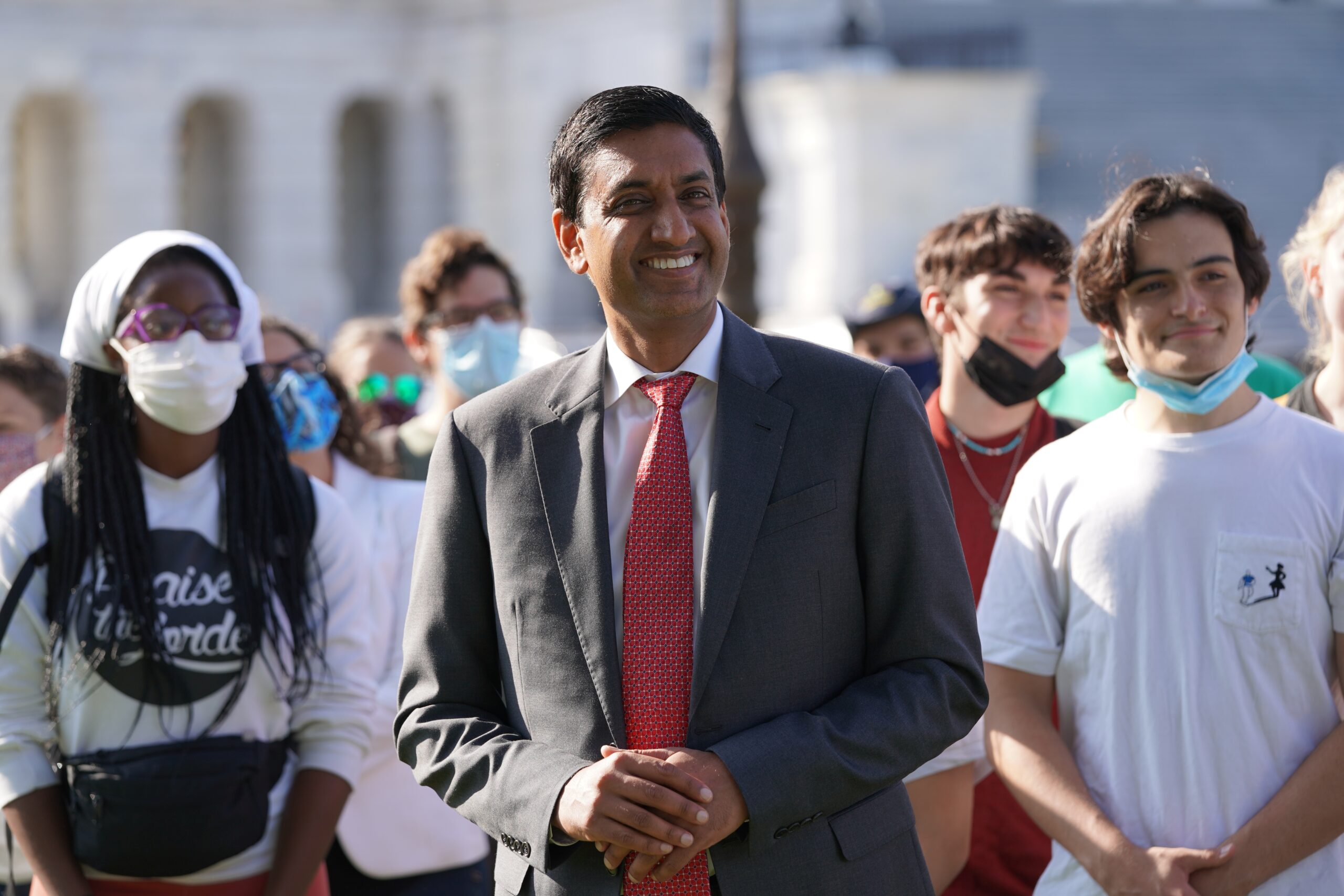
Congressman Ro Khanna came to Israel to carry out a staged confrontation intended to demonize Jewish “settlers” and curry favor with the more extreme anti-Israel and anti-Semitic elements of the Democratic Party. The stunt backfired, forcing him to delay releasing his video footage of the event because it contradicted every one of his claims of how the confrontation went down.
Khanna’s visit to Israel comes as he is vocally supporting Rep, Thomas Massie’s amendment to zero out all aid to Israel, including aid for offensive and defensive weapons like the Iron Dome.
“I cannot vote for aid to a country that committed genocide and has used tax dollars to detain Americans like me,” he posted to Twitter.
I’m voting yes on @RepThomasMassie’s
— Ro Khanna (@RoKhanna) July 14, 2026
amendment to zero out all aid to Israel, including aid for offensive and defensive weapons like the Iron Dome.
I cannot vote for aid to a country that committed genocide and has used tax dollars to detain Americans like me. pic.twitter.com/Fu1NS9Efb9
The original claim
Khanna’s account, posted to social media alongside a four-second video clip, was unambiguous. “Israeli settlers, brandishing American-made M4s, detained me and other Americans on my trip to Palestine,” he wrote. “When the IDF arrived, they sided with the settlers and continued our detention. They made a huge mistake. You will be hearing more soon.”
He escalated the account in later interviews, describing the men who stopped his convoy as young and contemptuous. “I saw the arrogance in the eyes of those settlers, 21- and 22-year-olds with guns, laughing that they had detained us,” he said, adding a broader indictment of the IDF soldiers on the scene: “The arrogance of those young IDF soldiers that my tax dollars are funding, having no respect for the fact that they were detaining Americans, no respect that there was an American congressperson in that bus, and laughing when our translator told them that there are Americans there, and the American embassy is concerned.” He summarized the episode to the New York Times as evidence of “the arrogance of power, of a power that has had no accountability, total impunity, and has created a toxic culture of oppression.”
Khanna went further still, framing the episode in explicitly racial terms. “Being in the West Bank and in Israel is the first time that I have really been acutely aware of being brown,” he said, adding that he felt local Israelis had seen him “first as brown, second as an American congressman, and third as an American citizen.” He told interviewers he had faced intimidation, racism, and disrespect because of his race.
Khanna said that touring Judea and Samaria was the first time in his life he felt “acutely aware of being brown,” the victim, he claims, of armed settlers and IDF soldiers who saw him as brown before they saw him as an American congressman. He said this about the one country in the Middle East with a substantial community of Jews who are, in fact, brown, a nation of Ethiopian, Yemenite, Iraqi, Moroccan, and Indian Jews built by people who look far more like Khanna than the European stereotype his accusation depends on.
The video that undercut him
The footage that emerged Monday, released by activists traveling with Khanna’s own delegation, showed nothing resembling an armed detention. It showed an argument between a Breaking the Silence activist accompanying the group and local security personnel, who insisted on waiting for police to arrive before resolving the dispute. A Fox News anchor interviewing Khanna expressed open astonishment that the congressman had not expected some form of stop after entering a restricted military zone without coordinating in advance with the IDF. Eitan Fischberger, an open-source intelligence investigator and former IDF sergeant, summed up the footage on X in four words: “What a glorious self-own.”
Even by Khanna’s own account, the dispute concerned whether the convoy could advance into the area, not whether the delegation was free to leave. No version of events, Israeli or American, describes soldiers or police blocking the group’s exit from the scene. Ambassador Leiter said plainly that the moment Khanna’s identity was confirmed, he was free to go. Khanna was not detained in the legal sense of the word he invoked. He was momentarily stopped from proceeding into an area believed to be a closed military zone, the kind of brief check any traveler encounters at a restricted gate, and was released once his identity was established.
Let's not lose our grip on the facts – instead of recriminations and accusations – just the facts.
— Ambassador Yechiel (Michael) Leiter (@yechielleiter) July 13, 2026
1) Congressman @RoKhanna was offered to coordinate his visit with the State of Israel – this goes beyond notifying of his presence in the country. He was offered in-depth…
The military’s account
The IDF said soldiers were dispatched to the area near Khirbet Zanuta after receiving reports that foreign nationals had entered what was believed to be a closed military zone, while, separately, Israeli civilians had blocked a nearby road. According to the military, soldiers moved the civilians away from the area, confirmed there was no security threat, and only afterward determined the location “was not, in fact, a closed military zone” before clearing the convoy to continue. “The process lasted several minutes,” the IDF said, adding firmly that “there was no physical confrontation or violence between those involved.” The military separately disclosed that one armed individual at the scene was an off-duty IDF soldier whose conduct is now under review, and acknowledged that Khanna’s visit had not been coordinated with the army in advance.
Israel Police backed the military’s account. Officers said they witnessed no violence and were informed by soldiers that the tour group had entered a designated closed military zone. Police added that body-camera footage showed the tour organizer being warned that any further violation of the military order could lead to immediate arrest, since it was reportedly not his first infraction. Participants were briefed on the order and then allowed to proceed.
Khanna’s camp pushes back
Khanna’s political team rejected both accounts outright. His office told the New York Post that armed “extremist settlers” blocked the convoy for roughly an hour, several carrying M4-style rifles, while soldiers stood by and did nothing. “The extremist settlers were laughing at us, videotaping us, kicking our tires, and the IDF soldiers watched,” his office said. The team called the military’s timeline of several minutes “demonstrably false” and insisted the U.S. Embassy had been notified of the trip in advance, alongside local police.
The ambassadors respond
Israeli Ambassador to the United States Yechiel Leiter delivered the most detailed rebuttal, posting a numbered account on X under the heading, “Let’s not lose our grip on the facts.” Leiter said Khanna had been offered in-depth coordination of his schedule specifically to avoid this kind of incident and declined it, and separately chose not to coordinate with the U.S. Embassy in Jerusalem. He noted that Khanna traveled with Palestinian activists, a representative from J Street, and New York Times journalists with cameras already in position. “The moment details of the Congressman’s identity were cleared, he was free to go,” Leiter wrote, adding that no member of the party was ever threatened by soldiers or armed civilians. He closed with sharp language: “To add insult to injury – the Congressman used this instance as an opportunity to tout ‘genocide’ and ‘apartheid’ libels to the press, propelling himself to the center of yet another anti-Israel media frenzy. The facts don’t lie – this was a cheap, anticipated provocation that could, and should have been avoided.” Leiter offered to host Khanna at the embassy to discuss his grievances directly.
U.S. Ambassador to Israel Mike Huckabee went further, accusing Khanna of outright lying about embassy coordination. “The left-wing activist who set up this stunt says ‘The embassy is involved.’ That is NOT TRUE,” Huckabee wrote. “We did NOT know a member of Congress was coming. We would have said don’t go to the restricted zone. As FACTS come out, it’s not helping the desired narrative. Not ‘held at gunpoint.'”
The left-wing activist who set up this stunt says "The embassy is involved." That is NOT TRUE. We did NOT know a member of Congress was coming. We would have said don't go to restricted zone. As FACTS come out, it's not helping the desired narrative. Not "held at gunpoint." https://t.co/FBSsbInkC8
— Ambassador Mike Huckabee (@GovMikeHuckabee) July 14, 2026
Khanna answered Huckabee directly, maintaining that “the IDF has now clarified it was not a restricted zone and Israeli papers have confirmed this,” and crediting Deputy Chief of Mission David Brownstein for helping extract the delegation. “We obviously notified our Embassy and Israel’s embassy about the trip given we were in constant touch with David,” Khanna wrote, while renewing his demand that “the violent settlers who detained us need to be prosecuted and the IDF officers who furthered that detention need to be investigated.”
The analyst who called it agitprop
Veteran Israeli journalist Haviv Rettig Gur, who has written extensively about extremist violence in Judea and Samaria in the past, said he approached Khanna’s claim expecting to believe it. He did not end up believing it. “I was ready, at first glance, to believe it happened here. But it didn’t,” Rettig Gur wrote. “This wasn’t Israeli violence. This was agitprop for your American audiences.”
Agitprop is a portmanteau of “agitation” and “propaganda.” It refers to the intentional and vigorous promulgation of political ideas—originally communist ideals in the Soviet Union—through mass media, literature, drama, music, and art. Today, the term is used more broadly to describe any highly emotional or biased cultural media designed to influence political opinion.
Rettig Gur noted that the “settlers” were members of the local civilian fast response team who had been alerted to intruders in a sensitive and restricted area. He argued the soldiers involved appeared “mostly just confused” about whether the area was still a closed military zone after a recent reopening, and pressed Khanna on the absence of any footage supporting the violence he described, despite the delegation traveling with a professional photographer and at least one bodycam. “If you produce that footage, I’ll join your demand for prosecution,” Rettig Gur wrote. “But if you don’t, I think it’s safe to assume you blew up a small inconvenience.” He also challenged Khanna’s use of the word “detained,” noting the gap between its meaning on “the spectrum of kidnapping crimes” and the far milder meaning of being briefly delayed.
Alas, Mr. Congressman, I'm not lying. And I started this line of questioning assuming you were telling the truth. I've written long essays on extremist Israeli violence in the West Bank. I know it happens. I was ready, at first glance, to believe it happened here. But it didn't.… https://t.co/R52qY5SJO3
— Haviv Rettig Gur (@havivrettiggur) July 13, 2026
“It’s a shame to have a congressman invent out of whole cloth an event that. . . simply doesn’t represent what happened.”@HavivRettigGur disputes Ro Khanna’s account of his West Bank encounter, arguing that all available evidence tells a very different story. pic.twitter.com/xbzC1bjaLR
— The Free Press (@TheFP) July 13, 2026
The site itself tells its own story
The Israeli NGO Regavim added a layer largely absent from Khanna’s account: the history of Khirbet Zanuta itself, the location where the incident occurred. Regavim said that while the site is routinely presented abroad as an ancient Palestinian village emptied by settler violence, it has documented Khirbet Zanuta instead as an illegal outpost built on a protected archaeological site in the South Hebron Hills, one containing Jewish remains more than 2,500 years old alongside Hellenistic, Roman, Byzantine, and Ottoman-era artifacts. The site was declared archaeological during the British Mandate. An EU-funded school built illegally on the site was demolished by Israel’s Civil Administration and illegally rebuilt, according to Regavim, and became a central prop in the narrative Khanna later repeated. Regavim said residents left the outpost after October 7, 2023, when heightened IDF security measures restricted movement in the area, returning to their homes in Dahariya inside Palestinian Authority-controlled territory, and that claims of “settler violence” driving them out surfaced only weeks afterward.
A Zionist congressman’s leftward turn
The episode did not occur in a vacuum. Khanna spent years building a public record as a supporter of Israel and, by his own repeated description, of Zionism itself. In the weeks after the Hamas-led October 7, 2023 massacre, Khanna voted for a string of pro-Israel House resolutions, including one on October 25 reaffirming Israel’s right to self-defense, and signed a resolution the following week condemning antisemitism and campus support for Hamas and Hezbollah. He voted to fund Israel’s Iron Dome missile defense system in 2021 and for years accepted campaign contributions from the liberal Zionist group J Street.
That record has reversed almost entirely over the past two years. Khanna voted against the $14 billion Israel Security Supplemental Appropriations Act in April 2024, calling it a “blank check” to Netanyahu. In September 2025, he endorsed the Block the Bombs Act, aimed at halting the transfer of offensive munitions used against Hamas. In April 2026, alongside Rep. Alexandria Ocasio-Cortez and J Street, he announced opposition to US financial support for the Iron Dome, the same purely defensive system he had voted to fund five years earlier. In June 2026 he became the first member of Congress to sign a pledge, promoted by the group Track AIPAC, committing to reject all pro-Israel lobbying money and to recognize what the pledge calls a genocide in Gaza. Khanna has used that word himself, telling reporters he agrees with findings describing Israel’s conduct in Gaza as genocide, and he led an unsuccessful push to have President Trump recognize Palestinian statehood at the United Nations.
Khanna maintains he still supports “Israel’s right to exist” and the “principles of Zionism,” telling one Jewish outlet that modern antisemitism means “denying the idea of a Jewish state.” But his voting record and his public alliances tell a different story than his self-description. He has appeared at a Dearborn conference alongside speakers who defended Hamas as legitimate resistance and laughed at the suggestion that October 7 deserved condemnation. He shared, then disavowed, a video from an antisemitic influencer who has blamed Israel for the September 11 attacks. His reversal has tracked closely with a broader shift inside the Democratic Party, where a rising bloc of democratic socialist and progressive lawmakers has made hostility to Israel, and to AIPAC specifically, a defining litmus test, and where distance from the pro-Israel lobby functions as a badge of progressive credibility rather than a political liability. Khanna, weighing a potential presidential run, has positioned himself at the leading edge of that shift rather than resisting it. His Judea and Samaria tour, and the accusation he built around it, is the latest expression of a currently fashionable cause inside his party rather than a break from character.
A claim of race that does not hold up
Khanna’s account of being seen as “brown” before being seen as a congressman or an American citizen invites a factual check the congressman did not offer himself. Israel’s Jewish population is not the uniform group the framing implies. Roughly half of Israeli Jews trace their family lines to the Middle East and North Africa rather than Europe, alongside established Ethiopian and Indian Jewish communities that have lived in the country for generations. Israel is also home to a growing Hindu population, drawn mostly from the same Indian states Khanna’s own family background traces to, alongside an Indian Jewish community numbering roughly 85,000. The area Khanna toured under Palestinian Authority administration has no comparable Hindu presence at all. If skin color and religious background were truly the operative factor in how Khanna was received, the demographic reality of the region he visited cuts against his own account rather than supporting it. Breitbart editor-at-large Joel Pollak made a similar case on Fox Business, telling anchor Stuart Varney that Khanna’s claim of a racist detention did not hold up given the diversity of Israeli society and its security forces, and argued the episode looked less like an account of genuine mistreatment than a manufactured moment aimed at building Khanna’s profile ahead of a potential 2028 Democratic presidential run.
The bigger picture
Khanna’s Judea and Samaria tour arrived amid a rockier political period at home. The congressman has faced backlash over his endorsement of a Maine Senate candidate who dropped out of the race after being accused of rape, and he has been criticized for declining an invitation to meet Israeli hostages and survivors of the Hamas October 7, 2023 massacre while touring the region instead with J Street and Palestinian activist groups. He has separately accused Israel of committing genocide, a charge Israeli officials reject entirely.
By the account of every party involved, including Khanna’s own, no physical violence took place. The dispute concerns whether Khanna’s language and the political theater built around it matched what actually happened on that road. The video his own team released answers that question. The Bible’s law of false witnesses answers what should happen next: a man who accuses others of a crime his own evidence cannot support does not get to walk away from that accusation unaccountable.
