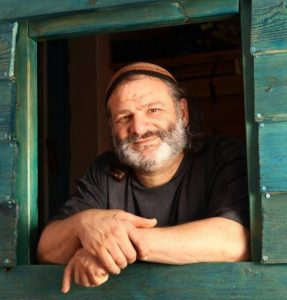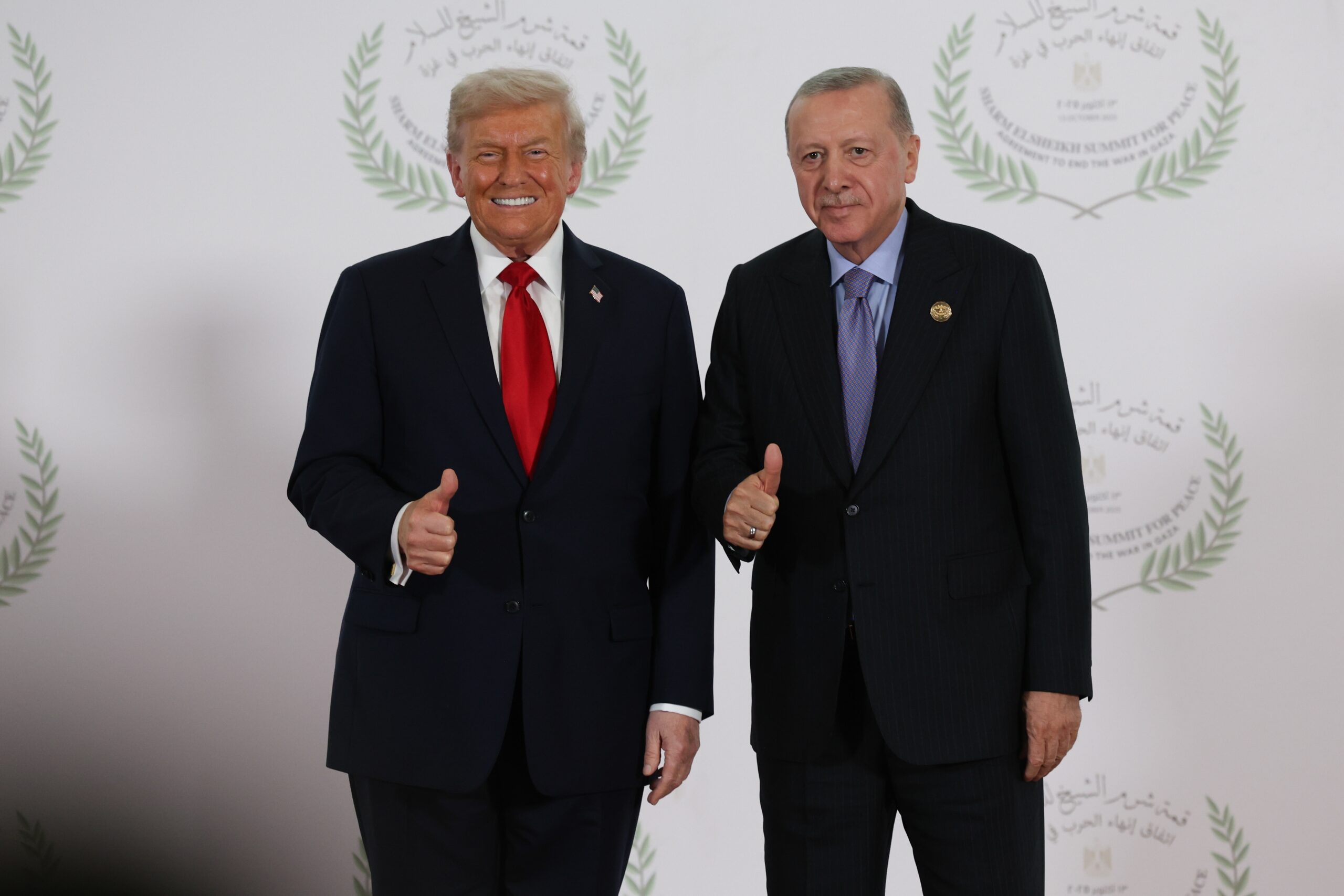
Turkey is positioning itself as the most consequential military threat facing Israel in the north, and this week’s NATO summit in Ankara has put that threat on full display. President Recep Tayyip Erdogan is pressing President Trump to readmit Turkey to the F-35 stealth fighter program, while Turkish-backed forces expand their footprint inside a fractured Syria, threaten the Kurdish population that has fought alongside the United States for a decade, and as Ankara continues to host and protect leaders of Hamas. As the diplomatic maneuvering unfolds in Ankara, the Sanhedrin, the reconstituted rabbinical court that traces its authority to the ancient Jewish high court, has issued its own pronouncement on the matter, invoking a biblical promise that nations that curse the people of Israel will themselves be cursed.
Turkey was removed from the F-35 program in 2019 after it purchased Russia’s S-400 air defense system, a system built specifically to detect and shoot down US aircraft like the F-35. American officials determined that operating the S-400 alongside the F-35 would allow Russian technicians to study the jet’s radar signature and stealth profile, handing Moscow a blueprint for defeating the very aircraft Turkey wanted to fly. Washington canceled the sale rather than risk exposing its most advanced fighter to a system designed to kill it. The dispute has never fully gone away. Trump’s move to lift CAATSA sanctions on Turkey changes the political atmosphere but not the underlying law: Congress still bars the transfer of F-35s to any country operating the Russian S-400, and Turkey has not disposed of the system.
Prime Minister Benjamin Netanyahu has renewed the argument in recent days, telling Fox News that supplying Turkey with F-35s or advanced fighter engines would upset the regional balance of power and threaten Israel’s air superiority. Netanyahu described Erdogan as a leader who has called for Israel’s annihilation, occupies part of Cyprus, threatens Greece, and backs Hamas. “The balance of power in the Middle East is ultimately protected by Israel’s air superiority and America’s posture in the region,” Netanyahu said. Foreign Minister Gideon Sa’ar confirmed that Israel has objected directly to Washington. “We made clear that we oppose supplying F-35s to Turkey,” Sa’ar said. “The prime minister himself said this to Trump. It is critical that Israel, in the region where we live, preserve its qualitative military edge.” That doctrine, known as Israel’s qualitative military edge or QME, is written into American law and requires Washington to ensure Israel maintains a technological and tactical advantage over every other military in the region. The law does not extend the same guarantee to a Turkish deal specifically, meaning Israel may not be entitled to automatic compensation if Turkey receives the aircraft, unlike deals involving Saudi Arabia or Egypt.
Turkey’s military expansion into Syria has accelerated sharply since the fall of Bashar Assad’s regime in December 2024. With Assad gone and Syria’s central authority shattered, Ankara has moved to fill the vacuum, pushing air defense systems and garrisons toward Palmyra and the T-4 air base in central Syria. Those positions sit close enough to threaten Israeli aircraft operating over southern Syria, where Israel has struck repeatedly to prevent Iranian-linked weapons transfers to Hezbollah and to keep advanced weapons systems out of the hands of Syria’s new rulers. Israeli officials have warned that if Turkey continues to expand its bases and military presence in Syria, Israel will consider taking equivalent measures on its own side of the border. Turkish drones have already tested Israeli air defenses in the area, and Israeli jets have struck Turkish-linked positions to slow the buildup before it solidifies.
Turkey’s expansion into Syria carries a second casualty beyond Israel’s security calculus: the Kurds. The Kurdish-led Syrian Democratic Forces fought and defeated the Islamic State in Syria over years of ground combat, doing so as the primary American partner on the ground and at a high cost in Kurdish lives. Ankara views the Kurdish forces controlling northeastern Syria as an extension of the Kurdistan Workers’ Party, a group that Turkey, the United States, and the European Union all designate as a terrorist organization, and has treated Kurdish self-governance in Syria as a threat to be dismantled rather than a partner to be preserved. Turkish-backed Syrian National Army factions have already carried out campaigns against Kurdish civilians in Afrin and Ras al-Ain, executing local Kurdish officials, looting Kurdish property, and driving Afrin’s Kurdish population down from roughly 97 percent to 35 percent through displacement and resettlement of Arab and Turkmen populations in their place. With Assad gone, Ankara now has a freer hand to pressure the Kurdish-controlled northeast further, placing a stateless people with genuine nationalist aspirations and a real record of fighting alongside the United States directly in the path of Turkish expansion.
Turkey has also become a safe harbor for Hamas leadership. Ankara has hosted Hamas delegations, permitted members of the terrorist organization to operate from Turkish soil, and reportedly issued Turkish passports to Hamas operatives, allowing men wanted for orchestrating terror attacks against Israeli civilians to travel under Turkish diplomatic cover. Turkey has stopped short of severing diplomatic relations with Israel entirely, but it suspended direct trade and imposed a full economic embargo earlier this year, even as it continues to shelter the same organization responsible for the October 7 massacre.
All of this places Turkey in an unusual category among America’s allies. It has the second-largest military in NATO after the United States, a growing domestic defense industry, and a strategic position bridging Europe, the Black Sea, and the Middle East. This is precisely why Washington has long valued the alliance despite its complications, and why no NATO summit was held on Turkish soil for 22 years before this one. Turkey is a NATO member whose president has called Israel a “terrorist state,” compared Netanyahu to Hitler and Stalin, and prayed publicly for the destruction of the Jewish state. Ankara has vetoed nearly every NATO-Israel exercise, meeting, and intelligence exchange since late 2023, using its position inside the alliance to isolate a fellow American partner. No other NATO government has used its membership in the alliance to shelter a designated terrorist organization while simultaneously lobbying Washington for its most sensitive military technology.
Turkish President Erdogan:
— Clash Report (@clashreport) June 27, 2026
The genocidal, occupying, expansionist ideology called Zionism threatens not only me, not only our party, not only our alliance—it threatens everyone.
When we struggle against Zionism, we are not waging this struggle for ourselves or for personal… pic.twitter.com/vC3leJP3Vo
The current tension is only the latest chapter in the Israel-Turkey relationship that has swung between quiet cooperation and open hostility for decades. For much of that history, Israel was not Turkey’s adversary but its benefactor. Turkey, under Mustafa Kemal Ataturk’s secular republic, was the first Muslim-majority nation to recognize the State of Israel in 1949. Through the 1990s, the two countries built one of the closest military partnerships in the region. Israeli defense firms modernized aging Turkish military hardware, most notably overhauling and upgrading Turkey’s fleet of F-4 Phantom fighter jets and helping extend the life of Turkey’s air force at a time when Ankara had limited access to Western upgrades. Israeli and Turkish air forces trained together, intelligence services cooperated closely against shared threats, and the two militaries signed formal defense cooperation agreements. That cooperation began eroding after Erdogan and his Justice and Development Party rose to power in 2002, and it collapsed in May 2010, when Israeli commandos boarded the Mavi Marmara, a Turkish vessel attempting to breach the Gaza blockade as part of a flotilla organized by a Turkish Islamist charity with ties to Erdogan’s political base. Ten Turkish nationals were killed in the confrontation, and the incident triggered a diplomatic rupture that took years and a formal Israeli apology, issued in 2013, to partially repair. Relations were briefly normalized again in 2016, with ambassadors restored, but they frayed once more over repeated Gaza flare-ups in the years that followed and have deteriorated sharply, and this time durably, since October 7, 2023.
Erdogan’s ambitions extend well beyond any single dispute over fighter jets. He has repeatedly cast himself as a defender of the Muslim world and has spoken in terms that evoke the Ottoman Empire, which ruled Jerusalem and the wider Middle East for four centuries until its collapse after the First World War. Turkish officials under Erdogan have cultivated ties with the Muslim Brotherhood across the region, positioned Turkey as a rival to Saudi Arabia and Iran for leadership of the Islamic world, and framed Jerusalem, not merely Gaza, as a matter of direct concern to Ankara. Erdogan has said Turkey could act militarily against Israel the way it acted in Libya and Nagorno-Karabakh, and he has told Turkish audiences that a Jerusalem under full Israeli sovereignty is unacceptable. The pattern is consistent with a leader who sees himself not simply as a regional power broker but as a modern-day claimant to the mantle of the Caliphate, with Jerusalem as its ultimate prize.
It is against this backdrop that the Sanhedrin issued a formal ruling last week, addressing the nations of the world, and specifically Turkey. The ruling, dated the 21st of Tammuz, 5786, opens by describing a global sorting taking place before what the court calls the revelation of God’s kingship and the Third World War foreseen by the Chofetz Chaim, of blessed memory, a sorting between nations that align themselves with the God of Israel and the Jewish people, and those that stand against them. The court noted that nearly all the nations of South America, many of them home to large populations of anusim, descendants of Jews forced to convert during the Spanish and Portuguese Inquisitions, have shifted from hostility toward Israel to open friendship in recent years.
The Sanhedrin’s ruling rests on a specific biblical promise, one the court cites directly: “I will bless those who bless you, and the one who curses you I will curse, and all the families of the earth shall be blessed through you” (Genesis 12:3). This is God’s covenant with Abraham, and the court states plainly that the covenant has never been broken or suspended. A second verse follows the same theme: “Cursed be those who curse you, and blessed be those who bless you” (Genesis 27:29), Isaac’s blessing to Jacob.
The full ruling, issued by the Sanhedrin’s sitting court, reads as follows:
“The Holy One, Blessed be He, revealed Himself to the entire world at the standing at Mount Sinai, and the people of Israel were present at that moment. Now, before the revelation of God and His kingship, and before the Third World War as foreseen by the Chofetz Chaim, of blessed memory, a sorting is taking place throughout the world: who stands for the Holy One, Blessed be He, and for His chosen people, and who stands against God and against the people of Israel.
“We give thanks to the Creator of the world that nearly all the nations of South America, which contain many descendants of anusim, have chosen to switch sides, from the progressive camp to the nations declaring a warm and good relationship with the people of Israel.
“The Holy One, Blessed be He, made a covenant with the people of Israel. That covenant has never been broken or suspended. Part of God’s covenant with the people of Israel is: ‘I will bless those who bless you, and the one who curses you I will curse, and all the families of the earth shall be blessed through you’ (Genesis 12:3). And likewise: ‘Cursed be those who curse you, and blessed be those who bless you’ (Genesis 27:29).
“As we can see, all of reality operates according to the plan of God. Whoever fights against the people of Israel pays a heavy price, is humiliated, and loses. Conversely, whoever blesses the people of Israel rises higher and higher.
“The court addresses the Turkish people and states: if the Turkish people are led by their leader, who states explicitly that he wants to destroy the State of Israel, then unfortunately the Turkish people will pay a very heavy price.
“The court addresses all inhabitants of the world and all nations and states: whoever wishes to be blessed by the Holy One, Blessed be He, must bless and praise the people of Israel. And whoever wishes to do the opposite is granted the freedom to do so, only let him not be surprised when he becomes cursed in the eyes of the Holy One, Blessed be He, and his entire world collapses.
“The court blesses all who serve the Holy One, Blessed be He, in the manner that God commanded the whole world at the standing at Mount Sinai. And we are confident and certain that God will repay each person or nation with the good that He wishes to give.
“All inhabitants of the world can serve the Holy One, Blessed be He, by fulfilling the seven Noahide commandments. In doing so, they receive a portion of a soul, a share in the World to Come, and are called Chasidei Umot HaOlam, Righteous Among the Nations.
“‘Behold, a people that dwells alone, and is not reckoned among the nations’ (Numbers 23:9). ‘The LORD alone guided him, and there was no foreign god with Him’ (Deuteronomy 32:12).
“And with this, we sign below.
“With the blessing of the complete redemption, in mercy and in joy, at the revealed and mighty kingship of God.
“Secretariat of the Sanhedrin”
The Sages have long taught that Genesis 12:3 is an operating law of history, one that shapes the fate of nations and empires. Pharaoh’s Egypt enslaved the Jewish people and was struck by ten plagues before its army drowned in the sea. The Assyrian and Babylonian empires that exiled Israel were themselves erased from the map within a few generations. Haman’s plot in Persia ended with Haman on his own gallows. Rome, which destroyed the Second Temple and drove the Jewish people into a two-thousand-year exile, no longer exists as an empire, its glory reduced to ruins that tourists photograph. Spain expelled its Jews in 1492 at the height of its power and entered a long decline from which it never recovered its former stature. Nazi Germany, which sought Israel’s annihilation more completely than any regime in history, was reduced to rubble within twelve years of taking power. The pattern the Sages point to is not a coincidence repeated occasionally. It is a law that has held without exception.
The Sanhedrin’s ruling applies that law directly to the current moment. It states that Turkey will pay a heavy price if the Turkish people allow themselves to be led by a leader who explicitly says he wants to destroy the State of Israel. The court’s language does not hedge: nations that curse Israel become cursed, and their worlds collapse. At the same time, the ruling extends an open invitation, teaching that any nation or individual can secure the same blessing given to Abraham by observing the seven Noahide commandments, the universal moral code the Bible sets for all humanity, and thereby be counted among the Chasidei Umot HaOlam, the Righteous Among the Nations, earning a portion in the World to Come.
The ruling closes with two verses describing Israel’s singular position among the nations: “Behold, a people that dwells alone, and is not reckoned among the nations” (Numbers 23:9), and “The LORD alone guided him, and there was no foreign god with Him” (Deuteronomy 32:12), both drawn from Balaam’s blessing and Moses’ final song, two texts in which enemies of Israel were forced, against their own intentions, to acknowledge that Israel stands under direct divine protection.
The pattern has surfaced within Turkey’s own parliament. In December 2023, Turkish lawmaker Hasan Bitmez of the Islamist Felicity Party delivered a floor speech in the Grand National Assembly attacking his own government for maintaining trade with Israel and declaring that Israel would “not be able to escape the wrath of Allah.” Moments after finishing the line and saying “I salute you all,” Bitmez collapsed at the podium in front of the full assembly and a live broadcast camera, suffering a heart attack. He died in an Ankara hospital two days later. Turkish and international media covered the moment as a medical tragedy, and there is no way to establish cause beyond the heart attack his doctors documented. But for a Sanhedrin working from the promise of Genesis 12:3, a Turkish parliamentarian collapsing at the exact instant he finished cursing Israel, on camera, in the chamber of the very government now negotiating for F-35s, is not the kind of detail a nation weighing its next move toward Israel should dismiss as coincidence.
Turkey’s leadership has a choice that history has already tested many times, and every empire that made the wrong one is gone. Egypt fell. Babylon fell. Rome fell. Spain declined. Germany was leveled. Israel remains, three thousand three hundred years after Abraham first received the blessing that the Sanhedrin invoked this week against a NATO member threatening the Jewish state. The F-35 dispute will be resolved in the halls of the Pentagon and the White House. The older dispute, the one the Sages say determines the fate of nations, is already being adjudicated somewhere else entirely.