


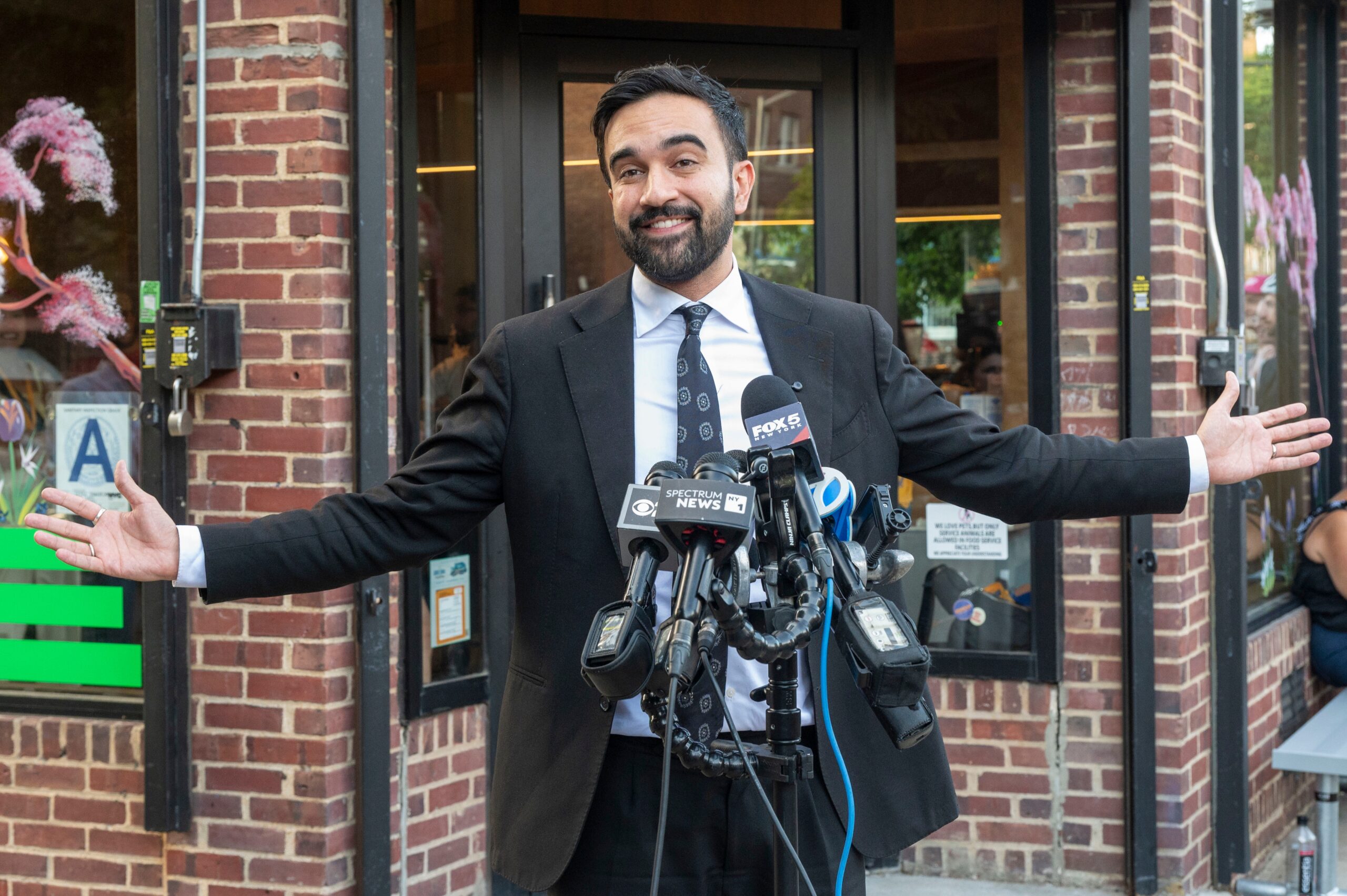
A new national survey has found that American Jews view New York City Mayor Zohran Mamdani, an outspoken critic of Israel who has refused to condemn calls for “intifada” and marked Nakba Day from City Hall, more favorably than Israeli Prime Minister Benjamin Netanyahu.
The Associated Press-NORC Center for Public Affairs Research poll, conducted June 11-17 among 1,022 Jewish adults as part of a broader 3,040-person national sample, found that 44 percent of Jewish respondents hold a favorable view of Mamdani, against 39 percent unfavorable, a net positive rating of five points. Netanyahu fared far worse: only 32 percent of Jewish adults view him favorably, while 59 percent view him unfavorably, a net negative of 27 points. Among those with strong opinions, the gap widens further. 21 percent of Jewish respondents view Mamdani very favorably, compared with just 11 percent who say the same of Netanyahu.
The poll measured the two men separately rather than asking respondents to choose between them, meaning the results reflect independent favorability ratings rather than a direct head-to-head preference.
A mayor who has built his career opposing Israel
Mamdani’s rating comes despite, or as critics argue, partly because of, a record of statements and actions that pro-Israel organizations describe as hostile to the Jewish state and corrosive to Jewish safety in his own city.
Mamdani has repeatedly refused to condemn the phrase “globalize the intifada,” a slogan tied to two Palestinian uprisings that killed more than a thousand Israelis, many in suicide bombings, and one widely understood by Jewish groups as a call to violence. Pressed on NBC’s Meet the Press during his 2025 campaign, Mamdani said only that policing language was not a mayor’s role. Anti-Defamation League CEO Jonathan Greenblatt called the phrase an explicit call for violence that celebrates and glorifies savagery and terror. Facing mounting pressure from Jewish leaders and business figures, including Pfizer chairman Albert Bourla, Mamdani eventually said he would discourage use of the term, though he has never condemned it outright.
In May, as mayor, Mamdani published an official city video and statement marking Nakba Day, becoming the first New York mayor to do so. The video, produced by his own office, framed Israel’s founding as “the expulsion of more than 700,000 Palestinians between 1947 and 1949” and declared that “the Nakba continues to this day,” language that omits the Arab invasion aimed at destroying the newborn Jewish state and the roughly 800,000 Jews subsequently expelled from Arab countries. The UJA-Federation of New York noted pointedly that Mamdani posted the video at 5:40 p.m. Friday, as Jewish New Yorkers prepared to light Shabbat candles, and thus wouldn’t be able to respond. Assemblymember Simcha Eisenstein called it government-sponsored incitement, and Assemblymember Sam Berger said the mayor was rewriting history to portray Israel’s existence itself as the original sin.
Today marks Nakba Day, an annual day of remembrance to commemorate the expulsion of more than 700,000 Palestinians between 1947 and 1949 during the creation of the State of Israel and the year that followed.
— Mayor Zohran Kwame Mamdani (@NYCMayor) May 15, 2026
Inea is a New Yorker and a Nakba survivor. She shared her story with us… pic.twitter.com/z2PBOaJq5Z
Mamdani has declined to attend the annual Israel Day on Fifth Avenue parade, breaking with decades of mayoral tradition, saying his absence reflects opposition to Israeli government policy in Gaza. He has accused Israel of committing genocide, opposed city investment in Israel Bonds, and rejected recognizing Israel specifically as a Jewish state, arguing instead that governments should guarantee equal rights regardless of religion or ethnicity.
The arrest pledge
Mamdani’s most provocative commitment involves Netanyahu directly. Since December 2024, he has repeatedly said that if Netanyahu visited New York, he would seek to honor the International Criminal Court’s November 2024 arrest warrant against the prime minister, which accuses him of the war crimes of starvation as a method of warfare and crimes against humanity, including murder and persecution. “That means upholding the warrants from the International Criminal Court, whether they’re for Benjamin Netanyahu or Vladimir Putin,” Mamdani said after his election.
The pledge unrealistic. The United States is not a signatory to the Rome Statute, the treaty establishing the ICC, and the federal government does not recognize the court’s jurisdiction. Constitutional law vests primary authority over foreign affairs in the federal government, and the Trump administration has already sanctioned ICC officials over the Netanyahu warrant. A mayor does not personally execute arrests; any order would run through the NYPD’s legal chain, which would have to weigh a direct conflict between city action and federal supremacy over foreign policy, a conflict legal analysts say the city would almost certainly lose. Netanyahu himself dismissed the threat, telling reporters in December 2025 that he still planned to visit New York and that Trump, whom he called his “big brother,” would accompany him.
Jewish groups sound the alarm
The pattern has drawn sustained criticism from Jewish communal organizations even as Mamdani insists he is committed to Jewish safety. Mark Treyger, head of the Jewish Community Relations Council of New York, said referencing the Nakba without acknowledging the UN partition plan that Jews accepted does nothing to advance understanding. NYPD data shows Jews were targeted in 60 percent of all hate crimes in New York City in the first four months of 2026, a higher rate than every other group in the city combined. Critics argue that a mayor amplifying one-sided narratives about Israel’s founding, while declining to condemn a slogan tied to deadly violence against Jews, sends exactly the wrong signal in a city already facing a surge in antisemitic incidents.
Why Netanyahu, not Mamdani, is the one Jews reject
The poll data suggests the divide has less to do with rejecting Israel than with rejecting Netanyahu personally, and with the partisan lens through which American Jews view both men. 58 percent of Jewish respondents said Israel is an extremely or very important personal issue, and 73 percent called Israel’s immediate military response to October 7 justified. But the sample leans heavily Democratic, with 59 percent identifying as or leaning Democrat and 27 percent Republican. Netanyahu has spent the past year closely aligned with President Trump, who is himself deeply unpopular among Jewish respondents: only 29 percent view him favorably and 70 percent unfavorably.
That combination of numbers points to a real possibility that Netanyahu’s low rating is driven substantially by his association with Trump and the Republican Party rather than by a broad Jewish turn against Israel itself. Jewish support for Israel’s underlying legitimacy remains strong across the same poll, with only 30 percent calling Israel’s conduct in Gaza genocide and 49 percent rejecting that charge outright. What appears to have collapsed is confidence in one man, at a moment when he is closely tied to a president most American Jews already dislike, while a New York mayor with an actively anti-Israel record benefits from being read through a different partisan lens entirely. The poll cannot isolate cause from correlation, but the pattern in the numbers is difficult to ignore.
