

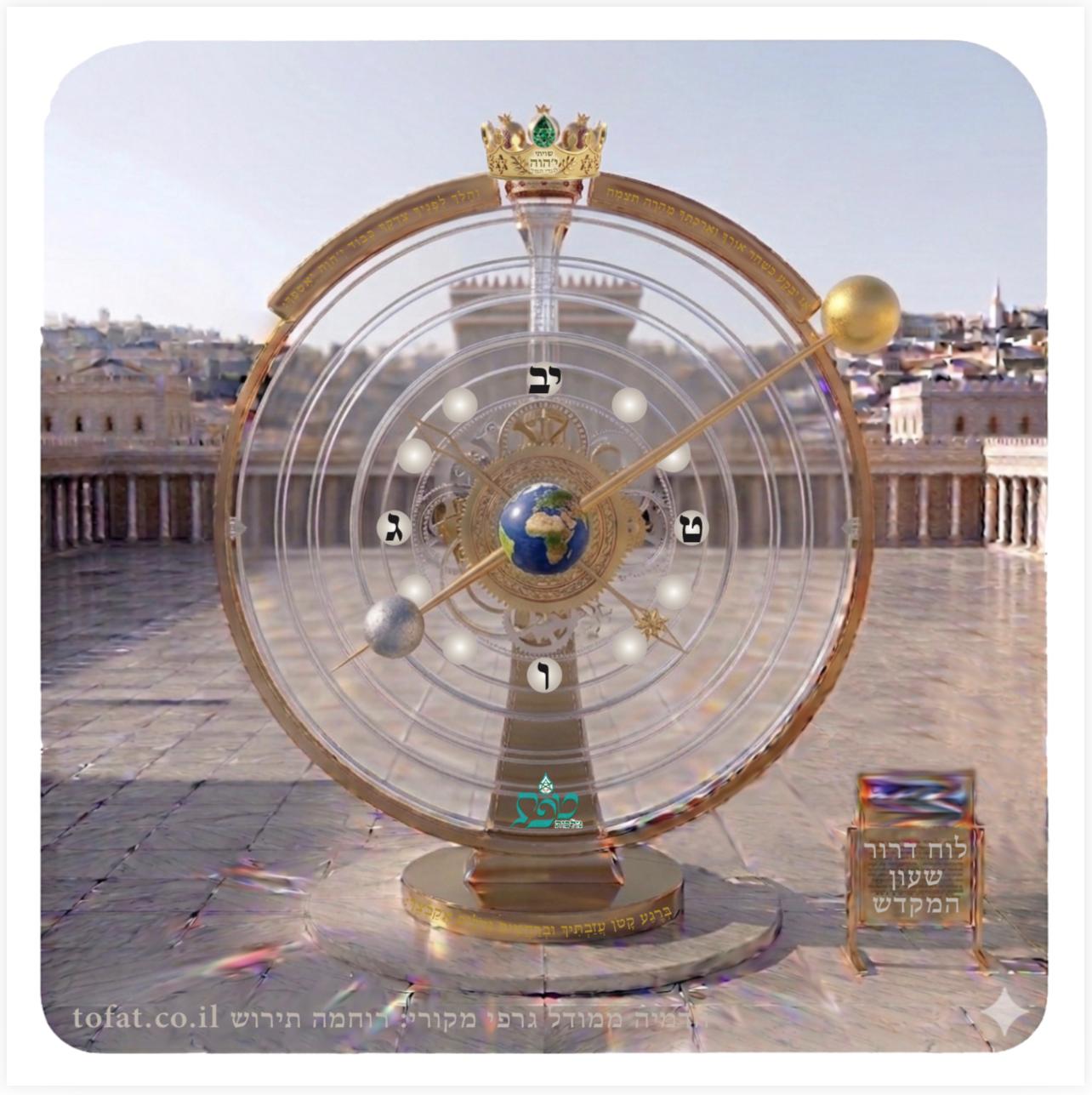
At first glance, it looks like a striking piece of Judaica art, the kind of intricate mandala a student might submit for a final project at Israel’s Bezalel Academy of Art and Design, destined to be framed behind glass or etched onto a pomegranate-shaped ornament. Behind the design of “Dror,” the Temple Clock-Calendar sits an ancient and largely forgotten body of knowledge that some scholars now believe traces directly back to the priests of the First Temple.
The piece is the work of Ruchama Tirosh, an artist who has spent decades producing complex Hebrew calendars, each one built from thousands of individual data points arranged with precision into a single unified image. Tirosh calls each of these creations a “book.” Since the Hebrew year 5783 (2022), she has produced a series of them, including a Luach Sapir (“Sapphire Calendar”) tracing the counting of the Omer in the shape of the seven branches of the Temple menorah, and a calendar-clock of the Hebrew year in the shape of the Star of David. Her latest creation may be her most ambitious: a functioning clock that keeps three calendars simultaneously, each tied to a different tier of biblical Israel, drawing on three decades of study of Jewish sacred texts and on knowledge passed down from her grandfather.
Why would anyone need three separate calendars running on the face of a single clock? The Bible itself answers that question, because Israel’s calendar was never meant to track one rhythm alone. Tirosh describes the three circles as three partners — Levites, priests, and the people of Israel — each entrusted with guarding the order of life established at creation, so that every person can give thanks and praise to the Creator for each day. In her account, a day on this calendar does not simply end after twelve or twenty-four hours. It continues in an unbroken, spiraling rotation.
Dror, a Hebrew word meaning “liberty” or “release,” and, in Tirosh’s reading, also connected to dirah, “dwelling,” is drawn from the law of the Jubilee year. The name comes straight from Leviticus: “And ye shall hallow the fiftieth year, and proclaim liberty throughout the land unto all the inhabitants thereof; it shall be a jubilee unto you; and ye shall return every man unto his possession, and ye shall return every man unto his family” (Leviticus 25:10). The Hebrew for “proclaim liberty” is ukratem dror, the same dror now stamped on the face of Tirosh’s clock. In Jewish law, the Jubilee carries a second command tied to this word: a man who killed unintentionally and fled to a city of refuge is released in the fiftieth year, returned from exile to his own dwelling, his dror. Tirosh says she revived the word from that same legal tradition for the name of her clock.
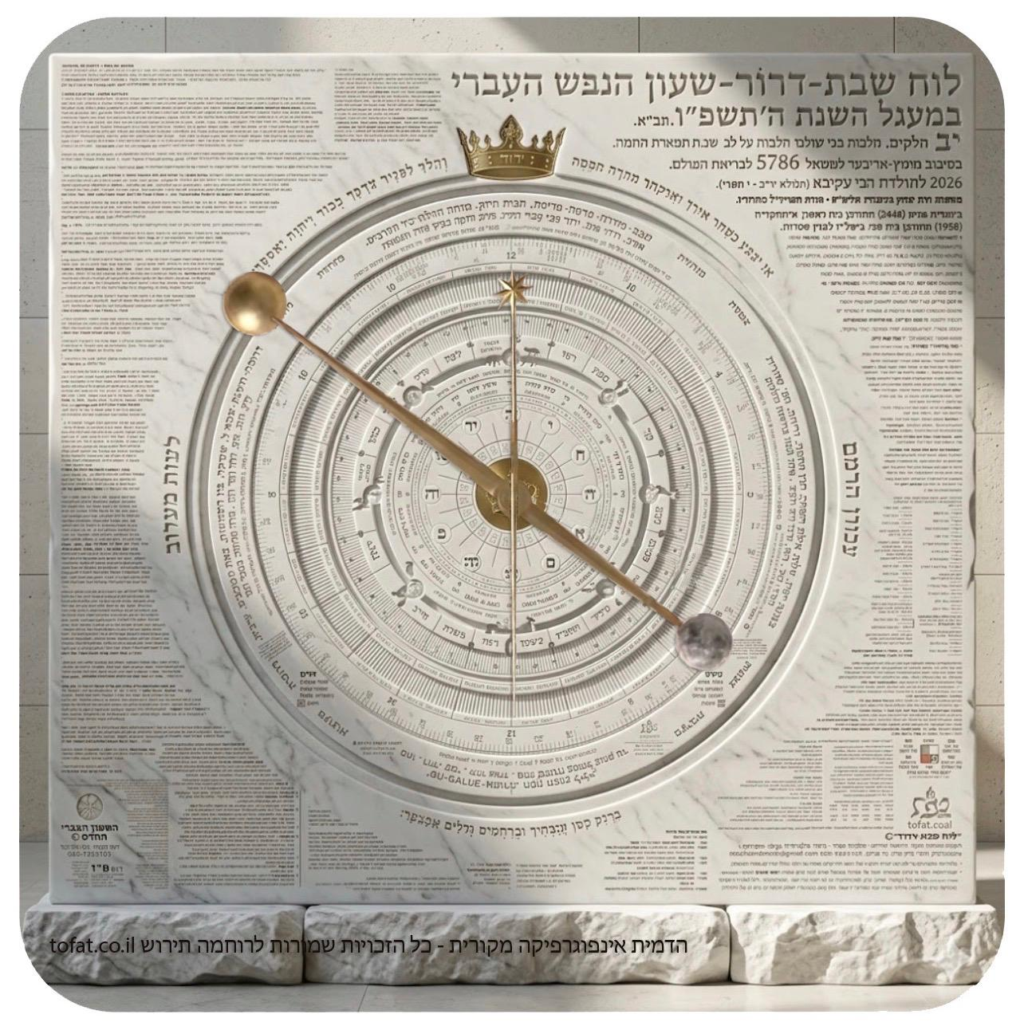
Dror layers together a lunar calendar of 354 days for the Levites, whose hand points to the Sabbath and the weekly Bible portion; a solar calendar of 364 days for the priests, whose hand points to the mishmarot kehunah, the twenty-four priestly divisions; and a third calendar of 360 days called Derech Kochav MiYaakov, “the Path of a Star from Jacob,” a reference to Balaam’s prophecy in the book of Numbers, representing the nation of Israel as a whole. That third hand marks the date itself and the shifting relationship between the other two calendars. Tirosh divides the clock face into twelve sections, corresponding to the points of the Star of David, representing the twelve tribal princes of Israel working alongside the priests and Levites.
The 364-day priestly calendar is where the piece intersects with a genuinely explosive area of biblical scholarship. Hebrew University professor Rachel Elior has argued for years that the Qumran sect responsible for the Dead Sea Scrolls was not a marginal fringe group but Bnei Tzadok, sons of Zadok the priest, First Temple priests who fled to the Judean desert and preserved calendrical traditions and writings from the Temple’s own library. Among the documents connected to that community is an ancient solar calendar built on a 364-day year, structured around the rotation of the twenty-four priestly courses first listed in the book of Chronicles: “Now these are the divisions of the sons of Aaron. The sons of Aaron: Nadab, and Abihu, Eleazar, and Ithamar” (1 Chronicles 24:1).
Tirosh traces the calendar back further still. She says the priestly reckoning was originally inscribed on calfskin scrolls and sealed in clay jars during the First Temple period, in the era of the prophet Samuel and King David, who purchased the threshing floor at the future Temple site from Aravnah the Jebusite: “So David bought the threshingfloor and the oxen for fifty shekels of silver” (2 Samuel 24:24). She connects the materials gathered for the building itself to Israel’s twelve tribal leaders, citing the verse, “So David gave to Ornan for the place six hundred shekels of gold by weight” (1 Chronicles 21:25), and to a tradition that every Israelite contributed two shekels of silver so that each person held a personal share in the building later completed by King Solomon.
Tirosh says the connection to Elior’s research struck her the moment she heard it. “I jumped from my seat and heard myself say with excitement: I already have one like this!” she recalled. “In that moment, I received confirmation from Heaven of its authenticity.”
The project’s roots run through several figures central to religious Zionist thought on the Temple and its calendar. The initial inspiration came from a map of the biblical festivals and appointed times created by Rabbi Shmuel Stern, a Breslov Chassid, developed together with Ram Hillel Netzer, who conceived the idea of a clock that rotates counterclockwise over a twenty-four-hour face, again mirroring the priestly courses, while working alongside Tirosh. The concept draws on centuries-old Jewish mystical tradition, elaborated in the teachings of Rabbi Yitzchak Ginsburgh on the structure of the Hebrew year.
Packed into the design are the rotations of the priestly courses through the Temple service, the count of the daily and communal offerings, the taryag mitzvot ( the 613 commandments), the twelve tribes of Israel and their stones on the Choshen ( the priestly breastplate), the thirteen attributes of mercy, and the Chayot HaMerkavah, the celestial beings of Ezekiel’s vision of the divine chariot, which Tirosh identifies with Israel’s own patriarchs and leaders: Abraham, Isaac, and Jacob; Moses and Aaron; Joseph and David.
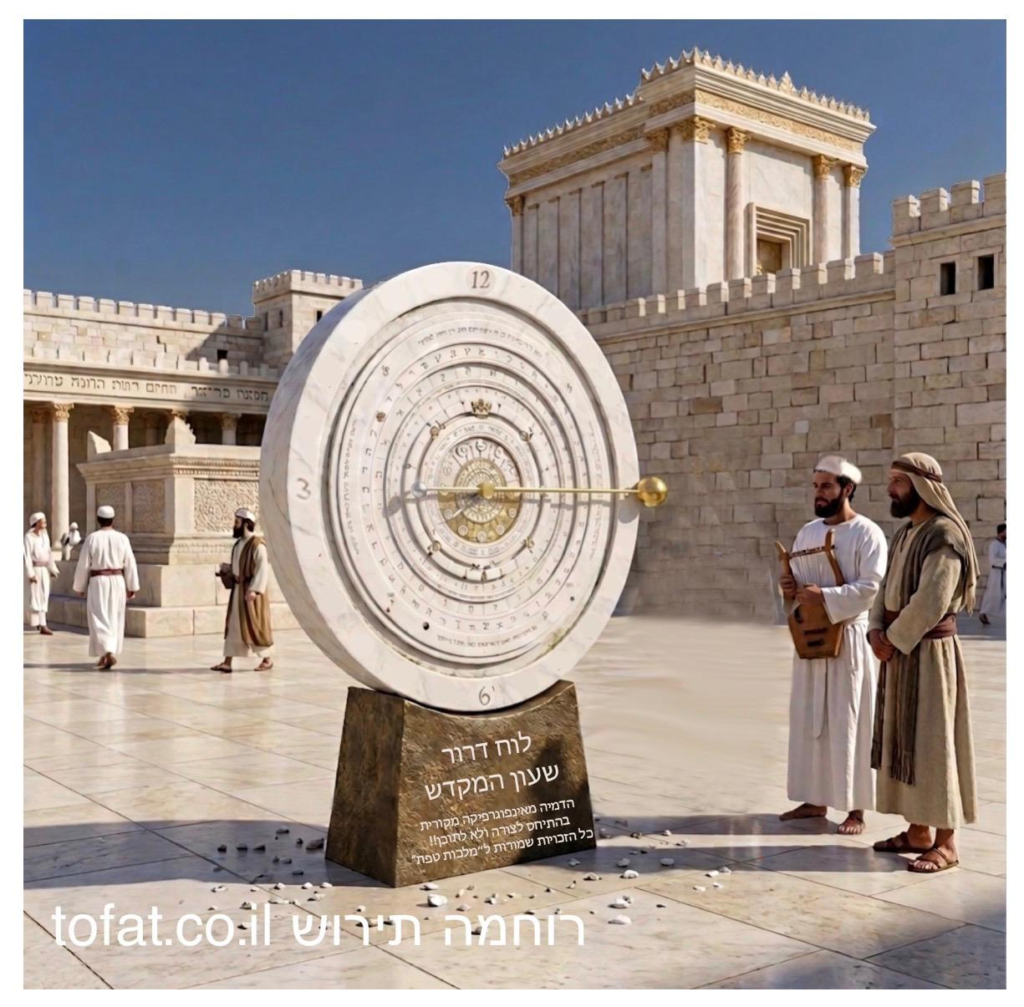
Tirosh has already produced AI-generated models of how the piece might be realized at a monumental scale. “My vision is for one of these to stand in the courtyard of the Temple,” she said, etched into glass and readable from both sides, or carved directly into marble.
The piece is produced under Tirosh’s label, Malchut Tofat, and is available at tofat.co.il.
The hands are already turning. What remains unbuilt is the courtyard itself, and the priests who will one day stand within it, counting their courses, under the appointment of the Priest Messiah.
The artist can be contacted by email: roochamatirosh@gmail.com
Her website is https://www.tofat.co.il/
She can be contacted on Whatsapp at: +972-50-4524455