




Finance Minister Bezalel Smotrich, Foreign Minister Gideon Sa’ar, U.S. Ambassador Mike Huckabee, and leading political analyst Amit Segal are among the prominent figures expected to take part in the second Middle East Summit, which Israel365 will host in Jerusalem on July 9 — a high-profile gathering convened as Israel, having remade itself over nearly three years of war into a regional superpower, now stands at the center of events reshaping the entire Middle East.
The summit arrives as the strategic landscape of the entire region is being rewritten. In the two and a half years since the October 7 massacre, Israel has dismantled Hamas’s command structure in Gaza, shattered Hezbollah’s leadership in Lebanon, and struck Iran directly — emerging, in the assessment of allies and adversaries alike, as the dominant military power in the Middle East. The order that governed the region for a generation no longer holds.
Much of what comes next remains unresolved. Iran, significantly weakened, is engaged in ongoing negotiations with Washington whose outcome no one can yet predict. Israel has battered Hezbollah but it remains a force in the region. And the broader web of regional alliances is shifting week by week, with Israel at its center.
The pace of that change was on display last week, when Israel and Lebanon signed a framework agreement in which Beirut, for the first time since 1948, affirmed in writing the right of both nations to exist as sovereign neighbors. A development of this kind would have been unthinkable only a few years ago.
It is against that backdrop that Israel365 built the summit’s agenda. Held at an iconic Jerusalem venue overlooking the walls of the Old City, the July 9 program is organized around four themes the organization identifies as central to the coming decade: Israel’s evolving security doctrine and its approach to victory since October 7; the emerging regional alliances reshaping the Middle East; the future of Israeli sovereignty, including in Judea and Samaria; and the innovations expected to drive Israel’s next phase of economic growth.
The lineup is expected to bring together senior members of the government, foreign envoys, parliamentarians, and some of the most recognizable figures in Israeli media, with several marquee conversations planned between decision-makers and the journalists who cover them.
The gathering is the second under the Middle East Summit banner. In October 2024, Israel365 convened the inaugural summit at Jerusalem’s Waldorf Astoria, drawing roughly 500 attendees to a program centered on former U.S. Ambassador David Friedman’s book One Jewish State and its argument for Israeli sovereignty over Judea and Samaria. That event, hosted by Member of Knesset Ohad Tal and featuring senior ministers, helped move the sovereignty debate from the political margins toward the mainstream of Israeli discourse.
Israel365 founder Rabbi Tuly Weisz is expected to open the July 9 program. Rabbi Pesach Wolicki, executive director of Israel365 Action, is slated to take part in a session on the future of the U.S.-Israel relationship, alongside the ministers, ambassadors, and analysts filling out the roster.
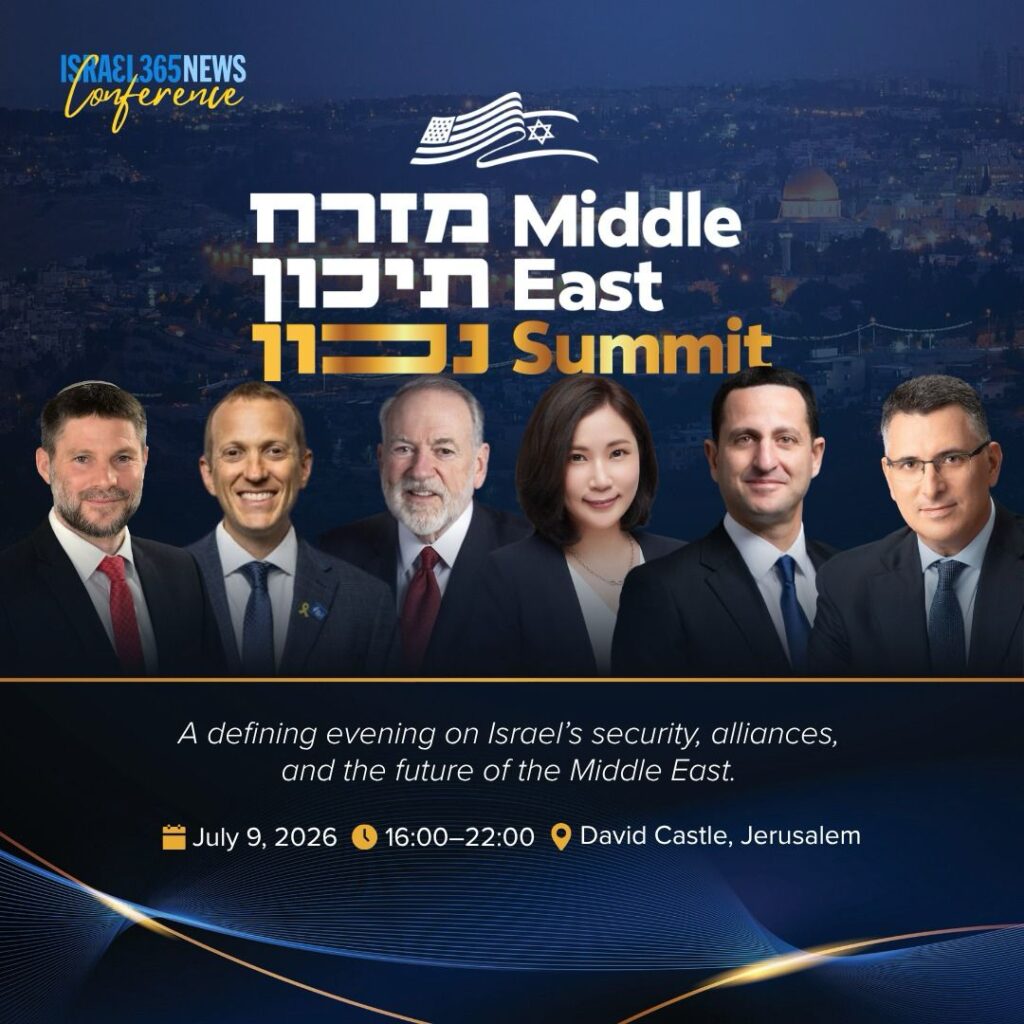
Both organizers frame the summit less as an event than as a working conversation among the people shaping Israel’s response to a transformed region — one intended to surface the analysis and debate that drive national decision-making rather than merely report on it.
The first Middle East Summit asked whether Israel would move beyond the diplomatic formulas of the past. The second convenes at a moment when many of those formulas are already giving way, and when the questions on the table — over Iran, over Lebanon, over sovereignty and the shape of the region to come — remain very much open.

