




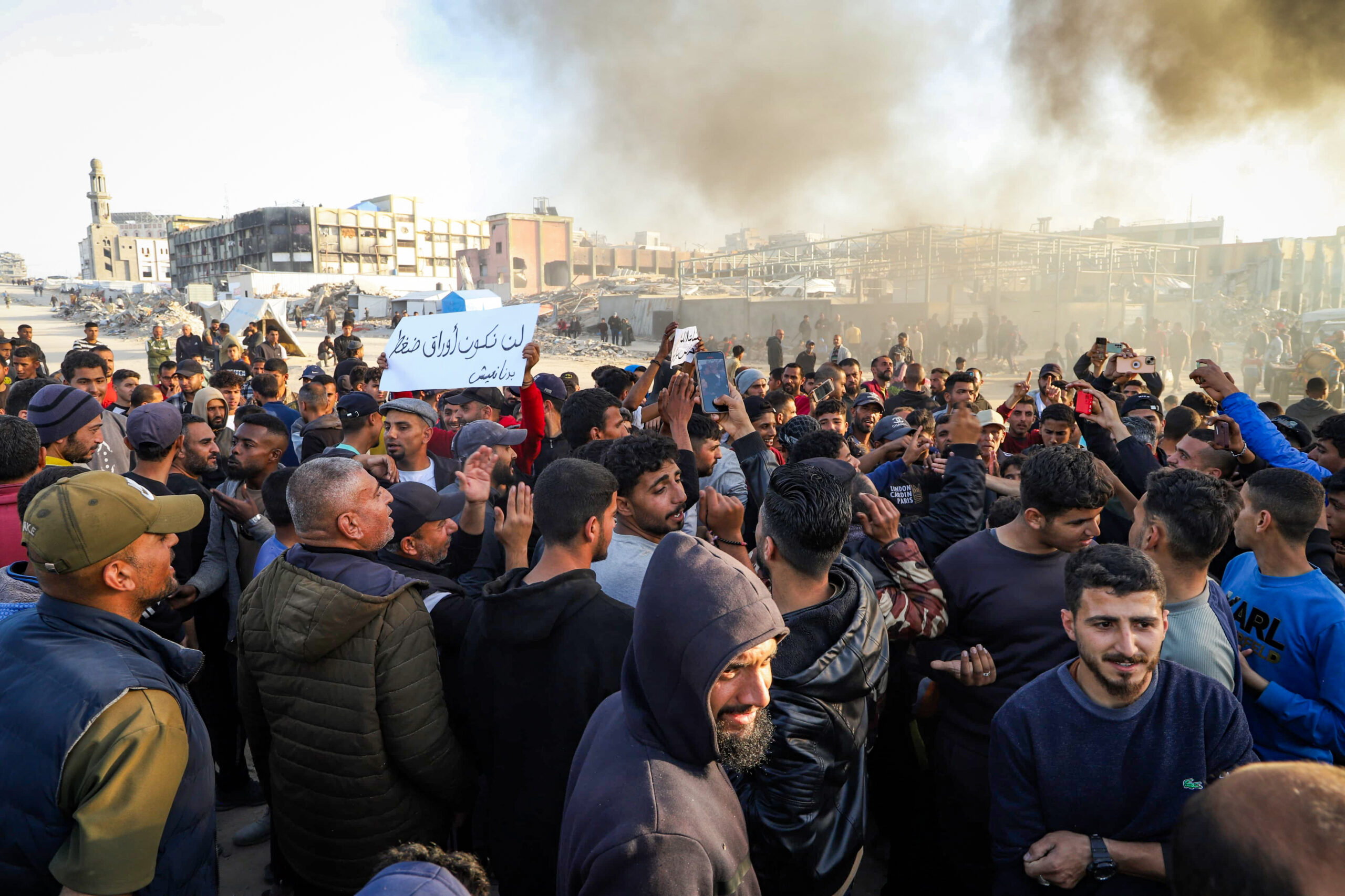
Hundreds of Gazans dared to take to the streets on June 26 carrying signs reading “God willing, Hamas out” and “We want to live.” By nightfall, Hamas’s security apparatus had detained or rounded up people at four hospitals across Gaza: Al-Shifa Hospital in Gaza City, Nasser Hospital in Khan Younis, Al-Ahli Arab Hospital in Gaza City, and Al-Aqsa Martyrs Hospital in Deir al-Balah. The streets were empty. The “June 26 Revolution” had been crushed before it could fully breathe.
This is what Hamas does to its own people.
The Association of Palestinian Scholars warned that those linked with the protests would be deemed collaborators with Israel, a crime punishable by death under Hamas rule. Before a single protester reached a gathering point, Hamas warned journalists not to cover the demonstrations. Mosque preachers across the Strip used their Friday sermons to declare that protesting the authorities was forbidden by religion. Hamas operatives threatened activists inside Gaza and threatened the families of organizers living abroad whose relatives remained in the Strip.
The list of grievances that drove people toward the streets on June 26 was long indeed. On June 18, several dozen people had already gathered outside Nasser Hospital in Khan Younis, one of Gaza’s largest medical centers, to protest the absence of adequate medical treatment for the wounded. One amputee said plainly: “Nobody cares, not even the Health Ministry. They are all thieves.” Another protester, blocked from seeking care abroad, said: “We are not allowed to leave and we will die here, while thieves with money forge medical reports and leave. This is not [Israel], this is the [Gaza] Health Ministry and the World Health Organization.”
Ahmed Fouad Alkhatib of the Atlantic Council said Hamas deployed hundreds of operatives across Gaza to suppress the protests, leaving streets “eerily empty.” Fear of Hamas was real, but it was not the only factor suppressing turnout. The absence of genuine political alternatives, fragmented leadership, and an overreliance on social media exposure rather than on-the-ground organization all weakened the movement. Hamas understood this and exploited every crack.
Which brings the story to Washington, and to a ceasefire agreement that was supposed to change all of this.
The US-brokered 20-point ceasefire plan was premised on a clear condition: Hamas was to disarm and hand over power to a transitional authority, paving the way for an Israeli military pullback and the rebuilding of Gaza. That was the deal. Hamas would go. A new governing structure would emerge. Reconstruction would follow. Those plans have yet to move beyond the initial ceasefire stage due to Hamas’s refusal to give up its weapons.
President Trump’s team brokered what was presented as a framework for ending Hamas rule in Gaza. Instead, Hamas used the ceasefire to reconsolidate. Hamas has maintained enough strength to exercise control over the parts of the Strip the IDF pulled back from, cementing its hold by executing opponents and others it views as threatening its rule. The ceasefire did not remove Hamas. It gave Hamas room to regroup, re-arm its internal security apparatus, and turn its suppression machinery back against its own civilian population.
Hamas’s Sahm Unit and Radaa Force continued operating throughout the war and the ceasefire period, targeting suspected dissidents and collaborators. These are not wartime emergency measures. This is Hamas governance. This is what the international community is being asked to reconstruct and fund around.
The suppression of June 26 follows a pattern that Hamas has refined across nearly two decades of rule. Anti-Hamas protests previously took place in 2023, 2019, 2017, and from 2011 to 2012. In 2019, Hamas police beat and arrested demonstrators openly, crushing protests that began as economic grievances before broadening into direct anti-Hamas chants. During the most recent wave, Hamas publicly flogged demonstrators, kidnapped several others, some of whom remain missing, and executed at least five Gazans for participating in protests. A recent UN report found that Hamas’ internal security bodies killed at least 60 civilians in Gaza during 2024 and 2025. Not Israelis. Gazans.
Hamas deployed armed guards and confiscated phones to crush planned anti-Hamas protests in Gaza.
— Hananya Naftali (@HananyaNaftali) June 28, 2026
The people of Gaza are suffering, and their biggest enemy isn't Israel, it's the brutal Hamas dictatorship that uses them as human shields. Free Gaza from Hamas. pic.twitter.com/tZjhY3pBcF
This is consistent with how Hamas came to power, seizing Gaza through the spilling of Palestinian blood. In June 2007, Hamas violently expelled the forces of its rival Fatah in a brutal series of clashes that left 188 people dead and more than 650 wounded, establishing the terrorist organization as Gaza’s sole ruler. According to the International Red Cross, at least 118 Fatah members were killed and some 550 wounded during that second week of June 2007 alone. Some had been thrown off the rooftops of high-rise buildings. Hamas fighters captured Muhammad Swairki, a 28-year-old cook for Palestinian Authority President Mahmoud Abbas’s presidential guard, bound his hands and legs, and executed him by throwing him from a 15-story apartment building in Gaza City. That same day, Hamas attacked the home of senior Fatah official Jamal Abu al-Jadiyan in Beit Lahiya, captured him, and executed him in the street with multiple gunshots. In the months that followed, more than 1,000 people, mostly Fatah members and Palestinian Authority personnel, were illegally arrested or detained, with Amnesty International and the Palestinian Centre for Human Rights documenting widespread abduction and torture. This is the organization whose “rule” the international community now debates preserving. This is the government that reconstruction dollars would rehabilitate. Gazans who took to the streets on June 26 chanting “Hamas out” were not making a political statement; they were demanding freedom from a terrorist organization that has ruled them at gunpoint since the day it threw its opponents off rooftops.
The people of Gaza who risked their lives on June 26 chanting “Hamas out” understood something that Western governments and UN agencies keep refusing to acknowledge: Hamas is not a political party that can be reformed or managed. It is a terrorist organization that executes its own civilians for holding signs. Over nearly two decades of rule, Hamas has successfully crushed every wave of protest against its government, none of which significantly weakened the group or led it to alter its behavior.
Any ceasefire, reconstruction plan, or political framework that leaves Hamas intact is not a solution. It is a guarantee of the next catastrophe for Israelis and for the Gazans brave enough to write “We want to live” on a piece of cardboard and walk into the street.


