


On 7 Tammuz 5786, June 23, 2026, the nascent Sanhedrin, the Jewish court reconstituted in Israel after a 1,600-year absence, issued a formal ruling addressed to the American people, warning that the US-Iran memorandum of understanding signed in Switzerland is built on illusion and places the United States in existential danger. The court opened its declaration with the ancient Aramaic legal formula bemutav beit dina ke-ḥada havina — “we were convened together as a single court” — a phrase that signals the ruling carries the full weight of a properly constituted rabbinic tribunal. The message: America is making one of the greatest strategic miscalculations in its history.
The Deal and Its Context
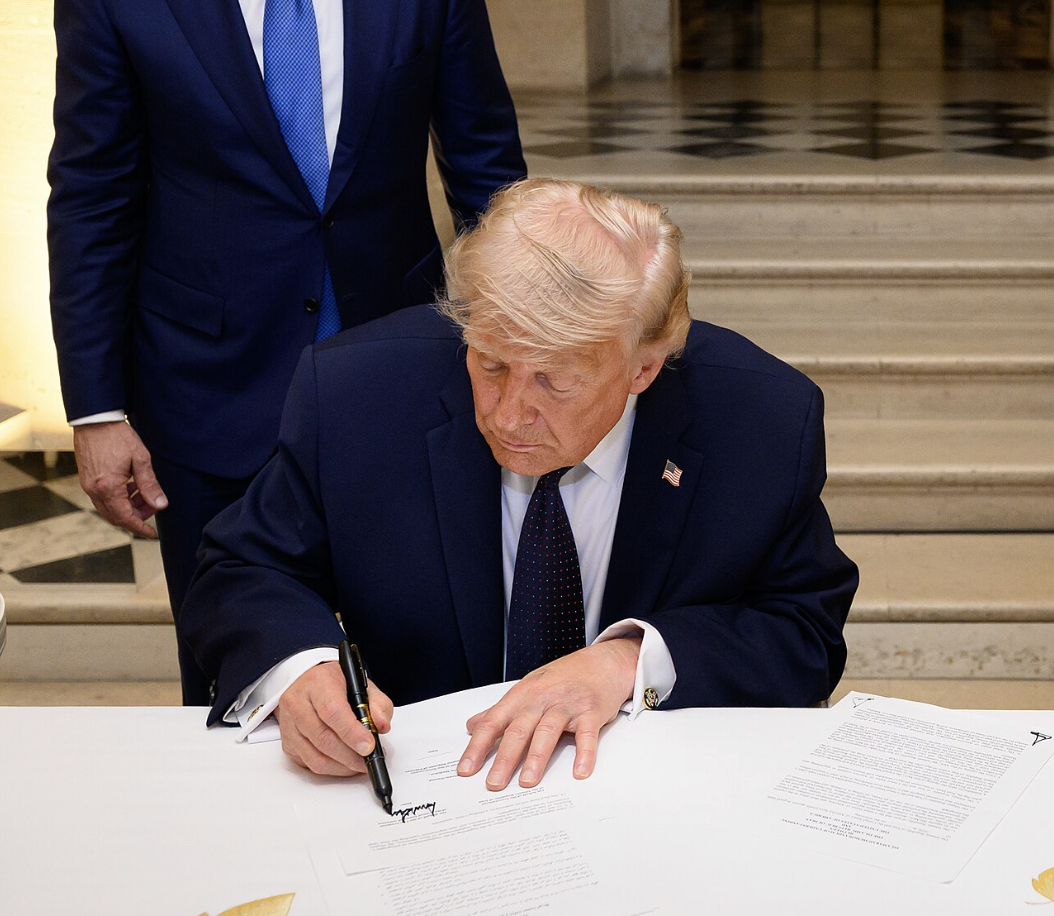
President Trump and Iran declared they had reached an initial agreement intended to end more than three months of war and reopen the Strait of Hormuz. The deal, signed in Switzerland, was described by Trump as complete: “The Deal with the Islamic Republic of Iran is now complete. Congratulations to all!” The initial pact, a memorandum of understanding, starts with reopening the Strait of Hormuz, a choke point for nearly one-fifth of the world’s oil supply. The deal on the table includes Iran’s commitment to halt enrichment and dismantle its nuclear sites, but the length of any pause remains a point of disagreement; the United States is reportedly pushing for twenty years while Iran reportedly will not go above ten. Iran’s state news agency made Iran’s position plain: it would negotiate on the nuclear issue solely within the framework of its “fundamental principles” and would not give up enrichment.
The Sanhedrin is unimpressed.
A Civilization Built on Imagination
The court’s statement opens with an unusual cultural analysis. Every civilization, it argues, has a single defining characteristic. The Greeks prized man; the Romans, power; the Germans, intellect; the Indians, spirituality; the French, sexuality. Americans, says the Sanhedrin, are defined by imagination — and it was imagination that gave the world Disneyland, Disney World, and Star Wars. The court does not mean this as a compliment. It means that the same faculty that generates great entertainment also drives American foreign policy, and that in the arena of geopolitics, fantasy kills.
The court then lays out its indictment of the Iranian regime, point by point. It notes that Iran has murdered more than 50,000 of its own citizens since the Islamic Revolution, executed at least 1,639 people in 2025 alone, a 68 percent increase over 2024, with an average of roughly four hangings per day, including 48 women. UN experts described the pace as “industrial scale” that “defies all accepted standards of human rights protection.” The regime has invested hundreds of billions in ballistic missiles and a nuclear program, and as of May 2025 possessed over 400 kilograms of uranium enriched to 60 percent purity. It has poured hundreds of billions more into proxy forces — Hamas, Hezbollah, the Houthis — specifically to export terror. At every mass assembly its leadership chants “Death to America” and “Death to Israel.”
The Sanhedrin’s question, stripped of all diplomatic language, is this: what rational observer looks at that record and concludes that a trillion dollars in oil revenue, unfrozen assets, reconstruction funds, and payments for access to the Strait of Hormuz will suddenly be redirected toward tourism, factories, and civilian construction?
The Bible long ago described the peril of trusting a sworn enemy. As the prophet Jeremiah warned: “They have healed the wound of My people lightly, saying ‘Peace, peace,’ when there is no peace” (Jeremiah 6:14). The Sages understood that a peace proclaimed by the wicked is not peace — it is a temporary repositioning before the next assault.
The Wider Danger
The Sanhedrin does not limit its concern to the Iranian threat alone. The court warns that China, Russia, and North Korea are watching American decision-making with interest, and what they see is weakness. Experts have cautioned that the MOU leaves many of the most challenging issues unresolved, noting, “We have been here before only to discover the parties cannot bridge the remaining gaps.” The court’s warning is that adversaries do not see an administration making a hard deal; they see an administration buying an illusion and calling it a victory.
The court further warns that the imaginary peace carries an internal American dimension. It predicts that armed militia groups operating within the United States will see the instability created by this agreement as a signal to act, triggering what the Sanhedrin calls milḥemet Yom HaDin, the War of the Day of Judgment, a civil reckoning.
The Call to American Jews
The Sanhedrin’s ruling concludes with a direct call to every Jew in America to make aliyah, the Jewish return to the Land of Israel, immediately, before the situation deteriorates beyond recovery. This is not the first time the court has issued such a call. The nascent Sanhedrin, headed by Rabbi Eliyahu Abergel, who served as head of the Rabbinical Court in Jerusalem, has previously ruled that all Jews worldwide have a mitzvah, a Torah obligation, to return to the Land of Israel, stating: “It’s necessary now more than ever to come to Eretz Yisrael, and we as a beis din have ruled that all Jews have to come as soon as they can.” The Iran deal gives that ruling a sharper, more urgent edge.

The Sanhedrin closes with the blessing of geulah shleimah, the complete redemption, “in the revealed and mighty sovereignty of the Blessed Name.”
A Court Without Consensus, A Warning With Teeth
The nascent Sanhedrin, reestablished in 2004, has not achieved universal acceptance within the Orthodox world. Its authority is contested. But its warnings have a way of landing in the middle of real events. The US-Iran MOU was signed the same week the court issued this ruling. The Strait of Hormuz remains partially closed. Iran’s nuclear program remains intact. The Iranian blockade has severely limited global energy supply and sent oil prices into disarray.
Whether or not one accepts the court’s halachic standing, its geopolitical reading is not easily dismissed. A regime that hanged four of its own citizens every day throughout 2025 does not, by any rational calculation, transform into a reliable partner because American negotiators flew to Geneva. Reality, as the Sanhedrin puts it, always slaps the fantasists in the face.
Not everyone has accepted the Sanhedrin’s intervention quietly. The ruling drew an immediate challenge: what business does a religious court have issuing verdicts on American foreign policy? Rabbi Meir HaLevy, spokesman for the nascent Sanhedrin, had a direct answer.
“The wise person is one who foresees the future,” he said, citing the Talmudic principle. “We foresee the future according to the halacha, according to the Torah. We can see the future because we are doing the deliberations as a Sanhedrin, and then the ruach hakodesh, the Holy Spirit, comes to us. What we are saying comes only from that place, and of course it is according to halacha and according to the Torah.”
Rabbi HaLevy was emphatic that the Sanhedrin is not entering the arena of partisan politics. “We don’t have anything to do with politics [or] with the interest calculations of various groups and countries. That is not our concern. What we are focusing on is what God wants from us, what God wants…us to do.” He cited King Solomon’s charge in Ecclesiastes: “Whatever your hand finds to do, do it with all your might” (Ecclesiastes 9:10). “That is what we are doing. We are asking what God wants from us, and from each nation.”
The Sanhedrin, Rabbi HaLevy clarified, is not telling politicians how to govern. It is pointing out where political leaders are straying from the path the Torah requires of a Jewish nation and of the nations of the world.
