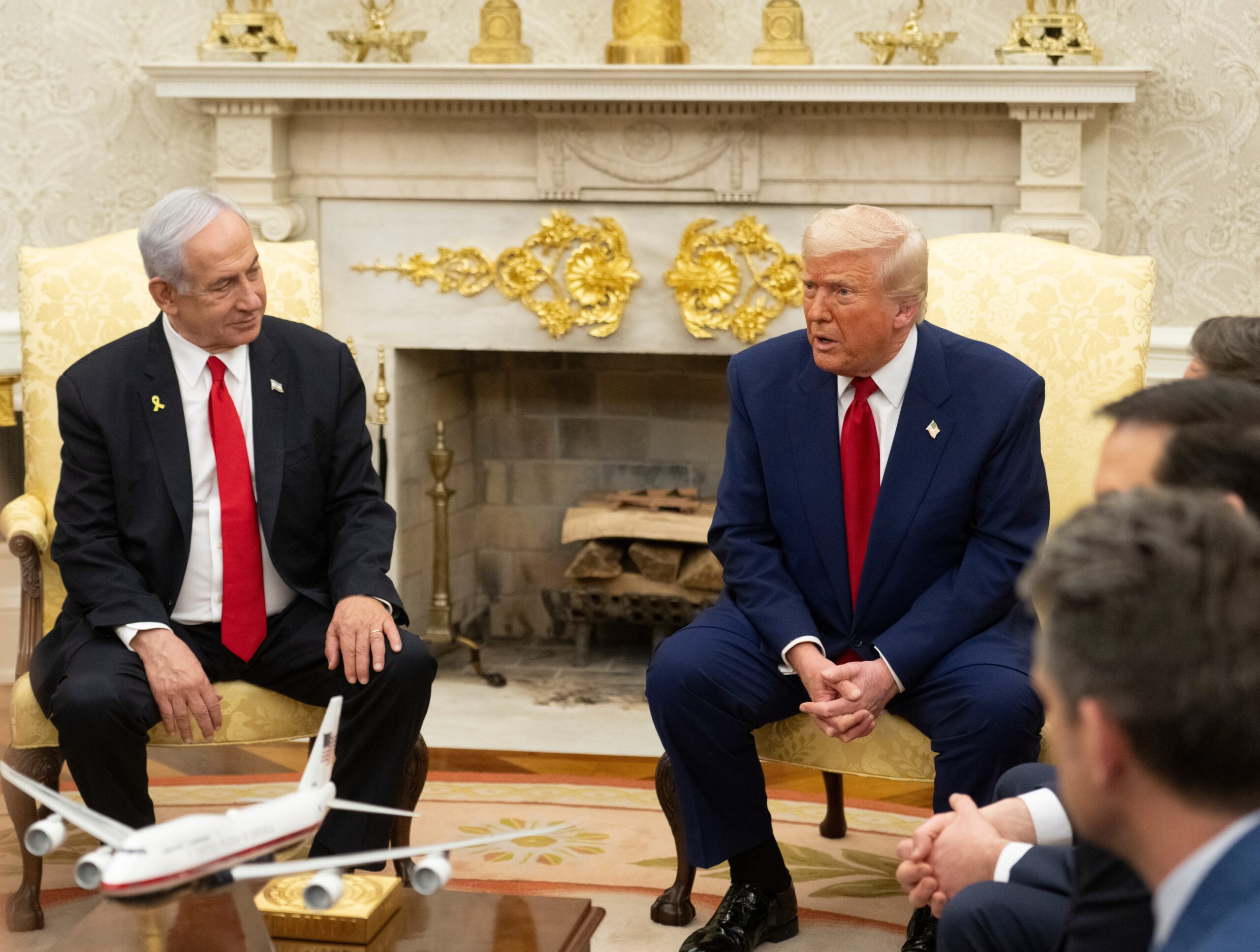
President Trump issued a rare public rebuke of Israeli military tactics in Lebanon on Tuesday, telling reporters at the G7 summit in Evian-les-Bains, France, that Israel does not need to flatten apartment buildings to root out Hezbollah terrorists. Trump said Israel has been fighting Hezbollah for “too long” and that too many people have been killed, adding that the buildings being struck contain many residents who are not Hezbollah operatives.
The comments mark an unusually sharp break between Trump and Prime Minister Benjamin Netanyahu, coming as the administration works to finalize a nuclear agreement with Iran and a separate ceasefire framework covering Lebanon. Trump told reporters he had personally urged Israel to let Syria take over the fight against Hezbollah, saying he believed Damascus would do a better job of it. He drew a contrast with the 1967 Six-Day War, suggesting Israel’s earlier wars were won quickly without leveling entire neighborhoods, and has grown visibly frustrated that the campaigns in both Lebanon and Gaza have dragged on for months without producing a clean victory.
𝗗𝗼𝗻𝗮𝗹𝗱 𝗝. 𝗧𝗿𝘂𝗺𝗽 𝗧𝗿𝘂𝘁𝗵 𝗦𝗼𝗰𝗶𝗮𝗹 𝗣𝗼𝘀𝘁 – 𝟭𝟬:𝟰𝟲 𝗔𝗠 𝗘𝗦𝗧 𝟬𝟲.𝟭𝟰.𝟮𝟲
— Commentary Donald J. Trump Posts From Truth Social (@TrumpDailyPosts) June 14, 2026
This morning’s attack on Beirut should not have happened, particularly on a special day when we are so close to a Peace Deal with Iran. Israel has the right to defend itself… pic.twitter.com/5RbSsVZzGW
Despite the public criticism, Trump insisted his relationship with Netanyahu remains strong, saying the Israeli leader simply needs to be more responsible regarding Lebanon. The White House moved quickly to contain the fallout. An official administration account posted video of Trump’s remarks, and a White House official told reporters that the United States remains Israel’s strongest ally and that the Israel Defense Forces are valued partners in the fight against Iran’s regional proxies.
The friction comes against the backdrop of a fragile US-Iran framework agreement unveiled around June 15, following a war that began in February when Israeli and American strikes targeted Iran’s nuclear and missile programs and killed Supreme Leader Ali Khamenei. Iranian Foreign Minister Abbas Araghchi has insisted that the memorandum of understanding effectively binds two pairs of parties together, the United States with Israel on one side and Iran with Hezbollah on the other, a framing Washington has explicitly rejected.
This is not the first time Tehran has tried to fold Lebanon into its negotiations with Washington, only to be turned away. In April, as a ceasefire between Israel and Hezbollah took effect without a matching pause in the broader Iran conflict, Araghchi publicly threatened to collapse the entire arrangement, insisting Washington could not separate Hezbollah’s war from Iran’s own ceasefire. The administration held firm that the Lebanon track and the Iran track would remain distinct. Hezbollah escalated the same demand again this week, declaring that Iran will refuse to finalize its nuclear deal unless Israeli forces fully withdraw from southern Lebanon, a position American officials have again dismissed as no part of the nuclear negotiations. Iranian parliament speaker Mohammad Bagher Qalibaf went further still, saying any talks with the United States would be unreasonable so long as the Israel-Hezbollah conflict continued. Washington has not budged.
Iran has been rebuffed on the opposite track as well. Israel and Lebanon began exploring direct negotiations in April, and on April 9, Netanyahu directed his political-security cabinet to open formal contact with the Lebanese government. Those talks have proceeded as a bilateral channel between Jerusalem and Beirut, brokered by Washington, with no seat offered to Tehran despite its insistence that Hezbollah’s fate cannot be separated from its own.
The Lebanese government itself has been pushing, however unevenly, to strip Hezbollah of its weapons. Lebanon’s cabinet ordered the Lebanese Armed Forces in August to draw up a plan placing all arms in the country under state control, a direct challenge to Hezbollah following President Joseph Aoun’s calls weeks earlier for the group’s disarmament. By October, Aoun was claiming that 80 to 85 percent of the territory south of the Litani River had been cleared of Hezbollah weapons, while Prime Minister Nawaf Salam said the goal was for Hezbollah to become a political party without a military wing. Hezbollah’s leadership has not gone quietly. Hezbollah chief Naim Qassem responded defiantly, telling the Lebanese government not to waste time on what he called storms stirred up by foreign dictates.
Trump’s suggestion that Syria handle Hezbollah rests on the rise of Ahmed al-Sharaa, the Syrian president better known for most of his adult life as Abu Mohammad al-Jolani. Al-Sharaa carried a ten-million-dollar American bounty on his head as recently as 2017 for leading what was then called the Nusra Front, accused by the State Department of multiple terrorist attacks inside Syria. His path into jihad began in Iraq after the 2003 invasion, where he was jailed by American forces at Camp Bucca and crossed paths with future Islamic State leader Abu Bakr al-Baghdadi, who later encouraged him to found an al-Qaeda affiliate in Syria.
The rehabilitation of his image has moved at remarkable speed. After cutting formal ties with al-Qaeda in 2016 and leading the lightning offensive that toppled Bashar al-Assad in December 2024, al-Sharaa traded combat fatigues for suits and met Trump in Riyadh in May 2025, with the president lifting US sanctions on Syria and describing him as a real leader with a strong past. By the time al-Sharaa visited the White House, becoming the first Syrian president to do so since independence in 1946, he had committed to joining the American-led coalition against the Islamic State and reopening Syria’s embassy in Washington. In December 2025 Trump sent him a personal handwritten note hailing him as a future great leader, completing a transformation that would have been unthinkable a year earlier.
The sanitized image obscures a far rockier reality on the ground. Syria’s Mediterranean coast saw days of sectarian killing in March 2025, with the Syrian Observatory for Human Rights reporting that government forces and allied factions massacred more than 1,700 civilians, most of them Alawites. Months later, fighting between Druze and Bedouin armed groups in Suwayda province killed roughly a thousand more, with the UN’s human rights chief reporting that both interim government forces and the armed factions carried out summary executions and other abuses. Analysts at Israel’s INSS have noted that al-Sharaa now faces pushback from hardline elements within his own movement who reject precisely the moderate posture he has adopted toward dialogue with Israel. Israel, for its part, has continued striking targets inside Syria, conducting more than 150 air and artillery strikes there in 2025 alone, even as Washington markets al-Sharaa as a stabilizing partner.
Whether a government still struggling to contain its own jihadist hardliners and unable to stop massacres of its own minorities could reliably suppress an entrenched Iranian proxy like Hezbollah remains an open question that Trump’s latest remarks did not address.