




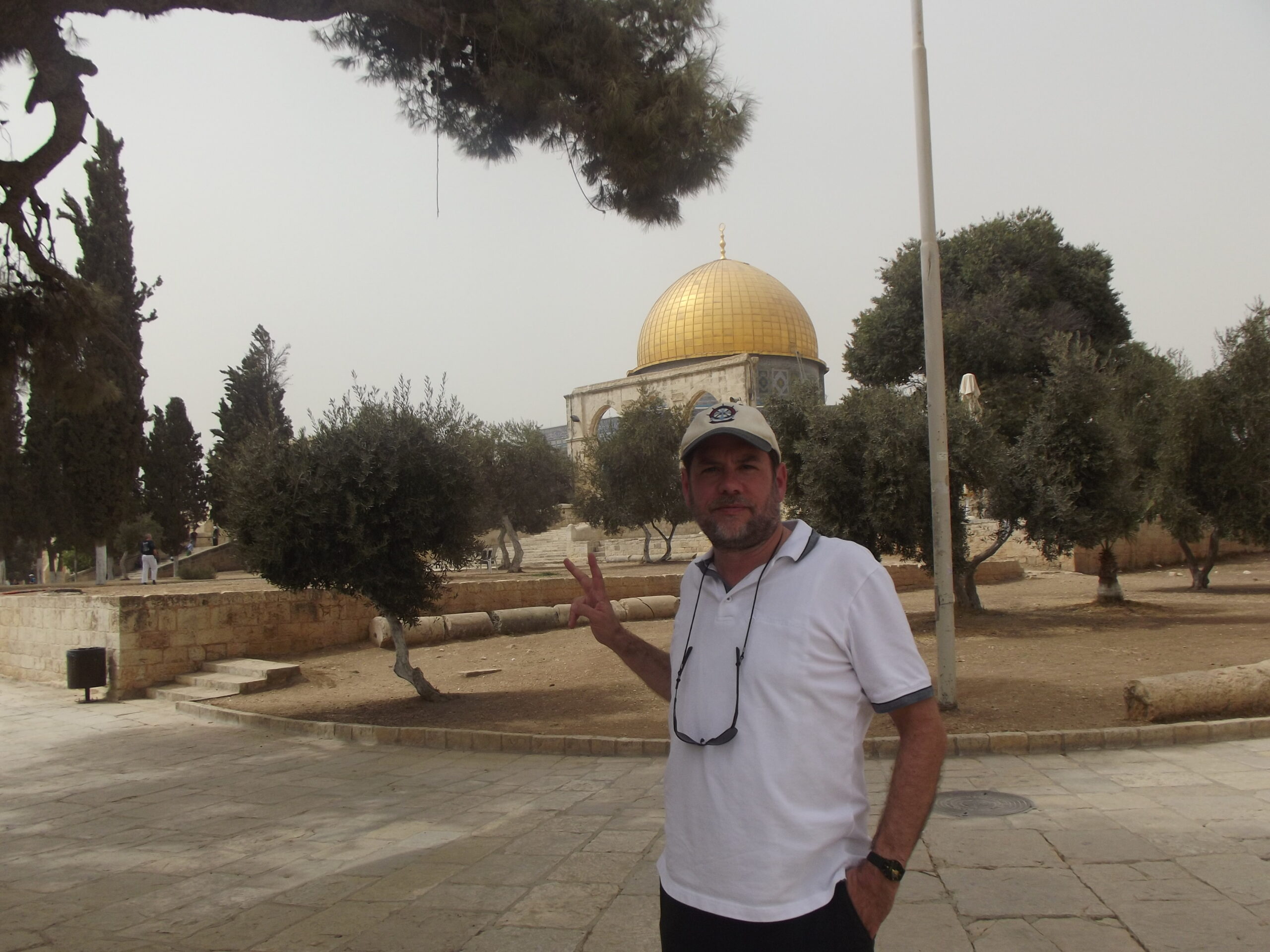
The term “status quo” as it relates to the Temple Mount is officially obsolete. The facts on the ground are evolving so rapidly that the phrase no longer really applies.
When I last penned an Op-ed on this volatile topic a decade ago, the site’s dynamics were entirely different. For years, any shift on the Mount favored only the Arab community, dictated by the heavy-handed oversight of the Jordanian WAQF. Visiting Jews and Christians were subjected to routine intimidation, harassment, and immediate removal by authorities for the “crime” of whispering a prayer. While the Israeli Antiquities Authority (IAA) strictly enforced its laws against uncovering biblical archaeology there, the WAQF was quietly permitted to use heavy machinery to bulldoze through the holy site, a concession made by past Israeli leadership and the Obama administration to placate threats of violence. This resulted in the unilateral construction of three unauthorized mosques, including the massive underground El-Marwani Mosque.
Today, however, a paradigm shift in another direction has been underway, and it’s nothing short of miraculous. Indeed, a new era of religious liberty was to follow.
The turning point began building in 2015 when a Jerusalem court upheld the fundamental right to Jewish prayer on the Mount, setting off a chain reaction that has slowly dismantled restrictions for religious Jews and Christian tourists alike. What started as a trickle has become a roaring wave of religious tolerance and prayer.
In 2018, Jewish worshippers were finally authorized to pray in designated areas, thereby affirming a new, more inclusive approach. Since then there has been a progressively rising trend, and the results are staggering: last year alone, over 68,000 Jews ascended the Mount to worship – a 22% explosion over the previous year, spanning a massive cross-section of Israeli society. Today, daily prayer quorums (‘minyanim’ in Hebrew) meet openly during morning and afternoon hours on the eastern perimeter behind the Dome of the Rock, complete with authorized prayer sheets and prostration – Jewish rituals not witnessed on the Mount for centuries. If this trend continues, the Temple Mount could one day represent the future of religious toleration in Israel, and perhaps be a beacon for that eventuality throughout the entire world.
The profound impact of this shift was brought home to me recently in Jerusalem’s Old City during a conversation with an Arab tour guide. He noted that the Mount has become significantly quieter and less attended from the Arab side, and proceeded to offer me an astonishing explanation:
“Ever since they started seeing Jews bowing all the way to the ground, they realized that the Jews actually respect the site and are genuinely praying without political incentive. Seeing the ‘real Jews,’ i.e., the ultra-Orthodox in black hats, and not just the ‘settlers in sandals’ bowing to God changed their perspective.”
But don’t be fooled. This is not a modern anomaly; it is the fulfillment of a long-standing Jewish dream and a miraculous return to a historical reality grounded in powerful religious and historical precedent.
Following the 1967 Six-Day War, Chief Rabbi Shlomo Goren envisioned a dedicated Jewish prayer space on the Mount. Decades later, the late Sephardic Chief Rabbi Mordechai Eliyahu submitted official blueprints to the Knesset for a Jewish house of prayer in the open northeastern sector, declaring that the Children of Israel could finally enter the permitted areas in holiness and purity according to Jewish law. Today, that dream has been revived: an amuta (non-profit organization) has officially resubmitted revamped architectural drawings and halachic rulings to the Knesset for a small synagogue, designed to be accessed discreetly from outside the Eastern Wall, adjacent to the Golden Gate, and nowhere near the Muslim shrines.
Skeptics continue to ask me, though: is there a precedent for a synagogue existing alongside Muslim structures on the Mount? History answers with a resounding yes:
- The Persian Era (613 CE): Following the ousting of the Byzantines, a Jewish house of worship, including a sacrificial altar, were immediately re-established by the new governor, King Khosru II, and were in use for the following 3 years, as documented by the renown Jewish poet: Rabbi Elazar Kalir in his liturgical lamentations.
- Early Muslim Rule (638 CE): Caliph Umar permitted Jews to pray on the Mount without interference half a century before the Dome of the Rock was built. Even the gradual metamorphosis of the Mount into Islam’s third holiest site didn’t result in a total exclusion of Jews from the location (see Jacob Mann, The Jews in Egypt and in Palestine under the Fatimid Caliphate).
- The Golden Age of Coexistence: For centuries under Fatimid rule in the early Muslim period, a wooden synagogue operated actively on the sacred compound. Pilgrims left Hebrew inscriptions on the internal walls of the Golden Gate (that are still visible today!). This fact was also substantiated by a Karaite sectarian by the name of Solomon ben Jeroham, who lived in Jerusalem between 940 and 960, affirming that “the courtyards of the Temple were turned over to them and they [the Jews] prayed there for many years.” After the Crusader Kingdom ended in the late 12-century, another synagogue is discussed in connection with the Kurdish Muslim warrior, Saladin (Emil Offenbacher, “Prayer on the Temple Mount,” Jerusalem Quarterly, 36 – 1985)
- Mamluk & Ottoman Periods: Renowned medieval Jewish authorities like the Radbaz (1479–1573) documented that Jerusalem’s Jews regularly ascended the Mount to pray with absolutely zero objections from local Muslim clerics (Responsa of the Radbaz, vol. 2, #691).
History therefore proves beyond a doubt that a shared space for prayer on the Mount is not a pipe dream—it is a proven, historical formula for stability.
For Israelis, for their part, enthusiasm is mounting – to say the least. During the first week of June, just 2 weeks ago, activists for the first time raised Israeli flags at the site, posing publicly in front of the Dome of the Rock. After all the predictable political condemnations that ensued from the various nations, nothing else was heard. It wasn’t too long ago that these same activists would have been unceremoniously arrested on the spot and taken to the police station for investigations lasting the duration of that day!
It’s important to note that the true wonder of the Temple Mount lies not just on what was built on the surface, but in what is poised to be revealed below. With over 50 known underground tunnels awaiting safe exploration, the site is a treasure trove where biblical archaeology is actively coming to life.
Indeed, if the current momentum is any indication, the next decade will not necessarily bring more conflict, but a glorious redefinition of the true status quo, a return to a holy house of prayer to be a permanent symbol of peace for all peoples. By replacing political agendas of forced exclusion with strength, mutual respect, and genuine religious liberty, the Temple Mount is positioned to become the ultimate global beacon of faith. It will ultimately stand as a place where Jews, Muslims, Christians, and all well-meaning people can worship God Almighty in unprecedented peace.
May it be realized in our days, amen.
The author is an investigative archeologist/journalist. He is a Remi-Award winning producer, and writer of the books, The ARK Report and The Vatican and ME. He is also the Director of the Jewish Heritage Project.

