

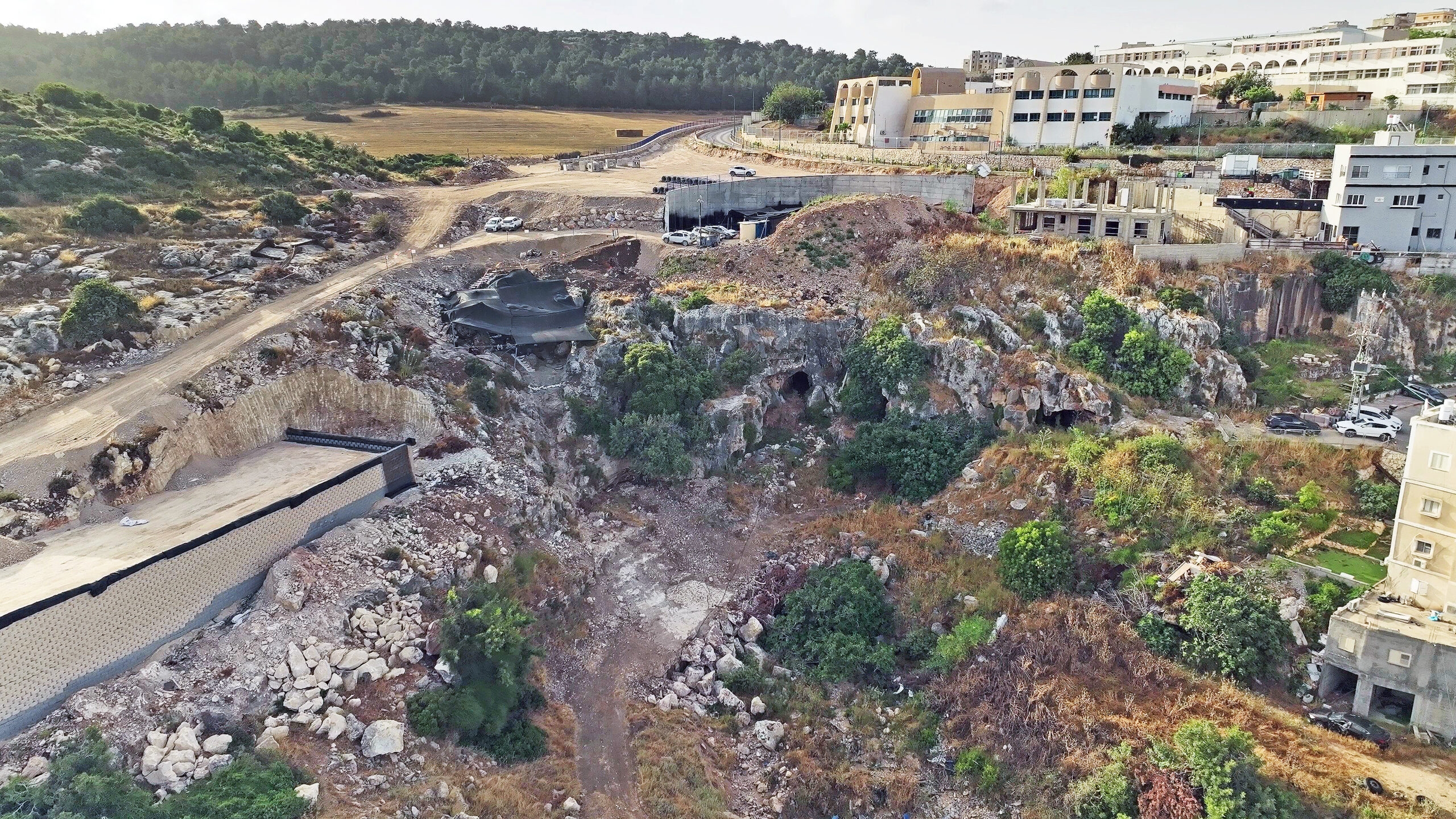
A prehistoric cave sealed for hundreds of thousands of years has been uncovered on the outskirts of Fureidis — a village south of Haifa whose name derives from the Arabic firdawis, meaning “little paradise,” borrowed from the Persian word for the Garden of Eden. The discovery is being called a site of global importance, offering a rare window into a chapter of human prehistory that researchers say remains almost entirely obscure.
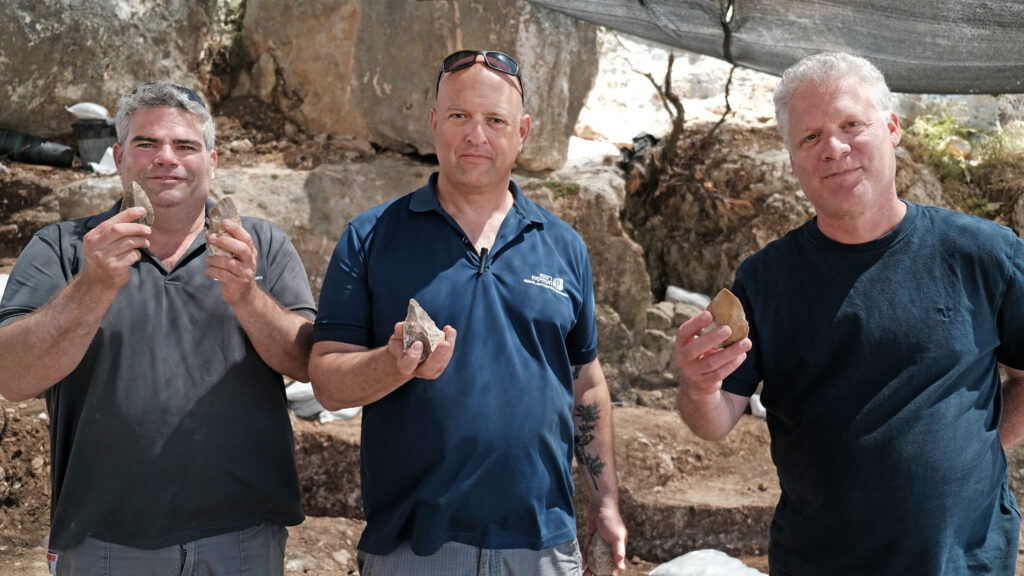
From right to left: researchers Prof. Ron Shimelmitz of the University of Haifa, Dr. Kobi Vardi and Amit Gabay of the Israel Antiquities Authority. Photo credit: Emil Aladjem, Israel Antiquities Authority
The cave, located near the Zikhron Ya’akov interchange, dates to between 250,000 and 400,000 years ago — a period at the twilight of the Lower Paleolithic era, just before Neanderthals and modern humans rose to dominance. The irony of finding what may be one of the most significant archaeological sites in the world in a town literally named “little paradise” was not lost on researchers who have been working the site under the direction of Dr. Kobi Vardi and Amit Gabbay of the Israel Antiquities Authority, in cooperation with Prof. Ron Shimelmitz of the University of Haifa’s Zinman Institute of Archaeology.
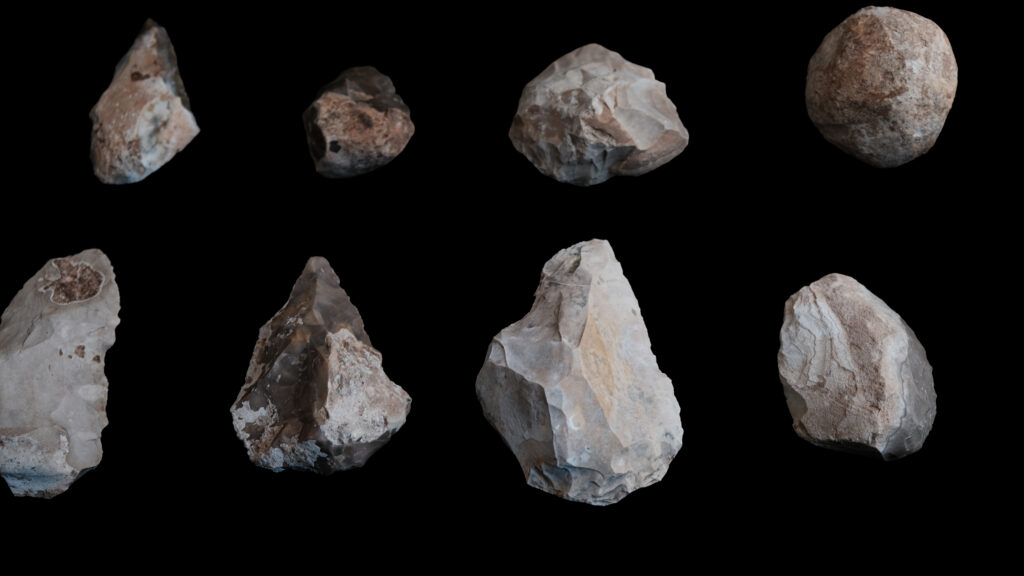
Prehistoric handaxes discovered in the ancient cave. Photo credit: Emil Aladjem, Israel Antiquities Authority
The site belongs to the Acheulo-Yabrudian culture — one of the least understood and most sparsely documented cultures in the entire archaeological record. “Sites from this culture are actually very rare,” Dr. Vardi told the Press Service of Israel. “We know of only 10 such sites in the entire Middle East.” What sets this cave apart from most of those ten is not only its existence, but its extraordinary state of preservation. The cave was sealed for hundreds of thousands of years, shielding its contents from erosion, looting, and the decay that has rendered most comparable sites unresearchable. “It is very rare to find a site in such a state of preservation,” Vardi said. “Every prehistorian who visits the site is absolutely thrilled.”
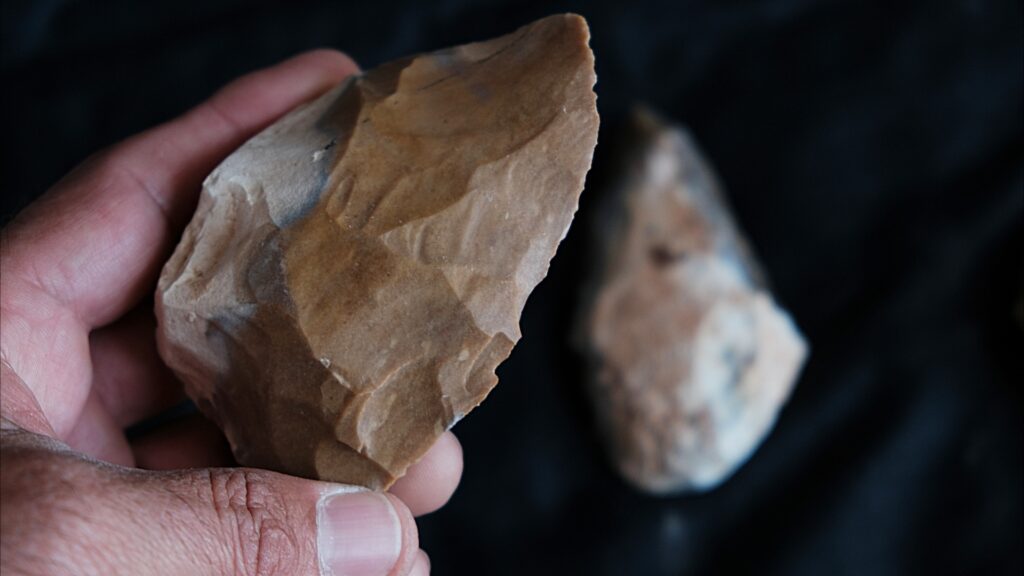
Prehistoric handaxes discovered in the ancient cave. Photo credit: Emil Aladjem, Israel Antiquities Authority
Fureidis adds another layer of irony to its geography. At the very center of the village stands a tomb-shrine known as ash-Sheikh Ghneim — a name strikingly similar to the Hebrew Gehenom, the Valley of Hinnom, which Jewish tradition associates with judgment and punishment. Despite the phonetic resemblance, scholars draw no etymological connection between the two. Still, a town named “little paradise” built around a shrine whose name echoes Gehenom — and now revealed to sit atop one of the most significant prehistoric sites on earth — is the kind of layered strangeness that only the land of Israel can produce.
The excavation, funded by Ayalon Highways Company after construction work threatened to damage the site, has yielded flint tools including small sharp hand axes, scrapers and blades — evidence of an advanced stone-working technology that researchers say was characteristic of the Acheulo-Yabrudian culture. Animal bones have also been recovered, including remains of fallow deer, gazelle and ancient horses. Evidence of a water source at the location likely explains why hunter-gatherer groups were drawn there across extended periods.
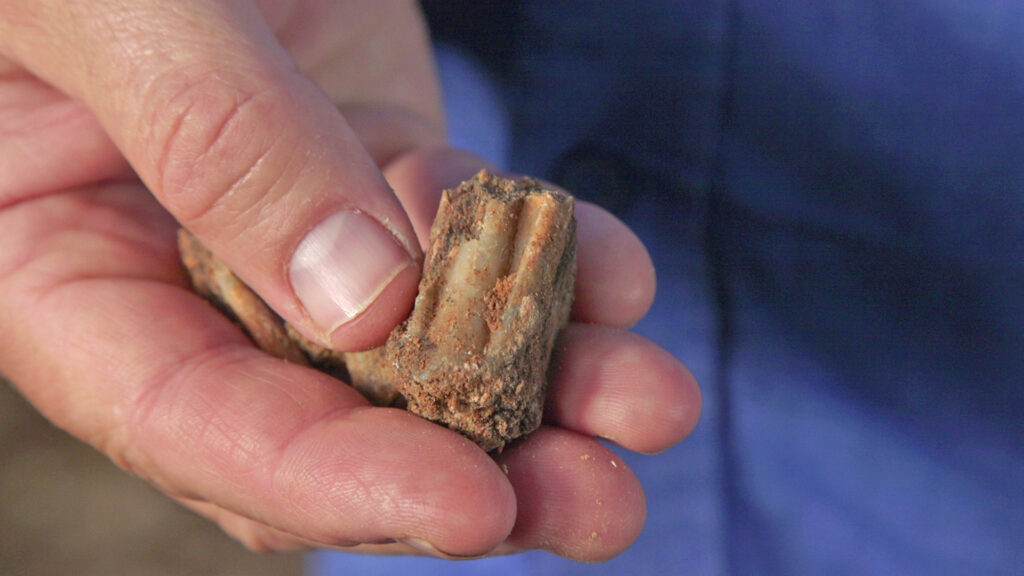
Ancient fallow deer tooth. Photo: Emil Aladjem, Israel Antiquities Authority
Prof. Shimelmitz described what makes the period itself so significant: “The gradual changes that emerged during this period in human physiology, technology, and society foreshadowed the traits and complex behavioral patterns that developed later and characterize both Neanderthals and modern humans. To a degree, they can be seen as the seeds that led to the development of our complex culture.” Among the most important findings: evidence of intensive fire use and prolonged habitation, suggesting that the occupants of this cave were not passing through — they were building something resembling a sustained social world.
“It is interesting because here we also see a transformation in cognition,” Vardi said. “Suddenly, we see a more developed flint industry. It probably teaches us about a different kind of social organization.”
The Israel Antiquities Authority and the University of Haifa are now advancing a large-scale research program to reconstruct how the cave’s inhabitants lived, adapted to their environment, and transmitted knowledge across generations. Researchers expressed hope that once the excavation and study are complete, the site will be opened to the public — accessible to local residents, to students at a nearby school, and to anyone with an interest in the earliest chapters of human history.
This stretch of Israeli coastline, overlooking the Carmel range, was not chosen by accident by those ancient hunter-gatherers. It sits in the heart of a land that has drawn human settlement, spiritual longing, and civilizational ambition for as far back as the record reaches — and, it now turns out, further back still. In the town of “little paradise,” the past was not buried. It was waiting.