


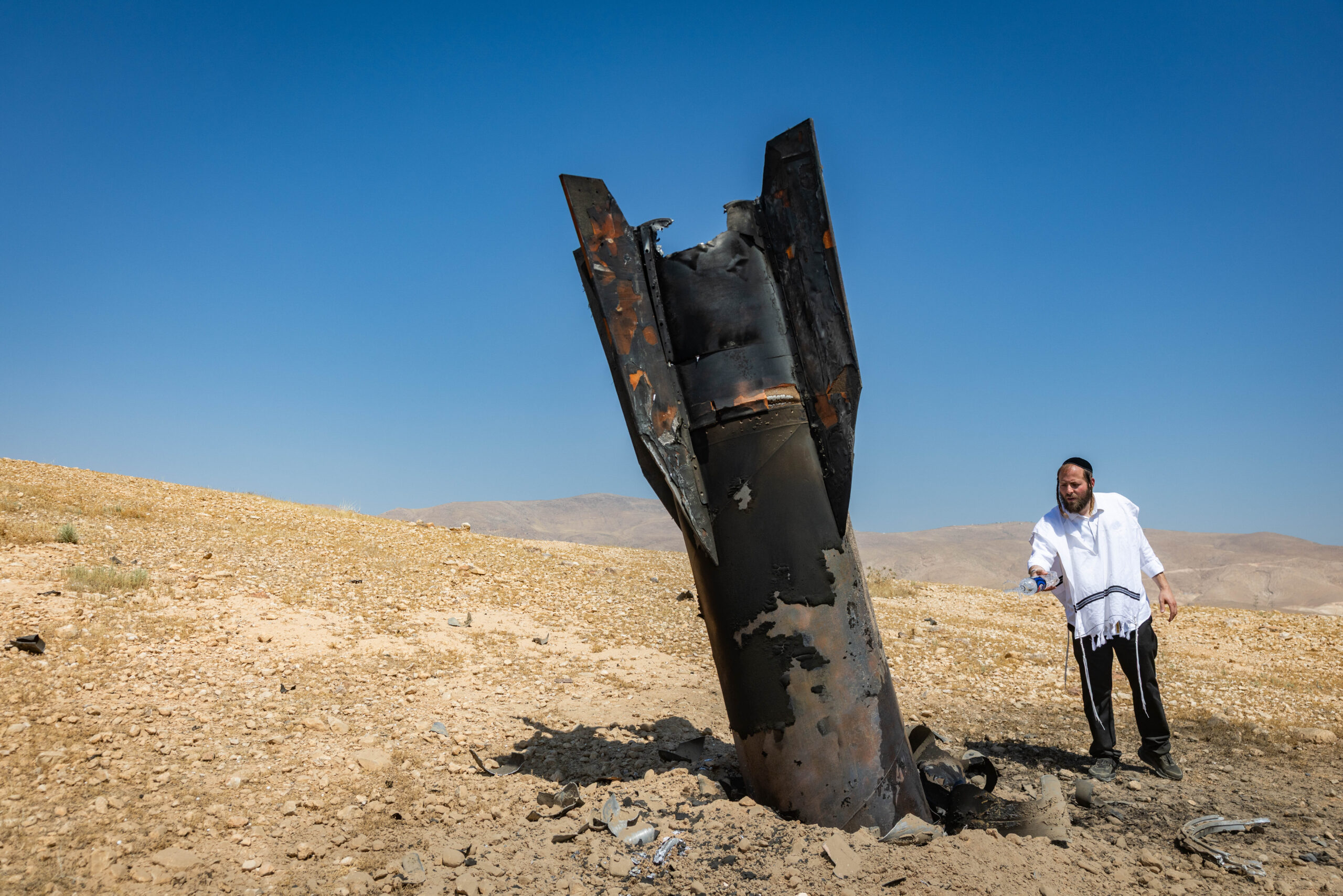
Sunday night, Iran launched ten ballistic missiles at Israel. This was not a strike against Israeli aggression toward Iran. Iran has long insisted that Hezbollah is an independent actor. Sunday night exposed that claim for what it is. For the first time in this war, Tehran made no attempt to disguise that they were going to war for Hezbollah.
On Sunday, Israel struck a Hezbollah command-and-control center in the Dahieh district of Beirut, responding to rocket fire Hezbollah had directed at northern Israeli towns. Within hours, Iranian parliament spokesman Ebrahim Rezaei posted on X: “Watch the sky of the occupied territories tonight.” Iranian parliament speaker Mohammad Bagher Ghalibaf, also Iran’s lead negotiator in the nuclear talks, declared that US assets in the region were now “legitimate targets.”
Iran is Hezbollah’s creator, its banker, its weapons supplier, and ultimately its commanding officer. When Israel hits Hezbollah, Iran responds. When Hezbollah fires at Israeli towns, and Israel strikes back, Tehran launches ballistic missiles.
Israel’s attack on Hezbollah should not concern Iran. Lebanon is over 2,700 kilometers distant from Iran. It could be argued that Lebanon is a key element in an Iranian land bridge to the Mediterranean, providing them with a maritime route independent of the Strait of Hormuz.
But the alliance is ideological. Hezbollah’s Dahieh headquarters is a command center from which terrorists direct rocket barrages against Israeli civilians, coordinate drone attacks on IDF positions in southern Lebanon, and plan the next stage of what Iran openly calls the “Axis of Resistance,” a coordinated campaign to destroy the Jewish state.
Prime Minister Netanyahu and Defense Minister Katz said explicitly that the Beirut strike came “in response to Hezbollah’s firing at Israeli territory.” Israel struck a military target in response to an attack on its citizens. Iran’s response was to fire ballistic missiles at Israeli homes.
Security Alert: As a result of the current security situation in Israel, including Home Front Command alerts for multiple regions, the U.S. Embassy has directed all U.S. government employees and their family members to shelter in place, and be prepared to move to a protected… pic.twitter.com/FyMdSKGBUI
— U.S. Embassy Jerusalem (@usembassyjlm) June 7, 2026
The IDF intercepted most of the incoming missiles Sunday night, but the barrages were not without consequence. Sirens sent millions of Israelis across the north, the Sharon, and Samaria, scrambling for protected spaces. A 79-year-old woman was treated at Rambam Medical Center in Haifa after hitting her head while rushing to a shelter. Fires broke out in the Galilee and the Golan Heights from interception debris. By early Monday morning, Iran launched a second barrage, with sirens sounding across central Israel, followed by a separate missile launch from Yemen.
In response, the IDF struck approximately fifteen targets inside Iran, including Mehrabad International Airport in Tehran, a UAV storage facility, and sites in Isfahan, Karaj, and Tabriz. A second wave targeted an Iranian petrochemical complex in Mahshahr in southwestern Iran. Four homes in a Samarian town were seriously damaged in Iran’s Monday morning barrage, though no injuries were reported from direct hits. Iran closed its western airspace, a clear sign it was bracing for more.
The ceasefire, such as it was, has been a fiction. Since Trump announced a truce with Iran in April and a separate arrangement with Lebanon, more than a dozen Israeli soldiers have been killed in Hezbollah violations of the Lebanon ceasefire. Near-daily explosive drone attacks have hit military positions and civilian communities in northern Israel. Two soldiers died over the weekend: Capt. Shahar Gamla, 23, from the Golan Heights community of Natur, was killed by a Hezbollah drone, and Sgt. Ohad Yaari, 21, from Rehovot, was killed in a separate incident in southern Lebanon. Hezbollah has stated explicitly that it does not consider itself bound by the ceasefire’s terms. Lebanese President Joseph Aoun put it plainly, addressing Iran directly: “It’s not your country, it’s our country. They are using Lebanon as a bargaining chip in their negotiation with the United States.”
President Trump urged Netanyahu not to “retaliate”, telling Channel 12 that the Iranian strikes “didn’t hurt anybody” and that “each of them had their fun.” He told Axios that a final deal with Iran could be signed within days. An Israeli security official indicated that Israel’s response, while certain, might be delayed. The IDF’s Chief of Staff, Lt. Gen. Eyal Zamir, was blunter: “The IDF will strike the enemy with force the moment the green light is given.”
Netanyahu, for his part, has not stood still. He told his cabinet that Israeli forces had eliminated 350 Hezbollah terrorists in the past week alone, captured Beaufort Ridge and uncovered a vast underground infrastructure there, and that Israel now controls more than sixty percent of Gaza, with seventy percent in sight. “We are striking them very forcefully, and we know that Hezbollah is in retreat,” he declared.
The picture that emerges is of a war with no clean front lines and no honest ceasefire partners. Iran fires missiles at Israel to protect Hezbollah. Hezbollah fires rockets at Israel while denying it is violating a ceasefire. And Israel, caught between the necessity of self-defense and American pressure to hold back, continues to absorb attacks while preparing measured but serious responses.
בתקיפה מדויקת בדאחייה: צה"ל תקף מפקדה של ארגון הטרור חיזבאללה
— צבא ההגנה לישראל (@idfonline) June 7, 2026
צה"ל תקף מוקדם יותר היום באופן ממוקד, מפקדה בה פעלו מחבלים מארגון הטרור חיזבאללה בדאחייה.
המפקדה שהותקפה שימשה את מחבלי ארגון הטרור חיזבאללה לקידום מתווי טרור נגד אזרחי מדינת ישראל וכוחות צה"ל הפועלים בדרום לבנון.… pic.twitter.com/ZTWzAw1hkE
By the Numbers: How Many Missiles and Rockets Have Been Fired at Israel Since October 7?
The scale of the assault on Israel since October 7, 2023 is staggering and is almost never presented in full by mainstream media coverage.
Over 26,000 rockets, missiles, and drones were launched at Israel by Iran and its regional terror proxies in the first year of the war alone, according to IDF data published on the first anniversary of the October 7 massacre.
By the 600-day mark of the war, that number had grown to nearly 30,000 projectiles. According to IDF data, approximately 10,100 indirect-fire launches came from Gaza, roughly 17,150 from Lebanon, about 45 from Syria, and about 50 from Yemen.
Iran launched three direct ballistic missile campaigns against Israel: the April 2024 strike, the October 2024 campaign, and the February-June 2025 exchanges following the US-Israel strikes that opened direct war with Iran. The April 2024 attack alone comprised more than 300 aerial threats — 170 drones, 30 cruise missiles, and 120 ballistic missiles — with 99% intercepted. The October 2024 strike involved at least 180 ballistic missiles fired in two waves. Iran fired around 300 ballistic missiles in the April and October 2024 attacks combined, followed by over 200 more in the days leading into the June 2025 escalation, and additional salvos thereafter.
Hezbollah’s contribution to this campaign has been relentless. Hezbollah began attacking Israel the day after the October 7 massacre, opening a second front from Lebanon and launching thousands of rockets, drones, and anti-tank missiles at Israeli communities. The group’s Lebanon-based launches account for the single largest share of the nearly 30,000 projectiles fired at Israel since the war began.
Every one of those launches was either directly funded, armed, or ordered by Tehran. Sunday night was simply the latest chapter in a campaign that has been underway since the morning after October 7.
