

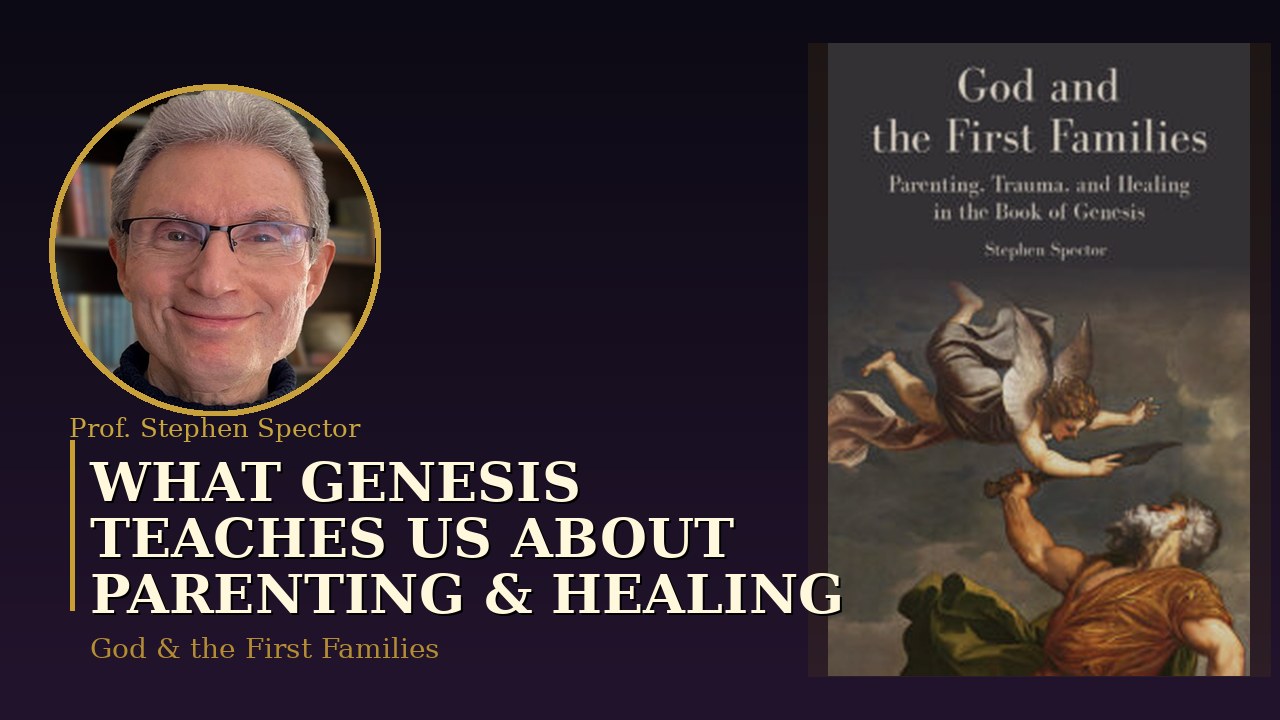
Most people know the stories of Genesis and the patriarchs—Abraham and Isaac, Jacob and Esau, Joseph and his brothers. But Professor Stephen Spector, professor emeritus of English at Stony Brook University and author of the new book God and the First Families, argues that these ancient narratives do something that modern psychology is only now catching up to: they map, with remarkable precision, exactly how parental love either builds resilience in children — or destroys it.
“Genesis is a lot about healing,” Spector told Israel365 News. “Just about every single character could be a case study.” Published by the Jewish Publication Society, the book uses four dominant American perceptions of God and four established parenting styles as lenses through which to read the first book of the Bible, and what emerges is a portrait of God as a parent who, contrary to traditional rabbinic assumptions of divine immutability, changes His approach as humanity itself matures.
The Sages have long maintained that God does not change. Spector respectfully challenges that view — not regarding God’s essence, but regarding His methods. “Although it’s a traditional rabbinic view that God does not change,” he said, “what I found was that God’s parenting style does.” In the Garden of Eden, God operates in what psychologists call the authoritarian mode: He issues commands without explanation and metes out punishment without elaboration. When Adam is told not to eat from the Tree of Knowledge, no reason is given. “When he punishes Eve, he doesn’t give her a reason,” Spector noted. “He doesn’t tell them why he didn’t want them to have the knowledge of good and evil — which is a serious question. Why would a parent not want the child to have wisdom?”
This stands in sharp contrast to what psychologists call authoritative parenting — a distinction Spector is careful to draw. “The authoritative God is not insisting mainly on obedience and submission to authority — the authoritarian God does so,” he explained. “Authoritative parenting is that you explain the reasons. You want your child to develop an ethical sense, to see the ethics behind the rules, and to develop a sense of empathy for others by understanding the way society works, rather than simply being told don’t do this or do that.”
By the time Genesis reaches Jacob and his sons, the dynamic has shifted entirely. God is no longer demanding simple obedience — He is engineering situations in which His children must learn, through lived experience and suffering, why their actions were wrong. “With Jacob’s children,” Spector said, “God wants them to know from personal experience why what they did was wrong and how it feels to do what they did to Joseph. By the time they’ve gone through the trials that Joseph puts them through, they’re capable of understanding, and they are capable of remorse, and capable of reconciliation. That’s the kind of personal growth that you don’t see in Adam.”
The biblical term for this process is teshuvah — return. And Spector sees it as the culmination of Genesis’s entire parenting arc.
The verse that anchors this shift is the account of Jacob wrestling with the angel:
“Your name shall no longer be called Jacob, but Israel, for you have striven with God and with men, and have prevailed.” (Genesis 32:29)
It is the moment when God stops demanding submission and begins honoring human agency. “From that point on,” Spector said, “God says, ‘You’ve wrestled, you struggled with God and humans, and have prevailed.’ That’s what he wants — but not earlier on. The authoritarian God wants obedience, submission, fear. At the moment of the Akeidah, the binding of Isaac, the angel says, ‘Now we know that you fear God.’ That’s what God seems to want at that moment.” The contrast with how God addresses Jacob after the wrestling match could not be sharper. “With Jacob, God emerges as the authoritative God — allowing some agency to humans and respect to people.”
This, psychologists today identify as the most effective model of child-rearing. Genesis reached that conclusion 2,500 years ago.
The book’s most striking finding concerns which characters in Genesis actually survive trauma intact. Of all the people who suffer in those narratives — and virtually all of them do — only two emerge with the full capacity to forgive and to make others feel safe. “There are only two characters in all of Genesis who survived trauma well, who come through it without being reduced in some way — who are capable of making others feel safe and forgiving,” Spector said. “One of them is Joseph. The other, which surprised me when I thought about it, was Esau — especially since in Jewish tradition Esau is a villain.”
The professor points to Joseph and Esau as the two characters who dealt most with difficulty. “These are the two characters who are able to transcend trauma,” Spector said. “They’re also the two characters who are well-loved by their fathers. Think about that.”
The trauma expert Bessel van der Kolk, writing today about trauma victims with no reference to Scripture whatsoever, reaches an identical conclusion. “Having been loved as a child,” Spector said, paraphrasing van der Kolk, “and knowing that you had a place in the heart of someone who took care of you — that is the best possible protection against the injuries of life. It prepares the brain. And what I’m saying is that 2,500 years earlier, Genesis makes the same point.”
Esau, the archetypal villain of Jewish tradition, comes through his betrayal by Jacob and is able to embrace his brother. Joseph — thrown into a pit, sold into slavery, falsely accused, imprisoned — feeds the very brothers who destroyed his youth and weeps with them in reconciliation. The ones not loved by their fathers do not forgive. The pattern holds without exception.
“Favoritism lifts up people, but it also causes trouble,” Spector noted. “Everybody suffers when you show favoritism in Genesis — including Joseph. It’s the reason his brothers treat him the way they do.” And yet Joseph’s suffering, rooted in that same favoritism, becomes the crucible for his remarkable capacity to forgive. “The lesson I’m trying to develop in the book is that love is at the heart of relationships. Being well-loved by your parents can, in a sense, inoculate against trauma.”
For Spector, this is not merely literary analysis. It is a blueprint. Genesis presents not perfect people but flawed people in the hands of a God who wants them to grow. “The idea that anyone is all good is put to a test, because there are so many flaws that emerge,” he said. “Humans are flawed, and that’s what God has to work with. It’s only when humans are capable of growth that God is able to change the parenting style. Suffering is God’s workshop — it’s the workshop where ethics are born.”
The Talmud’s critique of King Saul — she’hayah tzaddik, meaning he was too righteous, too perfect — affirms what Genesis repeatedly shows: it is David, the broken man crying out to God in his failure, who builds something that endures. “David’s story has in common with the ancestral section of Genesis,” Spector said, “that the narrators do not withhold describing the flaws of their heroes. That’s what God has to work with. And God wants them to grow up.”
God and the First Families is available through the Jewish Publication Society. Spector is also the author of Evangelicals and Israel: The Story of American Christian Zionism, widely credited with reshaping Jewish understanding of evangelical support for Israel. “What I found in interviewing their pastors and others,” Spector said of his research into Christian Zionism, “was that it’s much more complicated than many assumed, and that evangelicals — many of them — have a deep respect for Judaism, a gratitude and connection.”
The lesson of Genesis, as Spector reads it, is deceptively simple and almost impossible to execute. “One of the lessons of Genesis,” he said, “is be generous in your love and fair.” Every act of love compounds. Every withheld love also compounds. The first family in history already knew this — and wrote it down.