
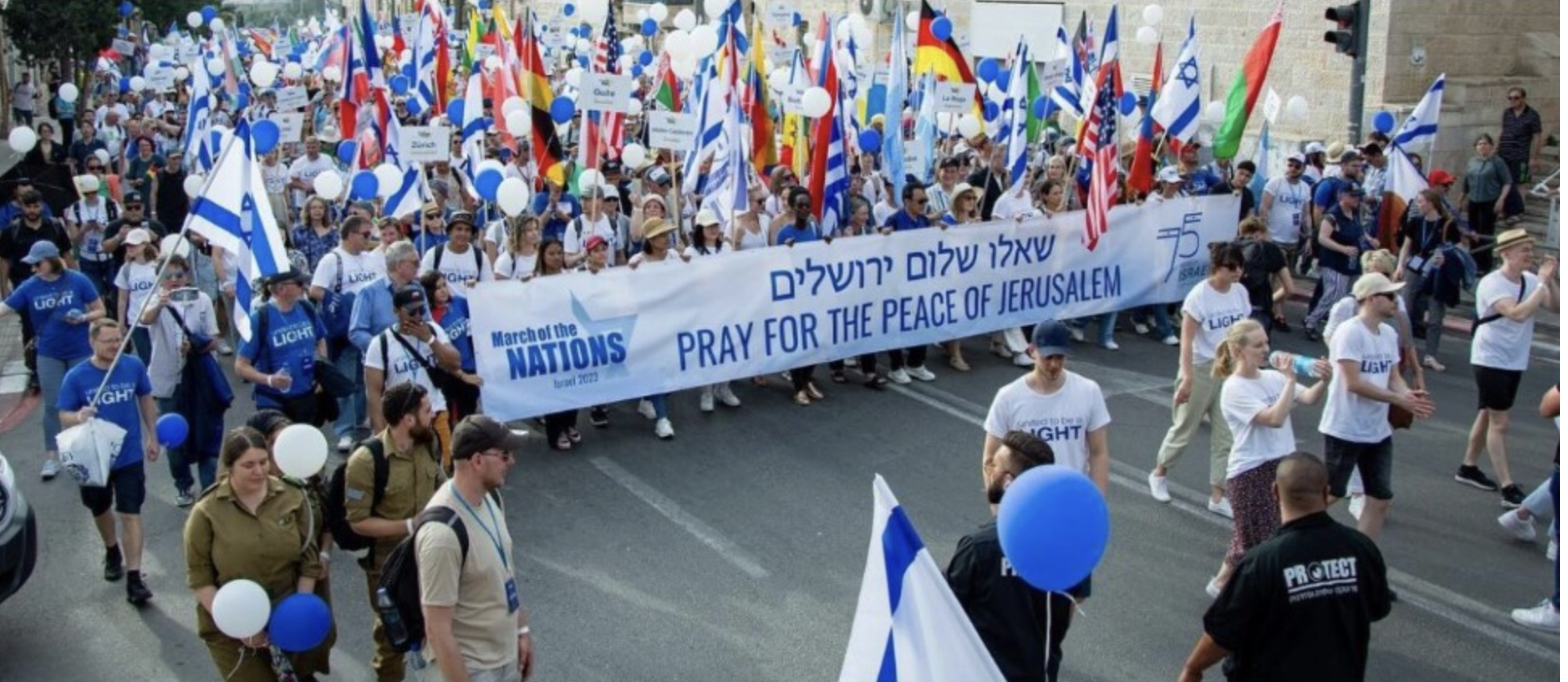
Even as rockets fell and air raid sirens pierced the Israeli night, more than 200 participants from 11 nations refused to cancel their trips. They had come to march through the streets of Israel; not to protest, not to demand anything, but simply to say: you are not alone.
The message was delivered by the March of the Nations, the annual Israel-focused event of the March of Life movement, which brought Christian supporters from across the world to march alongside Israelis in four cities: Haifa, Tiberias, Netanya, and Ashkelon. The marches took place around Yom HaShoah, Holocaust Remembrance Day, as they have done each year since 2007, when the movement was founded in Tübingen, Germany.
This year, however, the march carried a weight unlike any before. Israel is at war.
A Movement Born of Repentance
Among those who made the journey was Claudia Kiesinger, the New York-based National Coordinator for the March of Remembrance in America and one of the most recognizable faces of the March of Life movement worldwide.
Kiesinger’s paternal grandfather was an ardent Nazi and follower of Adolf Hitler. Out of a growing desire to know more about the dark cloud that hung over her family’s past, she took part in the first March of Life in 2007, a memorial march at historic locations of the Holocaust, joining 350 participants from 14 nations who walked over 200 miles from Bisingen, a concentration camp near Tübingen in southwest Germany, to Dachau in upper Bavaria, retracing the final death march of the Jews imprisoned in those camps.

That walk changed her life.
When Kiesinger was in her 40s, research into German government archives confirmed what she had long suspected: both of her grandfathers were Nazi perpetrators, ardent followers of Adolf Hitler. She had grown up being told she was descended from former German Chancellor Kurt Georg Kiesinger, a source of family pride, without knowing he too had been a high-ranking Nazi Party member. The shock of these discoveries led her to devote herself to the movement.
“We cannot really fix something, because we cannot undo what happened,” she told Israel365 News. “But it is important for us to be out on the street, to be visible, because the Holocaust happened publicly. So raising our voices against antisemitism and the things we see exploding worldwide means taking to the streets with marches in Europe and globally.”
Today, Kiesinger serves as the National Coordinator for the March of Remembrance in the United States, as well as a representative of the UN Prayer Watch, a Christian prayer and advocacy initiative at the United Nations on behalf of Israel.
Marching Under Fire
The decision to come to Israel this year was not easy.
Just days before the march was set to begin, a rocket fired by Yemeni Houthi rebels struck near Ben Gurion Airport, causing numerous flight cancellations. Through multiple rebookings, complicated open-jaw flights, and sheer determination, over 90% of registered participants still managed to reach Israel. Their willingness to rebook and reroute became, in itself, a powerful statement.
Kiesinger arrived a full week early. “I live in New York, and when you come to Israel, you don’t want to just come for a couple of days,” she said. “I wanted to have time, to see friends, to just be here.”
During her visit, the reality of wartime Israel was impossible to ignore. Air raid sirens sounded at night. Artillery fire could be heard in the evenings. Residents had instructed Kiesinger on the location of the nearest bomb shelter in her Airbnb.
“We asked our landlord where the shelter was, just to be prepared,” she said. “I’ve never been in that situation before. But we’re here.”
In total, around 300 people from 14 nations came to Israel from May 11 to 14 to show their friendship and support. On May 14, over 250 international participants marched together with hundreds of Israelis in five cities, carrying a clear message: “Israel, we are allied with you. You are not alone.”
Holocaust Survivors and Former Hostages
The march week began with a gala evening at Beit HaAm in Jerusalem.
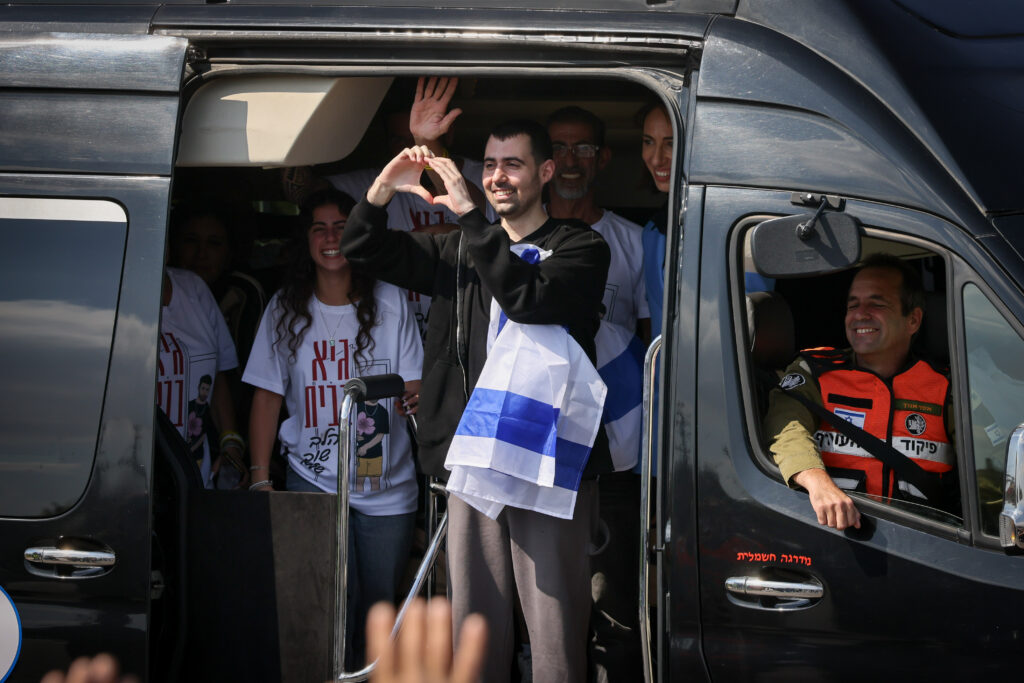
Guests of honor included Irene Shashar, Rachel Fletcher, Shlomo Hameiri, and Arye Itamar, all survivors of the Shoah, as well as Ilan Dalal and his family, who had been waiting for more than 600 days for the release of his son Guy Gilboa-Dalal from Hamas captivity.
Guy’s release was a moment the march community had prayed and hoped for across dozens of events. “All the marches we had last year, we had the hostage pictures, but we had also especially adopted Guy in a way,” Kiesinger said. “He was part of us, and our movement, and we prayed for the release of all the hostages.”
Also present was former hostage Luis Ha, who had been a dancer before his captivity. That evening, he danced with the March of Life’s dance team, a moment that drew tears and applause from the crowd.
In Haifa, 93-year-old Holocaust survivor Naftali Films, originally from Bratislava, Slovakia, joined the marchers. He had spent years traveling to share his story, but said he had long thought there was no one from the other side willing to share theirs. That day, a March of Life participant whose family came from just 20 kilometers away from his hometown stood before him and recounted what his mother had said when asked about the Jews who had lived nearby: “One day they were just gone.”
“That is the indifference we are trying to break through,” Kiesinger said.
‘Remembrance Means Responsibility’
The March of Life was founded by Jobst and Charlotte Bittner and TOS Ministries from Tübingen, Germany. Together with descendants of German Wehrmacht soldiers and members of the SS and police force, they organized memorial and reconciliation marches at sites of the Holocaust across Europe. In 2011, the March of Life was honored by the Israeli Knesset for its special efforts on behalf of Holocaust survivors.
This year, the movement’s motto was Remembrance Means Responsibility, a phrase that Kiesinger embodies in her work. Since joining in 2007, she has helped grow the movement’s U.S. presence and has organized annual marches across American cities in the weeks around Yom HaShoah.
“This year we already held 60 marches globally, and more are coming,” she said.
The movement’s approach is local by design. Each march features a Holocaust survivor sharing their story, and participants are encouraged to research the specific history of antisemitism in their own city and family.
“For example, Tübingen, that was an antisemitic city not just during the Holocaust, but way before, going back centuries in history,” Kiesinger said. “Knowing that, coming from there, and making the decision to go the other way, that is where the responsibility begins.”
A New Exhibition in Jerusalem
The march week also saw the opening of a new permanent exhibition on Joseph Rivlin Street in Jerusalem titled From Foes to Friends. The exhibit traces both the story of the March of Life movement and the deeper roots of antisemitism, including its history within Christianity, long before the Nazi era.
“We want to raise that subject with Christian tourists,” Kiesinger said, “to make them aware, because that was present in every other nation.”
The exhibition, which opened temporarily last year at Beit HaAm, will now remain in Jerusalem for at least one year, a permanent testimony in the heart of Israel’s capital.
‘After the Jews, They Come for the Others’
When asked about the explosion of global antisemitism since October 7, Kiesinger spoke with the authority of someone who understands how ordinary people enable atrocities.
“The main reason the Holocaust was able to happen was the indifference of the people,” she said. “My grandparents were not crazies. They were normal people who made it possible because all of society was going along with the Nazi ideology and the lies, or just being bystanders, looking the other way when their Jewish neighbors were deported.”
She drew a direct line to the present. “From the river to the sea, people don’t even know what river and what sea they mean. They don’t care. That indifference is what we need to break through.”
Right after October 7, the March of Life began hosting a daily online prayer for Israel. “I had a friend join us from the United States, and in the middle of the meeting, the sirens went off, and she was just gone. That was when we really understood what it means to live here.”
Kiesinger had no doubts about Israel’s cause. “I knew immediately after October 7: Israel is fighting also for me. Because after the Jews, they come for the others.”
‘If It Happens Again, I Will Not Be Alone’
For Kiesinger, one moment above all others crystallized her life’s mission. It came at an ordinary coffee table, from a Holocaust survivor named Rose Price, the first survivor she had ever met, at the 2007 march to Dachau, who became a close friend of her mother.
“One day, out of the blue, she turned and said to me: ‘I’m glad you’re my friend, because if it happens again, I will not be alone, like I was during the Holocaust.'”
“That was the moment,” Kiesinger said. “I cannot say I would have been one of the brave ones during the Holocaust. I cannot say that. But I live today. And today, that’s my decision.”
She brought her nephew and niece on this year’s march.
“My whole family is in it together,” she said.
As she prepared to board a flight back to New York, carrying the weight and the hope of another year of marches in American cities, she left Israel with one final promise: “Israel, you are not alone, and we will not stop.”