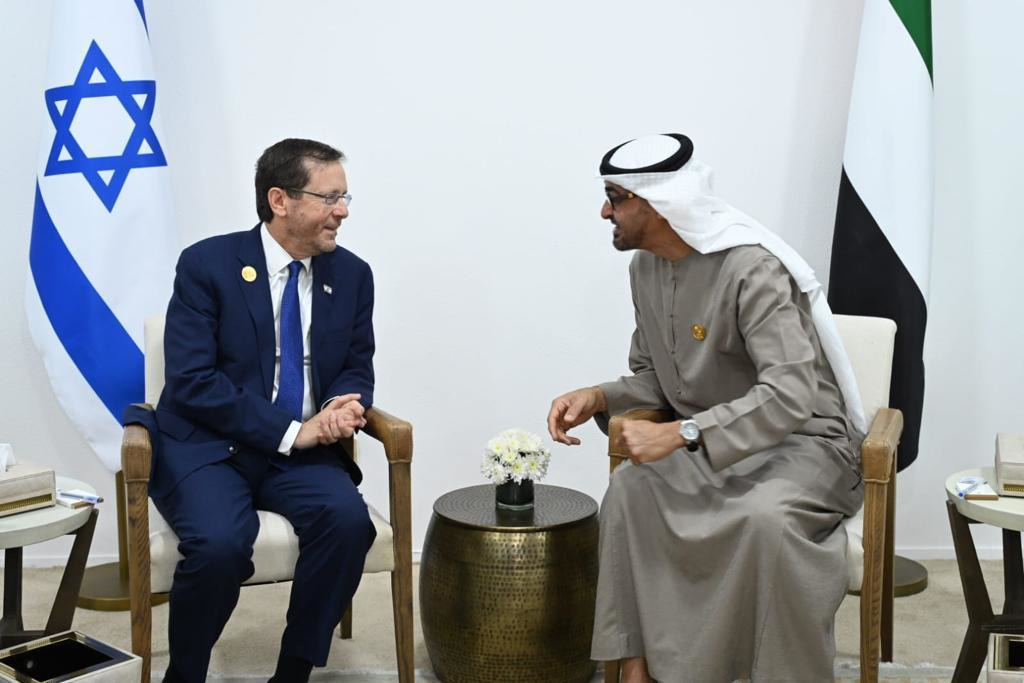
When Iran unleashed its fury on the United Arab Emirates on February 28, firing over 550 ballistic and cruise missiles and more than 2,200 drones at Emirati cities, airports, and energy facilities, something unprecedented happened. Israel, a Jewish state, sent its soldiers and its most advanced defense technology to protect an Arab nation. That moment, more than any diplomatic ceremony or signed accord, revealed the true depth of what the Abraham Accords had quietly been building for five years.
The prophet Yeshayahu (Isaiah) foresaw a day when old enmities would dissolve in the face of a shared purpose: “In that day, Israel will be the third, along with Egypt and Assyria, a blessing in the midst of the earth.” (Yeshayahu 19:24) The Sages understood this verse not as idle poetry but as a geopolitical prophecy: Israel’s true role among the nations is not isolation, but serving as a stabilizing force at the center of a transformed Middle East. The events of 2026 are beginning to look like that vision made flesh.
Following a direct phone call between Prime Minister Benjamin Netanyahu and UAE President Mohamed bin Zayed Al Nahyan, Netanyahu ordered the IDF to deploy an Iron Dome battery — interceptors, operators, and all — to Emirati soil. It was the first time Israel had ever sent the system abroad, and the first time the Iron Dome had ever been fired in a foreign country. Israeli crews went on to intercept dozens of Iranian missiles and drones aimed at UAE targets, while the Israeli Air Force simultaneously struck short-range missile launch sites in southern Iran to neutralize threats before they could be launched at the Gulf states.
Israel also dispatched a version of the Iron Beam, its high-power laser interception system, which had only received its first operational IDF delivery in December 2025, along with an advanced surveillance system known as Spectro, capable of detecting Iranian drones from up to 20 kilometers away. These were not symbolic gestures. They were battlefield deployments.
According to reporting by The Wall Street Journal, Abu Dhabi conducted dozens of airstrikes against Iranian targets, including the Lavan Island oil refinery, the Asaluyeh petrochemical complex, the port city of Bandar Abbas, and sites on Qeshm and Abu Musa Islands in the Strait of Hormuz, with intelligence assistance from both the United States and Israel. The operations continued even after the April 8 ceasefire was announced, and their scale far exceeded what had been previously disclosed. IDF Chief of Staff Lt. Gen. Eyal Zamir made a secret wartime visit to Abu Dhabi to oversee joint defense operations alongside American delegates.
Iran’s response to Emirati participation was to make the UAE the most heavily targeted country in the entire conflict, even more than Israel itself. Tehran’s goal was transparent: raise the cost of involvement high enough to break the coalition. It failed. “The war brought an unprecedented level of closeness, driven largely by a shared sense of fate. Both countries were attacked, and the enemy is common,” one Israeli official told CNN. “This will definitely be reflected in the expansion of relations from here on.”

A senior Emirati official put it with equal directness: “We are not going to forget it.” Another said: “It was a real eye-opening moment. To see who our real friends are.”
U.S. Ambassador Mike Huckabee, offering the first official American confirmation of the Iron Dome deployment, credited the Abraham Accords directly: “Look at the benefits. Israel just sent them Iron Dome batteries and personnel to help operate them. How come? Because there’s an extraordinary relationship between the UAE and Israel.”
The Abraham Accords, signed in September 2020, were criticized at the time by those who dismissed them as shallow normalization deals with no real peace, no real friendship, and no real cost. The war with Iran has answered that criticism definitively. What was signed on paper in Washington has been written in missile intercepts over Dubai and in Israeli soldiers standing guard on Emirati soil. The Sages taught v’ahavta l’reiacha kamocha, Love your neighbor as yourself, is the foundational principle of human relations. In 2026, Israel and the UAE put that principle into practice on a battlefield, and the Middle East will not look the same again.