


The Kohanim planned it like a military operation, training for months, consulting leading rabbinical authorities on every halachic (Jewish legal) detail, preparing backup loaves in case of failure, and assigning each participant a precise role. And then, on Shavuot — a day when the Temple Mount was officially closed to Jews — they ran barefoot across the holy site, dodging Arab worshippers hurling plastic chairs and police officers trying to tackle them, and waved the Shtei HaLechem (the Two Loaves offering) for the second consecutive year. Thirteen of the fourteen participants were arrested. The loaves are in police custody. And the men who carried them say they felt nothing but joy.
13 נאמני הר הבית הצליחו לפרוץ לתוך מתחם הר הבית, מתוך מחסום משטרתי. זו לא פעם הראשונה בשבועות האחרונים שהם מצליחים להיכנס להר הבית בניסיון לבצע קורבן. אבל זה בהחלט פעמים ראשונות בתקופת מפקד המחוז הנוכחי שזה קורה פעמיים ובטח ובטח בתקופה מתירנית של השר הנוכחי. pic.twitter.com/A2dgXJwpuK
— Yossi Eli (@Yossi_eli) May 22, 2026
This is their story, in their own words.
The Kohen Who Waved the Bread
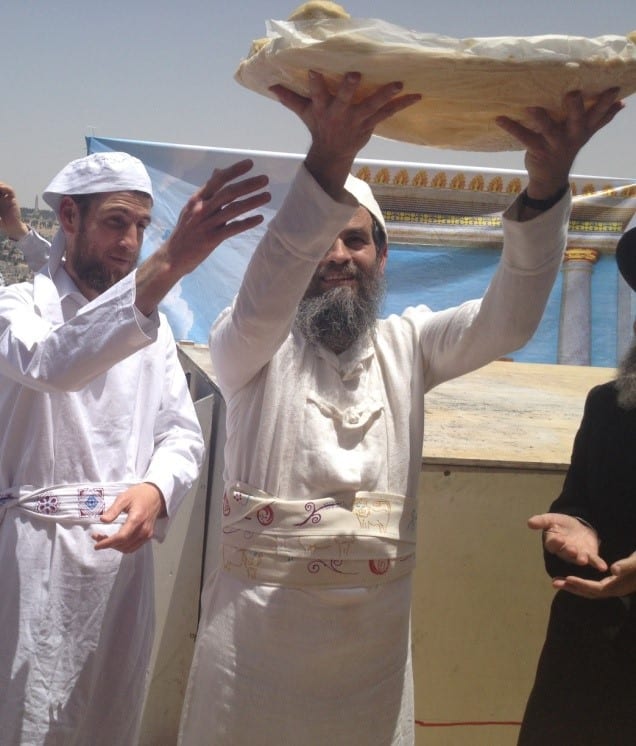
Ariel Cohen is the kohen who performed the waving itself — this year and last year. He arrived on the Temple Mount dressed in bigdei kehuna — full priestly garments — including an avnet (belt) prepared according to the method of the Rambam (Maimonides), with special embellishments this year, including techelet (blue dye) colored lishmah — specifically for the purpose of the commandment. The avnet contained shaatnez — the normally forbidden mixture of wool and linen — which is permitted specifically for priestly garments worn in service.
The loaves themselves, prepared by a specialist in Temple-related baking, were enormous. “They are very large and very heavy,” Cohen said. “I can’t say exactly how much they weighed, but approximately five kilos. It was very hard to run with priestly garments and the tray.”
The group entered through Sha’ar HaTzon — the Sheep’s Gate — in the northwest corner of the Temple Mount compound. The plan was to enter at around 5:30 PM, when the site would be relatively calm. It was not. That hour coincided with Muslim evening prayers, and the site was more crowded than expected.
Cohen managed to receive the metal thermos needed for the kidush yadayim veraglayim — the ritual sanctification of the hands and feet required before priestly service — while running and taking blows. “One of the young men managed to reach me with the thermos at a certain point while running and receiving hits,” he recounted. “I washed first both feet and my left hand, then my right hand.” The thermos fell several times along the way and was even dented — but made it.
“During the entire ascent, there was chaos. At least three young Arab men beat members of the group and tried to block their path. Police also used force and scratched my forehead, but miraculously, my glasses and priestly cap did not fly off.”
Amid the chaos, his avnet began to loosen and eventually fell. He cannot say with certainty whether this happened before, during, or after the waving. “Everything was a matter of a few seconds.”
Cohen was able to advance as far as possible toward the Azarah — the Temple Courtyard — though he acknowledges he cannot state with absolute certainty whether he crossed fully into its boundaries. “There is no complete certainty, but there is a high probability. Afterward, it is hard to point to an exact location, because everything happened very fast.”
Despite not managing to recite the blessing over the sanctification of hands and feet this year — something he had succeeded in doing last year — his satisfaction was unmistakable. “I am glad we reached what we reached despite the difficulties and the many disruptions. Yitbarach shmo shel HaKadosh Baruch Hu — blessed be the Name of the Holy One, blessed be He.”
Cohen emphasized that behind the action stand years of preparation and study, and that this was no spontaneous act. “It is important to understand that this did not come in a vacuum. The entire possibility of arriving and bringing offerings requires great preparation. This is not something anyone can do at home.” He added that rabbinical support has been broader than many might assume. “There are rabbis who support what we did. Many support it after the fact, including Haredi rabbis from Bnei Brak. There are also rabbis who oppose it due to many halachic questions.”
The Alternate Kohen: Planning a Military Operation
Eliyah Nachman Cohen of Bat Ayin was designated the backup kohen — ready to perform the waving if Ariel Cohen was stopped before completing it. He describes the months-long planning process as resembling a military operation in its precision.
“We had to plan the technical details — from entry to the Temple Mount, entry into the Azarah (courtyard), bringing the Shtei HaLechem in without breaking them and without rendering them impure, bringing in a vessel for the sanctification of hands and feet — all without being harmed by Arabs along the way and without being stopped by police.”
Two pairs of loaves were prepared in advance in metal trays. A legal condition was stipulated: the moment the kohanim entered the Azarah with the loaves, the trays would become sanctified as Temple vessels, and the loaves with them.
The logistics unraveled almost immediately. The person tasked with bringing the backup loaves was arrested at the gate — the loaves disappeared and have not been found since. (“They weren’t sanctified, so it’s not a disaster,” Eliyah Nachman noted.) The group of Israelites assigned to shield the kohen and distract the police did not make it up to the elevated platform in time. The man who brought the loaves to the group was nearly arrested due to an unrelated mistake.
“Specifically, the failures highlighted for us the hand of God, which watched over us and ensured the commandment was fulfilled properly,” he said. “We truly felt the hand of God.”
When police ultimately seized the waved loaves after the fact — grabbed from the hands of a group member who had taken them to prevent Arabs from stealing them — Eliyah Nachman remained focused on what had been accomplished. Under halacha, the Shtei HaLechem must be burned after the waving. He expressed hope the police would permit this. “The two loaves are under police arrest. According to halacha they must be burned, and I hope the police will allow it.”
Shabbat and the holiday were spent in custody. There was no properly supervised cooked food. “We had to make do with bread and jam. We barely received grape juice for Kiddush. We were not permitted to leave for synagogue.” Havdalah at the end of Shabbat was recited over wine alone, and only upon release by a judge did they receive a candle and spices.
“Despite everything, we were in an elevated atmosphere and in great joy over the privilege that fell to our portion.”
When asked about future plans, Eliyah Nachman closed the subject with a single request: “Pray that with God’s help the Temple service will soon be renewed.”
The Youngest Participant
Rafael Ben Weis is 15 and a half years old.
He joined the planning group back in the month of Shvat — months before Shavuot — when preparations began in strict secrecy, with the understanding that police would attempt to prevent entry. He describes the entire event simply as “kiddush Hashem meturaf” — an incredible sanctification of God’s name.
The group of 13 young men, aged 15 and a half and older, divided into two subgroups to avoid drawing attention and early identification. Each subgroup had a kohen carrying a set of the Shtei HaLechem, with two sets prepared at different measures of isaron (a unit of flour volume), so that if one kohen failed, the other could complete the commandment.
All participants immersed in a mikveh — a ritual bath — both the day before and the day of the ascent to the Temple Mount, to avoid the status of tevul yom (one who has immersed but whose purification is not yet complete).
Rafael recounts that when they reached the gate, it was closed, with only the small door within it open. The police officer asked them to leave. They pushed through together, forced the door open, and ran. Waqf officials standing behind the door were knocked back unintentionally. “We came only to fulfill the commandment of waving the bread. We opened the gate with force without knowing that Waqf officials were standing behind it.”
Arab worshippers threw plastic, wooden, and metal chairs at the running group. “Miraculously, they did not manage to hit the kohen or the bread,” Rafael said.
He saw the waving moment directly. “I saw Ariel wave the bread, and then a police officer jumped on him and knocked him to the floor.” Moments later, he himself was thrown to the ground by a police officer. He used the moment to prostrate himself before God.
The police response was massive. “Around 40 to 50 Magavnikim” — Border Police officers — “fell upon us and removed us with violence.” As he was being taken out, Rafael called out Shema Yisrael and Hashem Hu HaElokim — “Hear O Israel” and “The Lord, He is God” — to perform a public kiddush Hashem (sanctification of God’s name).
He describes the treatment by police as that reserved for the most dangerous of terrorists, which he called “a disgrace for the State of Israel, which is a Jewish state and should be strengthening the fulfillment of commandments.” The group remained handcuffed for seven hours — part of the time hands only, part of the time hands and feet. Police, in their urgency to catch participants, arrested two young men who had no connection to the event at all and simply wore similar shirts.
Shabbat in custody, despite the conditions, was, by his account, genuinely uplifting. The group made Kiddush in their cell on Friday night and again at the Shabbat midday meal. They received two prayer books. “We had a very elevated Shabbat despite the conditions, because we felt we had merited to perform a great commandment.”
The judge released them at the end of Shabbat, over the police’s objection.
Rafael has been active in Temple Mount and Temple-related activism for two and a half years. His focus is not on individual action but on building a mass movement. “The Temple belongs to all of the Jewish people — this is not a private matter,” he said. He insists on acting in groups rather than alone, because the commandments of the Temple are communal, not individual. “The more we do this, the more the public becomes accustomed and begins to want it as well.”
He had known before the ascent that arrest was likely. “I knew it would not be simple, and that they would probably arrest us, but I knew I was doing something great and I was very happy in the commandment I fulfilled.”
His final words: “We had actual miracles. I was certain they would arrest us on the way, and we would not manage to arrive at all — but in the end we succeeded. We saw in this assistance from Heaven.”