
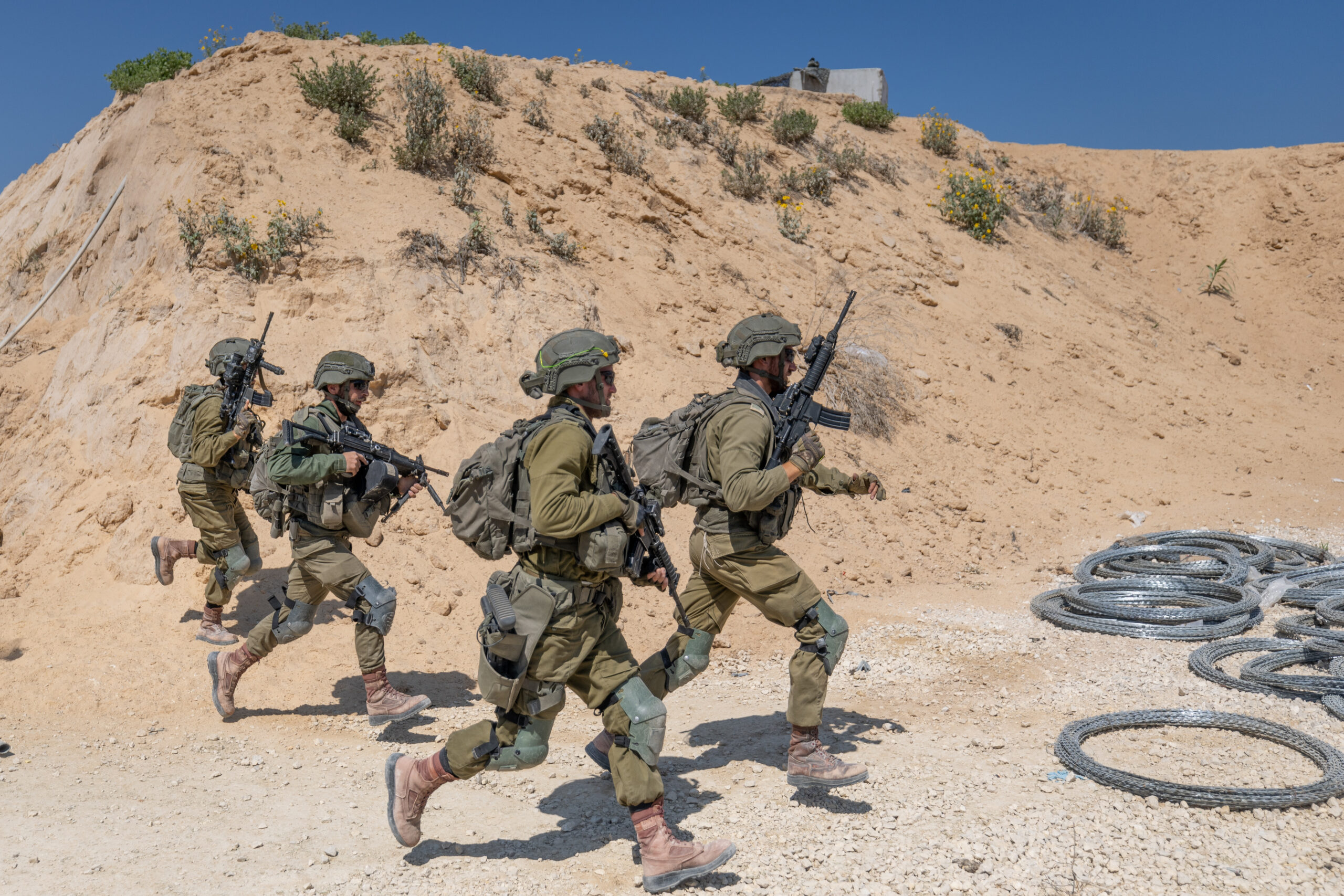
The IDF announced this week that 433 ultra-Orthodox recruits enlisted during the April-May 2026 recruitment cycle, a 24% jump over the same period in 2025, including a record 272 in combat roles. The image is striking: young men with beards, peyos (sidelocks) curling past their jaws, carrying rifles in the Jordan Valley. They are Haredim — ultra-Orthodox Jews — and they are soldiers. The numbers are real. So is the firestorm surrounding them.
When the Jewish people faced existential war, the expectation was clear: The exemptions listed in Sefer Devarim (the Book of Deuteronomy) were narrow, specific, and temporary. The Sages understood that national survival was a communal obligation — not optional for the inconvenient or the ideologically opposed.
Halacha — Jewish law — takes this further through the concept of milchemet mitzvah, a war mandated by God. Maimonides, the Rambam, codifies in Mishneh Torah (Hilchot Melachim, Laws of Kings 5:1) that a milchemet mitzvah requires no special royal declaration and carries no opt-out: it includes wars fought to defend Israel from an enemy attack. In such a war, the Rambam rules, “everyone goes out, even a groom from his chamber and a bride from her canopy.” The Sages derived this from the wars of Joshua and from the logic that the survival of the Jewish people overrides virtually every other religious consideration. A man is obligated to interrupt Torah study itself to take up arms when the community is under direct threat. The current war, fought simultaneously in Gaza, Lebanon, and against Iran’s proxies across seven fronts, fits the definition of milchemet mitzvah by any classical standard.
This is the halachic ground that makes the conscription debate so theologically charged. The Haredi leadership does not dispute the category of milchemet mitzvah — they dispute whether this war meets the threshold, or whether the particular form of communal Torah study they maintain constitutes its own existential defense. That argument has deep roots in Jewish thought: the Talmud in Makkot 10a states that Torah study protects those who engage in it. But the Sages who said that never suggested it replaced swords. The Maccabees, whose name the Hashmonaim Brigade carries, were Kohanim (priests) — men of the most sacred religious caste — and they fought.
The current surge is being driven, at least in part, by legal compulsion. In 2024, the High Court of Justice struck down the blanket exemptions that had shielded the Haredi community from conscription for decades. Since that ruling, more than 79,000 conscription orders have been issued. The Israel Democracy Institute credits the enforcement measures that followed for the gradual rise in enlistment numbers, while stressing that the IDF’s manpower needs remain far from met.
The flagship unit for Haredi soldiers is the Hashmonaim Brigade — Hativat HaHashmonaim — named for the Maccabees, the priestly warriors who reclaimed the Temple in Jerusalem in the 2nd century BCE. It is an infantry unit designed to allow soldiers to maintain a fully Haredi lifestyle: beards and peyos intact, no foul language, dress in accordance with halacha (Jewish law), and Torah study woven into the service structure. Enlistees sign a formal commitment to that standard. This cycle, 96 Haredi combat recruits joined the Hashmonaim Brigade — a new unit record. The brigade entered active operations in Lebanon in mid-March 2026, as part of the broader Iran war.
Prime Minister Benjamin Netanyahu traveled to visit the unit in the Jordan Valley this week, with Knesset Foreign Affairs and Defense Committee chairman Boaz Bismuth at his side. Netanyahu’s formulation on the draft controversy was deliberate and politically loaded. “Whoever does not study Torah must enlist,” he said. “And when he enlists, he must have the right to enter as a Haredi and leave as a Haredi.” He stopped short of calling for across-the-board Haredi conscription, drawing the line instead at those outside the yeshiva system — a position calculated to preserve his coalition with ultra-Orthodox political parties while satisfying neither side fully. He called the Hashmonaim soldiers “Maccabees” and told them they are “trailblazers.”
Brig. Gen. Shay Tayeb, head of the IDF’s Personnel Support Division, praised the recruits while making clear the numbers are still inadequate. “The operational need remains significantly greater, as does the IDF’s capacity to absorb additional recruits,” Tayeb said. “Given the scope of its missions, the IDF must continue expanding the number of recruits and service members from all sectors of Israeli society.”
That word — “all sectors” — is where the political war erupts. The ultra-Orthodox political parties, primarily Yahadut HaTorah (United Torah Judaism) and Shas, have for decades treated conscription exemptions as a non-negotiable condition of their coalition participation. Their argument is theological: Torah study sustains the Jewish people spiritually, and those who dedicate their lives to it perform a form of national service no less vital than military service. The secular and traditional Israeli majority — particularly the families of soldiers killed and wounded in Gaza and Lebanon — reject that argument with growing fury. The resentment is not abstract. It is felt at funerals, at reserve duty call-ups, at kitchen tables across the country.
The Knesset has been unable to legislate a durable solution. Every proposed framework either fractures the coalition or fails to meet the court’s constitutional threshold. With elections approaching, Netanyahu’s visit to the Hashmonaim Brigade reads as much as a campaign statement as a military one. His balancing act — honoring Torah scholarship while insisting non-scholars must serve — satisfies the IDF brass no more than it satisfies the Haredi street.
What is not debatable is what the Hashmonaim soldiers themselves represent. These are men who chose to serve, who carry weapons with tzitzit (ritual fringes) under their uniforms, who are proving in practice what the political class cannot agree on in theory: that Haredi identity and military service are not mutually exclusive. They are the Maccabees Netanyahu called them — and like the original Maccabees, they are fighting a battle on two fronts simultaneously, one external and one very much within their own people.