

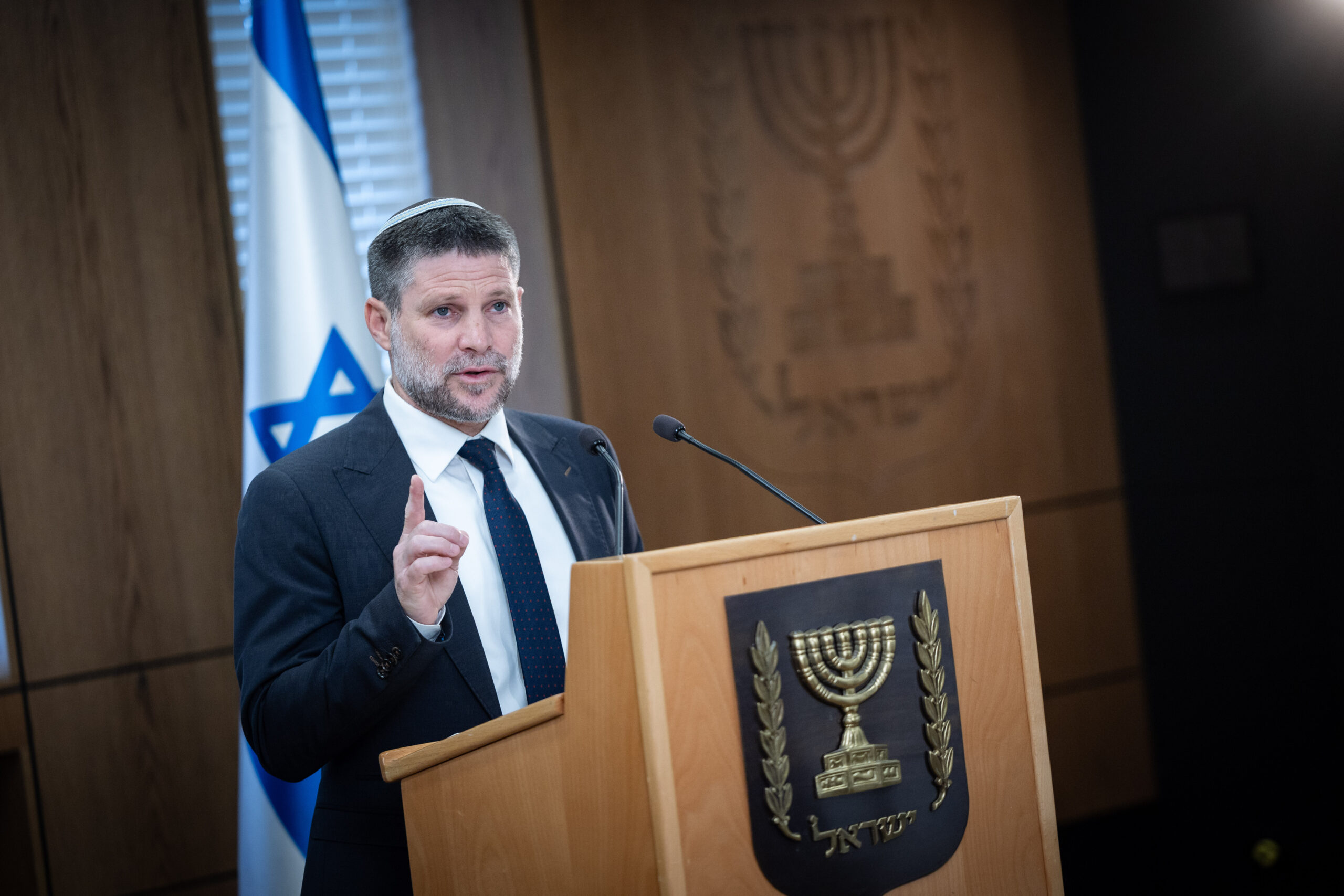
Thirty-three years after the Oslo Accords were signed, Israel’s Finance Minister Bezalel Smotrich has a message for the world: it’s over. The framework is dead. And Israel has roughly two years to make that permanent.
In a wide-ranging interview with Matzav HaRuach, the Hebrew-language Israeli weekly, Smotrich laid out his case for dismantling the Palestinian Authority entirely — and replacing it with something that can never become a state. Smotrich came to the interview with a detailed blueprint, built around a specific diplomatic window that he believes Israel cannot afford to waste.
“The day after Trump will come,” Smotrich warned, “and who knows what will happen in the United States. Will there be backing [for Israel’s right to Judea and Samaria]? Will there not? And what government will be here? I don’t know many people like Netanyahu who are capable of standing up to such enormous international pressure without caving.”
What Oslo Actually Said. And What Happened Instead.
To understand Smotrich’s argument, it helps to understand what the Oslo Accords actually created. Signed in 1993 and expanded in 1995, the Accords divided Judea and Samaria — the biblical heartland that many in the West call the “West Bank” — into three administrative zones. Area A, roughly 18% of the territory, was handed entirely to Palestinian Authority control, encompassing major Arab population centers like Ramallah, Jericho, and Jenin. Area B, about 22%, gave Israel military control while the PA managed civilian affairs. Area C, the remaining 60%, remained under full Israeli administration — and under the Accords, Israel retained the right to build there freely.
The Accords were sold as a transitional framework. A final-status agreement was supposed to follow within five years. It never happened.
What remained was the Palestinian Authority — not a state, but steadily drifting toward one. “The PA is already a UN observer state,” Smotrich told Matzav HaRuach, “and soon the UN is set to discuss putting it in line to chair the General Assembly. The reality is not static.”
A Partner That Was Never a Partner
Western governments and the media rarely acknowledge the truth: the Palestinian Authority is not a governing body that happens to have a terrorism problem. It is an institution that was built on terrorism and has no intention of changing.
Mahmoud Abbas, the PA’s president, was elected in 2005 to a four-year term. He is now in his twentieth year in office. There have been no elections. His sons, Tarek and Yasser, have accumulated multi-million-dollar business empires while ordinary Palestinians have remained mired in poverty, their internationally donated funds siphoned off by PLO officials who built luxury villas in Ramallah. Critics who speak up pay a steep price. In 2021, PA security forces beat dissident Nizar Banat to death in custody. No one was held accountable.
But the PA’s most revealing policy is one that Western governments have quietly funded for years: Pay for Slay. Under this official PA program, the Palestinian Authority pays monthly salaries to Palestinians imprisoned for murdering Israelis — and to the families of those killed while carrying out attacks. The more Israelis killed, the higher the salary. This is not a fringe phenomenon or a rogue expenditure. It is a budget line item, embedded in official PA financial planning, funded in part by international donor money.
This is the entity the world has been demanding Israel accept as a peace partner.
Why Israel Must Act Now
Smotrich posed a simple question: if the Palestinians have not honored the Oslo framework — building tens of thousands of illegal structures throughout Area C, arming beyond what the Accords permit, running what he called “commando training” against Israeli communities — why should Israel remain bound by it? As of 2022, there were over 81,000 illegal Arab-built structures in Area C alone, covering an area twice the size of all Jewish communities in Judea and Samaria combined. Oslo, for the Palestinians, has been a one-way street.
His alternative is a system of local municipal administrations. Palestinians in Hebron, Nablus, Ramallah, and Jenin would elect mayors and city councils, manage daily life, and hold local identity documents. What they would not have is a military, a sovereign political entity, or any institutional path toward statehood. “They will have no military or security force that threatens me, no weapons, no political entity that can challenge Israel in the international arena,” he said, “and above all, the door to Palestinian statehood — for them and for every foreign government pushing for it — will be closed permanently.”
Smotrich does not pretend the hard questions don’t exist. What happens to the more than one million Palestinians living in Judea and Samaria? He acknowledges the difficulty openly. But he argues that preserving the PA — a governing body with its own security forces, its own weapons, and its own political ambitions — is far more dangerous than dismantling it. Israel tried that experiment once before, in Gaza. “The last time we gave territory to a non-state entity to govern as it pleased, we got October 7 in the face.”
Since the current Israeli government took office three years ago, Smotrich’s party, Religious Zionism, has driven an unprecedented expansion of Jewish settlement across Judea and Samaria — hundreds of new farms and communities established across the biblical heartland. That expansion, Smotrich argues, has already changed the facts on the ground in ways that cannot easily be reversed. New communities have connected Jewish territorial corridors while fragmenting the contiguous Palestinian territory that a viable state would require. “What I did this year on the ground has killed the Palestinian state in practice,” he told Matzav HaRuach. “There is no longer a realistic path to create it, because our communities and farms have connected our corridors and severed theirs.”
But facts on the ground are not enough. The formal political moment must come too — and for that, Smotrich is looking directly at Netanyahu and Trump. “Netanyahu has proven he knows how to bring President Trump around to what he believes is right and existential for the State of Israel. Just as he succeeded in bringing Trump to confront Iran and remove the existential threat, he can and must bring Trump to understand the existential threat of a Palestinian state — and the need to get out of this stranglehold once and for all.”
The clock, Smotrich is saying, is ticking.