

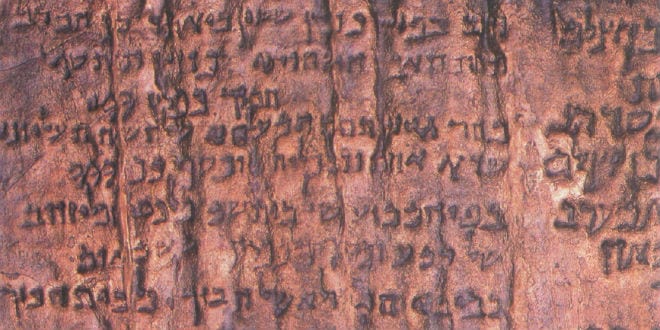
In 1952, archaeologists working in a cave 1.8 kilometers north of Qumran, overlooking the Dead Sea, pulled from the rock wall something unlike anything discovered before or since. Considered one of the Dead Sea Scrolls, the Copper Scrolls, as their name implies, are unique as they are not made from parchment. The Copper Scrolls were two rolls of nearly pure copper, originally a single scroll 2.3 meters long, riveted together from three separate plates. One of the seams had corroded over two millennia and snapped apart. The text engraved on its surface was perfectly legible. The meaning was not.
Now, more than 70 years after that discovery, archaeologist Shimon Gibson of the University of North Carolina at Charlotte has proposed a theory that reframes everything scholars thought they knew about the Copper Scroll—and, in doing so, connects it directly to one of the most dramatic and consequential chapters in Jewish history.
The scroll, cataloged as 3Q15 and found in Cave 3 at Qumran alongside the Dead Sea Scrolls, is a list. Just a list. Sixty-four entries, each one describing a location and a cache of valuables. Gold. Silver. Priestly vestments. Vases. The first entry, translated by Dead Sea Scrolls scholar Józef Tadeusz Milik, reads: “At Khorrebeh, situated in the valley of Achor below the steps leading to the east, [dig] forty cubits: a coffer [full] of money, the sum of which is the weight of seventeen talents.” The second reads: “In the funerary monument of Ben Rabbah, of Beit Shalisha: 100 ingots of gold.”
And so it goes for all sixty-four entries — specific yet impenetrable, detailed yet useless. There are thousands of ancient cisterns in Judea alone. There were countless funerary monuments. Nobody knows who Ben Rabbah was. In the 1960s, John Allegro of the University of Manchester mounted an actual expedition to find the treasures and came home empty-handed. In the decades since, not one item from the Copper Scroll’s list has ever been located.
The scroll itself deepened the mystery at every turn. Unlike the other roughly 900 Dead Sea Scrolls — written on parchment or papyrus, containing biblical texts, halachic (legal) commentary, sectarian writings, and liturgical works — the Copper Scroll has no narrative, no introduction, no context. It was engraved on an expensive and laborious medium. And here is the critical detail: it could not actually be read. Metal does not bend and re-roll like parchment. The scroll was sealed shut by its own material nature. As Gibson puts it, “This was a record that was intentionally engraved some 2,000 years ago and then kept firmly shut.”
A document that cannot be read. A list of treasures that cannot be found. Directions that lead nowhere. For decades, scholars fell into two camps: those who believed the Copper Scroll cataloged real Temple treasures hidden before or after Rome’s destruction of Jerusalem in 70 CE, and those who thought it was fantasy — a wish list, a symbolic inventory for a Temple yet to be rebuilt.
The Temple treasure theory had intuitive appeal. The Arch of Titus in Rome’s forum, and a second arch discovered in 2017 at the Circus Maximus, commemorate the looting of the Temple in full Roman triumphalist style. They show the great menorah (seven-branched candelabrum) and silver trumpets being carried off. If Jews had successfully hidden the menorah before the Romans arrived, how does one explain the fact that the Romans visibly paraded it through Rome? Gibson presses this contradiction directly: the menorah‘s capture by Rome undermines the claim that Temple treasures were successfully concealed.
Gibson’s new theory, published in Volume 36 of Eretz-Israel: Archaeological, Historical and Geographical Studies by the Israel Exploration Society, proposes something else entirely. The Copper Scroll, he argues, was not a treasure map. It was a financial ledger — a record of donations and pledges collected to fund the Bar Kokhba revolt.
The revolt of Shimon Bar Kosiba, known to history as Bar Kokhba — a name meaning “Son of a Star,” a messianic title drawn from the verse “A star shall come out of Jacob” (Bamidbar 24:17) — was the last and most devastating Jewish uprising against Rome. It began in 132 CE and ended in 136 CE with the destruction of Betar, Bar Kokhba’s final stronghold southwest of Jerusalem, and Bar Kokhba’s death there in 135 CE. The Romans subsequently renamed the province Syria Palaestina, banned Jews from Jerusalem entirely, and plowed the city under. The human cost was catastrophic.
But in 132 CE, when the revolt began, the Jews believed they could win. Bar Kokhba was recognized by Rabbi Akiva himself as a possible Mashiach (messiah). The uprising was soaked in eschatological expectation — what the Dead Sea Scrolls elsewhere call aharit hayamim (the End of Days). The Sages of the period understood the expulsion of Rome from the Land of Israel not as a political project but as a cosmic one. Defeating Rome meant the restoration of the Temple, the renewal of the Jewish commonwealth, and the fulfillment of prophetic promise.
Any military revolt of that scale required funding. Bar Kokhba used the Judean Desert and the Dead Sea region as operational territory — caves served as hideouts, supply depots, and refuge. Numerous finds from the Bar Kokhba period have been recovered from these same caves, sometimes alongside scrolls from the earlier Second Temple period. Supporters of the revolt, wealthy Judean families and communities, contributed gold, silver, and goods. Those contributions had to be recorded.
Gibson argues that the Copper Scroll was precisely that record—a financial accounting of pledges made to Bar Kokhba’s rebellion. Around 133 or 134 CE, as the Roman general Sextus Julius Severus arrived to crush the revolt with overwhelming force, fear swept through the Jewish population. A list of donors was political dynamite. If the Romans captured it, every name on it meant death or enslavement for that family. The solution was to engrave the financial record on copper — durable, permanent — and hide it. Not to be retrieved during the war, but to be produced afterward, in the moment of victory, when Bar Kokhba would formally recognize the families who had backed the rebellion.
“Any accountant worth their salt will tell you that incomplete data is poor bookkeeping,” Gibson notes. And the Copper Scroll itself, at its very end, mentions another scroll hidden at a place called Kohlit — a location not yet identified — which Gibson believes contained the complementary data: the actual names of donors that would have completed the record.
Joan Taylor of King’s College London, who re-examined Cave 3Q with Gibson and helped pinpoint the scroll’s original hiding place, concurs on the Bar Kokhba dating based on the scroll’s language — early Mishnaic Hebrew, characteristic of the mid-to-late second century CE. She reads the purpose somewhat differently: not a donor ledger for the revolt, but a record of tithes and contributions to the Temple cult, which observant Jews continued to maintain even after the Temple’s destruction in 70 CE, in anticipation of its rebuilding. The scroll’s references to priestly vestments support her reading. The copper medium, she suggests, was chosen precisely because it would endure — “a time capsule, made for the future,” created by people who had “a fairly dismal view of their own survival.”
Both readings reach the same conclusion: the Copper Scroll is not a treasure map. It is a record of real wealth collected for a real purpose during the Bar Kokhba revolt.
The reaction from other scholars has been measured but receptive. Yonatan Adler of Ariel University called Gibson’s hypothesis “intriguing,” noting that “enigmatic finds of this kind absolutely invite thinking outside of the box.” He added: “Even if we still lack a ‘smoking gun,’ novel and well-argued hypotheses of this kind are what move the inquiry forward.”
Whether Gibson’s theory ultimately proves correct, it restores to the Copper Scroll something that decades of treasure-hunting had stripped away: the possibility that it is not a puzzle to be decoded, but a testament to a people who refused to surrender.