




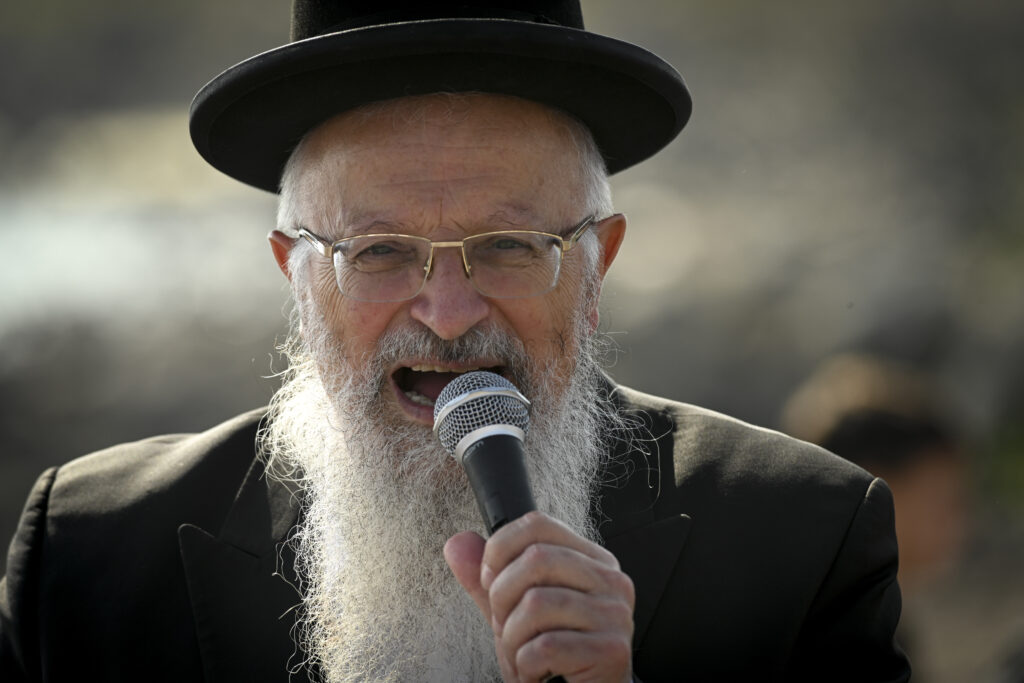
On Yom Yerushalayim (Jerusalem Day), Rabbi Shmuel Eliyahu, Chief Rabbi of Tzfat (Safed), stood opposite Har HaBayit (the Temple Mount) and declared what Israeli law already mandates but Israeli governments have refused to enforce: Jews have the right to pray at their holiest site, and it is time to build a synagogue there.
“You see here the (black-domed) mosque that is behind me, Al-Aqsa — that is from the exile,” Rabbi Eliyahu said. “For 2,000 years, we were in exile, so they built this structure here, but in truth, the First Temple and Second Temple were here, and the Third Temple will be here. That is a fact.”
The call was a direct challenge to a policy that contradicts Israel’s own law.
The Protection of Holy Places Law, passed by the Knesset on June 27, 1967 — the same day Israel extended its jurisdiction over unified Jerusalem — guarantees that Holy Places shall remain accessible to all faiths without interference, and explicitly criminalizes acts that violate the freedom of access of members of different religions to places sacred to them. Violators face up to seven years for desecrating a holy place and five years for obstructing access. The law applies to Jews and Muslims alike — in theory.
In practice, the law has never been applied equally. Jews are afforded limited access to visit the Temple Mount, restricted to certain hours and barred on Fridays and Shabbat and weekdays at night. Jews are frequently barred from praying there and may not perform Jewish rituals at the site. Muslims are permitted 24/7 access, and all Muslim prayer is permitted. Israel entrusted the internal religious administration of the Mount to the Islamic Waqf, a Jordanian-controlled religious trust. The result is a legal absurdity: the state that passed a law guaranteeing religious access to all faiths actively enforces the denial of that right to Jews. Christians are also restricted and barred from praying or displaying religious symbols. Israeli police also prohibit the display of Israeli flags.
Israeli courts have periodically acknowledged this contradiction. In May 2022, Jerusalem Magistrate’s Court Justice Zion Saharay ruled that bowing and reciting Shema — “Hear O Israel, the Lord is our God, the Lord is One” — does not constitute a reasonable suspicion of conduct likely to cause a breach of peace, overturning a 15-day ban imposed on three Jewish teenagers who had prayed on the site. Saharay cited remarks by Israel Police Chief Kobi Shabtai himself, who had publicly stated that officers would ensure freedom of religion for “all residents of the country” at the site. The Jerusalem District Court ultimately reversed the magistrate’s ruling under government pressure, with the state invoking security concerns to override both the law and its own police chief’s stated policy.
The Israeli government’s response was telling. The Prime Minister’s Office issued a statement insisting that no change to the status quo was planned and that the magistrate’s ruling “does not establish anything regarding the permissibility of Jewish prayer in general at the Temple Mount.” In other words, the courts may rule what they will; Jews still cannot pray.
This is not a new battle. It is a decades-long one, and it has a history the Israeli government would prefer to forget.
The actions of the Israeli police and the statements by Netanyahu contradict the Prophet Isaiah who declared: “Ki veiti beit tefillah yikarei l’chol ha’amim” — “For My house shall be called a house of prayer for all peoples” (Isaiah 56:7).
Rabbi Eliyahu’s father, the late Sephardi Chief Rabbi Mordechai Eliyahu, took that verse seriously. In the early 1990s, Chief Sephardi Rabbi Mordechai Eliyahu began advocating the construction of a synagogue on the Temple Mount in Solomon’s Stables — a large underground space constructed by King Herod that had remained largely empty. It seemed an ideal solution, allowing Jewish access that was separate from Muslim entrances.
The Waqf’s was a wanton demolition of Judaism’s holiest site and a site Muslims claimed to revere. The Waqf began construction on Solomon’s Stables in 1996, without a permit and in gross violation of the status quo agreement signed two years earlier, in which Israel granted custodianship to Jordan. The builders used heavy equipment to clear the site, destroying artifacts of immense archaeological importance and damaging the structural integrity of the southern wall of the Temple Mount. The Waqf announced its intention to build the country’s largest mosque, capable of accommodating 10,000 worshippers. Later that year, the El-Marwani Mosque was inaugurated. The underground mosque is always open to Muslims, but prayers are only held there on Muslim holidays when rain or heat makes outdoor prayer uncomfortable. The Waqf seized a space that was proposed for Jewish prayer, converted it into a mosque capable of holding tens of thousands, and then barely uses it.
The destruction left a trail that archaeologists are still following. In 1999, the Northern Branch of the Islamic Movement conducted additional illegal renovations on the Temple Mount and disposed of over 9,000 tons of dirt mixed with invaluable archaeological artifacts. The Waqf had bulldozed a section in the southeastern corner of the Temple Mount to create a stairway down to the underground mosque — hundreds of truckloads of archaeologically rich soil were dumped into the Kidron Valley just east of the Temple Mount. The debris was rescued by archaeologists Dr. Gabriel Barkay and Zachi Dvira, who launched what became the Temple Mount Sifting Project in 2004. With the help of nearly 250,000 volunteers, thousands of valuable finds have been discovered, including over 5,000 ancient coins, inscriptions, mountains of pottery, Egyptian-era cultic items, jewelry, remnants of warfare, and charred bone remains of Temple Mount sacrifices. Every artifact recovered is proof of the Jewish history the Waqf’s bulldozers tried to erase.
Now, Rabbi Shmuel Eliyahu is renewing his father’s call. He urged the Knesset to change the policies governing Jewish prayer at the site and to establish a beit knesset — a synagogue — on the compound. He was joined in spirit by National Security Minister Itamar Ben-Gvir, who ascended Har HaBayit on Jerusalem Day and declared that Israel had “restored sovereignty on the Temple Mount thanks to determination and deterrence.” Ben-Gvir has taken steps during his tenure to integrate Jewish prayer into police guidelines and permit more open worship practices — incremental moves that have altered what the previous political consensus treated as untouchable.
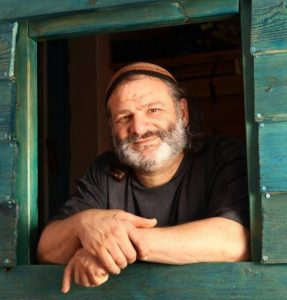
Josh Wander is part of the NGO led by Rabbi Shmuel Eliyahu that advocates for the construction of a synagogue on the Temple Mount.
“There has been a push for decades to create a synagogue on the Temple Mount that started immediately after the liberation of the mount in 1967, which was begun by the former Chief Rabbi of the IDF, Chief Rabbi Yisrael Goren. It continued with pushes from the Rishon LeZion (Chief Sephardi Rabbi of Israel), Rabbi Mordechai Eliyahu.
“The construction of a synagogue would allow direct access to the Temple Mount. It would, at the same timehich would also, at the same time, restrict access to areas of the mount which are Halachically (Jewish law) questionable as to whether we’re permitted to access them or not. It would ensure that Jews who are unaware of the Halacha would not inadvertently wander into areas, that may be questionable or problematic.
“So the construction of a synagogue would actually solve several problems, in addition to fulfilling Israeli law and creating a constant Jewish presence on the mountain. Spiritually, we would be allowed to observe Jewish practice in a manner we currently lack. We could pray the evening and nighttime prayers, and perhaps even Shabbat and holy days. Jews would be able to wear a Tallit (prayer shawl) and Tefillin (phylacteries) and read from a Torah Scroll.
“There have been a few different options as to where the synagogue should go. Some have suggested it be in the northeastern side near Shaar HaShevatim. Others have suggested that it be on top of Shaar HaRachamim (The Golden Gate).”
