




Elie Mischel
A few weeks ago, millions of Israelis paused their lives to celebrate. Not just the religious neighborhoods or the national-religious communities — everyone. Offices and stores closed, families gathered on hillsides with their barbecues, and the skies above every city filled with fireworks. Yom HaAtzmaut, Independence Day in Israel, is not a polite civic commemoration. It is a full-throated national celebration, shared by secular and religious Israelis alike, a day when the whole country feels like one people.
Today, Jerusalem Day, could not be more different.
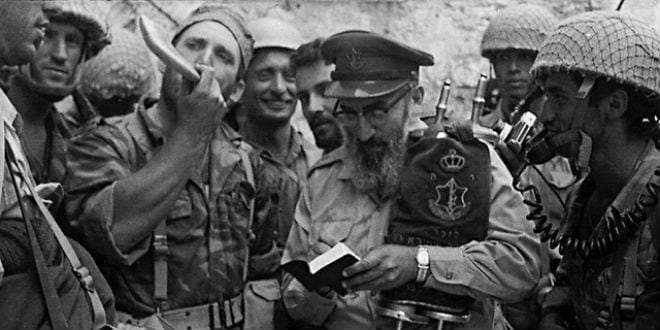
Jerusalem Day is observed each year on the 28th of Iyar in the Hebrew calendar — this year falling on May 15 — commemorating the incredible victory of June 7, 1967, when Israeli paratroopers fought their way to the Western Wall and the ancient heartland of Israel returned to Jewish hands for the first time in nearly two thousand years. The Temple Mount, Hebron, Bethlehem, and Shiloh. The hills where Abraham walked, where David shepherded his flock, where the prophets delivered God’s word to His people. On that awesome day, Israel didn’t just win a war. We came home.
And yet, in most of Israel, you would barely know it.
Rise Up with Israel — donate at israel365charity.com/rise-up/
Two Chapters of Zionism
Why does a day commemorating the liberation of Jerusalem — the city that every Jew faces in prayer three times a day, the city at the heart of every Jewish wedding ceremony, the city that the Jewish people have longed for across two thousand years of exile — why does this day pass with barely a ripple in Israeli public life, while Independence Day brings the whole country to its feet?
Rabbi Yehuda Leon Ashkenazi, one of the most original Jewish thinkers of the twentieth century, explains that the history of Zionism falls into two distinct chapters.
The first chapter began with Theodor Herzl in the late nineteenth century and ran through the founding of the State of Israel in 1948. This was secular Zionism: a political and national movement that built a Jewish state through diplomatic genius, military courage, and iron determination. The founders were largely secular men and women who wanted a homeland for the Jewish people, and they built one. God was not officially part of the program.
That Zionism worked. The British Empire, which took control of the land of Israel after World War One, initially seemed like a partner. The Balfour Declaration of 1917 promised a Jewish homeland in the land of Israel, and for a moment it appeared the great powers of the West were on the side of the Jewish people. But by the 1930s and 1940s, the British reversed their pro-Jewish policies. They sealed the borders of the Holy Land to Jewish refugees — including Jews fleeing Nazi Europe — and fought Jewish immigration with warships and detention camps. The Zionist leadership fought back, politically, diplomatically, and militarily, until the British withdrew and Israel declared independence in 1948.
But 1967 opened a second chapter entirely.
Sixty Years and Counting
During the Six-Day War, Israel liberated Judea and Samaria in six days. We have been fighting to hold it ever since.
Nearly sixty years have passed since 1967, and the pressure to give this land away has never stopped. The United Nations, the European Union, the State Department, the international media — all of them treat Jewish communities in Judea and Samaria as illegal, illegitimate, an obstacle to peace that must be removed. Take a moment to think about how insane this is. The land of Abraham, Isaac, and Jacob. The land where the patriarchs are buried, where David built his kingdom, where the prophets delivered the word of God. And yet the world insists it does not belong to the Jewish people.
Why? How does that make any sense? Why do the nations deny that the land of the Bible belongs to the people of the Bible?
Why Secular Zionism Is Not Enough
Before 1967, Israel’s primary opposition came from the West — the British Empire, European powers, and the secular international community. Their claim to this land was political and colonial. They had no spiritual or covenantal connection to it. Against political opposition, secular Zionism was strong enough to win.
But Judea and Samaria present a different challenge entirely. Unlike the Western powers that came before them, the Arab and Muslim world claims this land not only politically but spiritually — through Islam’s connection to Abraham, and the legacy of Ishmael. When the Jewish people returned to the biblical heartland in 1967, we were not simply reclaiming territory from a colonial power. We were entering a contest over land that another civilization claims at the level of faith.
Secular Zionism cannot win that contest alone. The only answer strong enough to meet a spiritual challenge of Islam is a Zionism that is itself rooted in the spirit — in the Bible, in Torah, in the unshakeable certainty that this land was promised to the Jewish people long before any other claim existed. The people of Israel must know not only that this land is strategically vital, but why it is holy.
This is why Independence Day and Jerusalem Day feel so different in Israel today.
The Holiday Israel Isn’t Ready For — Yet
Independence Day belongs to the first chapter of Zionism. It celebrates something that secular and religious Israelis can embrace equally — the establishment of the State of Israel and the triumph of Israel’s will to survive. You do not need to believe in biblical prophecy to celebrate that.
Jerusalem Day belongs to the second chapter. It asks something deeper: do you believe that the Jewish people’s return to the biblical heartland is not merely a military achievement, but the fulfillment of God’s ancient promise? That question makes secular Israelis uncomfortable. And so many of them simply skip the holiday altogether.
But something is changing. Among Israel’s younger generation, there is a remarkable return to faith and tradition, a growing sense that being Jewish means something beyond national identity. I believe that as that return continues, Jerusalem Day will grow into what it was always meant to be — the holiday that celebrates not just Israel’s survival, but Israel’s purpose.
We are not there yet. But we are getting closer.
The Fight We Cannot Afford to Lose
The fight for Judea and Samaria cannot be won through military strength or diplomatic maneuvering alone. It requires people who understand why this land matters at a level deeper than strategy — people who will stand up and say clearly: this is not occupied territory. It is the fulfillment of a divine promise that was made long before Muhammed was born.
Israel365 Action is committed, heart and soul, to this fight. We believe that if Jews and Christians stand together and advocate for Israeli sovereignty over Judea and Samaria – as God intended – we will prevail.
Jerusalem Day will become what God always intended it to be. But that will only happen if enough people choose to stand with us. This Jerusalem Day, we are asking you to be one of them. Your donation to the Rise Up with Israel campaign funds this fight directly — the advocacy, the coalitions, the voices that refuse to go silent on the land God promised to His people.
“I have set guardians upon the walls of Jerusalem, all day and all night. They shall not remain silent.” (Isaiah 62:6)
“A people that rises like a lion — it does not rest until it devours the prey.” (Numbers 23:24)
Rise Up with Israel — donate at israel365charity.com/rise-up/

