
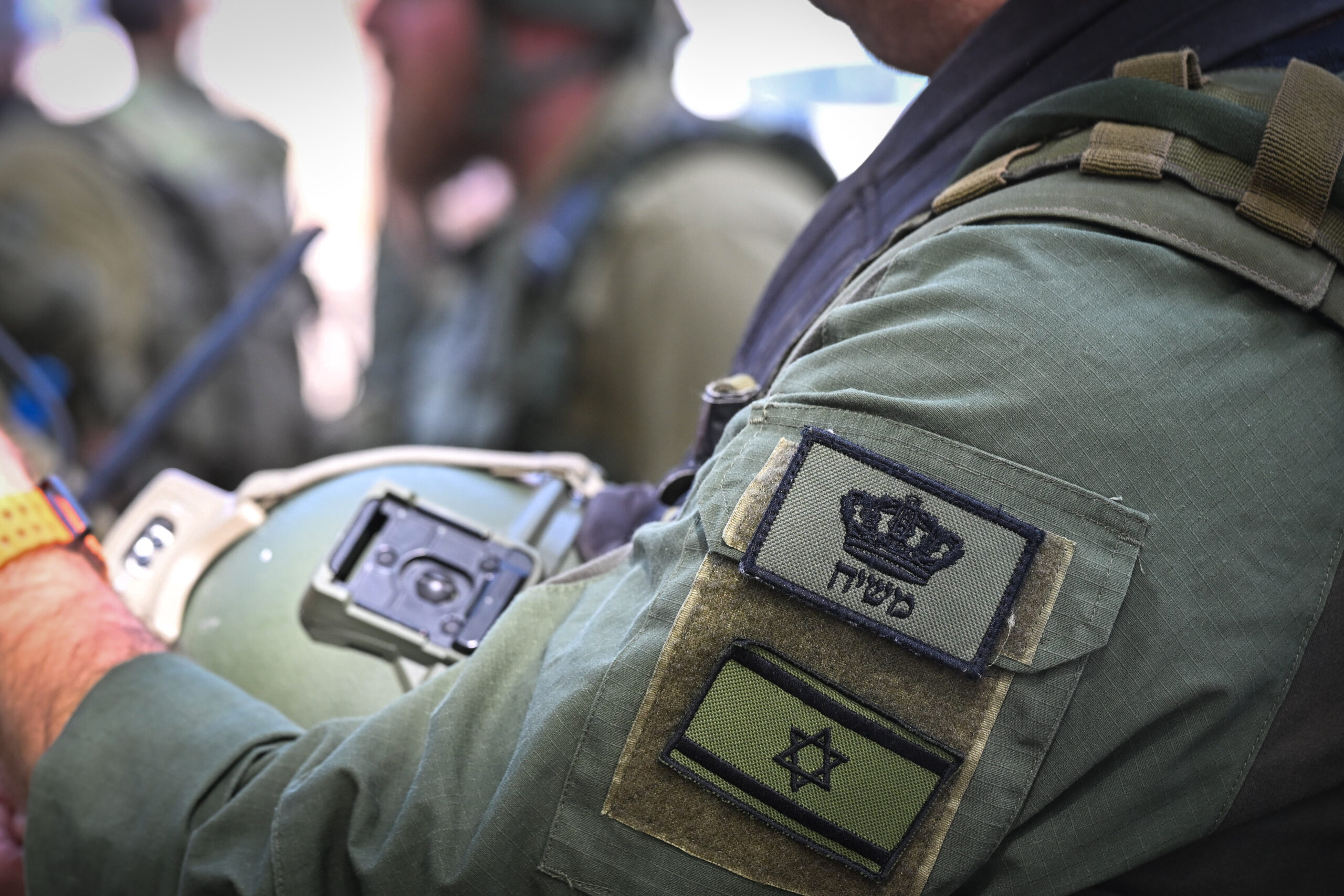
IDF Chief of Staff Lt.-Gen. Eyal Zamir made an unannounced visit to a Nahal Brigade company in Sa-Nur in Samaria, where he spotted a soldier wearing a Moshiach (Messiah) patch associated with the Chabad-Lubavitch Hassidic movement. The discovery triggered immediate disciplinary action up the chain of command, and the soldier received a 30-day military prison sentence.
The IDF stated that the patch “does not represent the IDF or its values,” and stressed that wearing non-military symbols on IDF uniforms is strictly prohibited. The platoon commander received a 14-day suspended sentence, the company commander was formally reprimanded, and the battalion commander received a citation. The soldiers had been briefed in advance about the Chief of Staff’s visit, yet despite the warning, “they behaved in a manner that was inconsistent with expectations and did not comply with rules of discipline.”
The wording of the reprimand raises deep concern over the direction the State of Israel is taking. Israel’s founding document calls for “the redemption of Israel,” yet a soldier can receive 30 days in military prison for displaying the word Moshiach, while the terrorists who butchered 1,200 Jews on October 7 openly framed their massacre in religious and jihadist terms. IDF soldiers are forbidden from expressing Jewish messianic motivation, while Hamas uses the Dome of the Rock, built on the ruins of the Jewish Temple, as its official emblem.
The IDF is the army of the Jewish people fighting in the land the God of Israel promised them. The tension between that reality and the secular military’s drive for uniformity is not going away.
What the IDF Regulations Actually Say
The IDF formally codified its patch policy in April 2025, stating: “The IDF only approves three types: Israeli flag, name tag, and unit insignia. Beyond these three, IDF soldiers will not be permitted to attach any other type of patch to their uniforms.” The new regulations marked the formal end of the Moshiach patch, skull patches, and others that became popular during the war. The policy covers not only Moshiach patches but Temple patches. Soldiers photographed outside Gaza City in February 2024 were seen wearing patches depicting the Beit HaMikdash (Holy Temple) with the words “Soon in our days.” Greater Israel map patches depicting borders extending to Jordan, Lebanon, and parts of Syria and Iraq are also banned under the same regulation.
During a conference last month with senior officers, Zamir highlighted several irregular incidents he had observed in the field, including the display of various symbols, and reportedly said the patch in question constitutes “a rebellion against IDF values.” He told commanders: “The justice of our path is based on the spirit and values of the Israel Defense Forces, and they are an inseparable part of victory. We are a victorious army, a disciplined army that upholds its values and norms is a victorious army.”
Previous Cases: A Pattern of Confrontation
In October 2024, then-IDF Chief of Staff Lt.-Gen. Herzi Halevi visited Golani Brigade combat forces in southern Lebanon, where he encountered a soldier who had put a Moshiach patch on his uniform. Halevi approached the soldier, removed the patch, and placed it in the soldier’s shirt pocket, explaining that if the patch was important to him, he could keep it there, but it should not be displayed on the official uniform.
News of Halevi reprimanding the soldier sparked backlash in some circles. The pro-government Channel 14 network broadcast an animated clip portraying Halevi seeing the badge, causing his eyes to enlarge and for him to start screaming in agony. A military source in the Northern Command told the Walla news site at the time: “Reserve soldiers have not taken off and will not take off the Messiah patch. This is a patch related to their faith. Senior commanders failed on October 7 and were not judged, so you want to punish soldiers with a patch?”
In a January 2025 incident, two Givati reservists, in uniform, attending a soccer match in Netanya, were confronted by former IDF spokesperson Avi Benayahu for wearing Moshiach badges. The soldiers defended the patch, saying that it is “worn by so many soldiers who are risking their lives in combat,” and accused Benayahu of harboring hatred toward Judaism.
Knesset Members Push Back
The punishment of the Sa-Nur soldier drew immediate fire from elected officials. Knesset Foreign Affairs and Defense Committee chairman MK Boaz Bismuth (Likud) called the decision “grave and scandalous,” writing on X/Twitter: “Just a year ago, Chief of Staff Zamir expressed himself entirely differently,” referring to a time Zamir said he would not tear patches off soldiers, leaving enforcement to lower-ranking officers. “The Chief of Staff must explain what has changed since then, and whether external media and political pressures are being applied to the IDF’s senior command that he is unable to withstand. The IDF must maintain discipline, but also fairness. Release the soldier now!”
MK Tally Gotliv (Likud) was blunter: “If, because of a messianic patch on the uniforms, the Chief of Staff sends a fighter to 30 days in prison, then for this severe distortion of thinking by the Chief of Staff, I would send him home!”
Does Any Israeli Law Prohibit Moshiach?
No Israeli law, Basic Law, or Knesset statute prohibits calling for Moshiach (the Messiah) or geula (redemption). In fact, the very opposite is true. Israel’s Declaration of Independence, the founding document of the state, closes with a call “to the Jewish people all over the world to rally to our side in the task of immigration and development and to stand by us in the great struggle for the fulfillment of the dream of generations — the redemption of Israel.” The Hebrew word used there, geula, is precisely the term that religious soldiers associate with their faith, their fight, and their patches.
The document concludes with the words “Placing our trust in the Tzur Yisrael (Rock of Israel),” a biblical term for God taken from Jewish liturgy, chosen by Ben-Gurion as a deliberate compromise between the religious and secular founders of the state. In all government English translations of the Declaration of Independence until 1962, Tzur Yisrael was actually rendered non-literally as “Almighty God.”
The soldier jailed for 30 days for displaying a Moshiach patch is an heir to a founding document that itself speaks the language of redemption.
The Dome of the Rock in Gaza Homes — and Hamas’s Flag
What makes the crackdown on Moshiach patches all the more striking is the context in which these soldiers are fighting. Many IDF soldiers reported seeing images of the Dome of the Rock prominently displayed in many homes in Gaza. Hamas chose the Dome of the Rock with crossed swords as its emblem, and named one of its key factions the Al-Aqsa Martyrs Brigade. The alleged Islamic claim to Jerusalem’s Temple Mount sits at the ideological core of their war against Israel. Hamas named the October 7 massacre “Operation Al-Aqsa Flood,” not after Gaza, not after the Palestinian people, but after the mosque built on the site of the destroyed Beit HaMikdash.
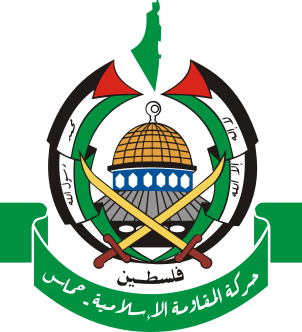
It should be noted that while the Hamas emblem is the gold Dome of the Rock, Al Aqsa is actually the black dome on the southern edge of the Temple Mount compound. The gold dome, referred to in Arabic as Qubbat aṣ-Ṣaḫra, is a shrine. The Dome of the Rock is not a mosque, and Islamic law actually forbids Muslims from praying toward it. Muslim prayer (salat) must be directed toward the Kaaba in Mecca. The Dome of the Rock sits over the Even HaShetiya, the Foundation Stone, which Jewish tradition identifies as the precise location of the Holy of Holies, the Kodesh HaKodashim. Islamic law explicitly prohibits a Muslim from facing that spot in prayer, because doing so would mean turning away from Mecca.
The golden Dome of the Rock, which Hamas plasters on its flag and which filled the walls of Gaza homes, is a qubbah, a commemorative shrine. not a house of prayer. Muslims who pray on the Temple Mount plaza are careful to face south toward Mecca, which means they pray with their backs to the Dome of the Rock and, unknowingly or not, are facing the direction of the Kodesh HaKodashim.
The term “Al-Aqsa” as a symbol and brand has become pervasive: the Al-Aqsa Intifada, the Al-Aqsa Martyrs’ Brigades, Al-Aqsa TV — Hamas’s official television channel — Al-Aqsa University, and multiple jihadist organizations all carry the name. The Dome of the Rock, looming from the walls of Gaza homes and the crests of terrorist organizations, is a declaration of Islamic supremacy over the holiest site in Judaism.
When Israeli soldiers display Third Temple imagery, they are answering that claim with an equally uncompromising declaration: this land, and this mountain, belong to the Jewish people by divine right.
The IDF fights Hamas terrorists who have made Jerusalem’s Temple the explicit target of their genocidal ideology. An army that jails its own soldiers for proclaiming Moshiach while the enemy marches under the banner of the mosque built over the Temple’s ruins should ask itself: whose values, exactly, are being protected?