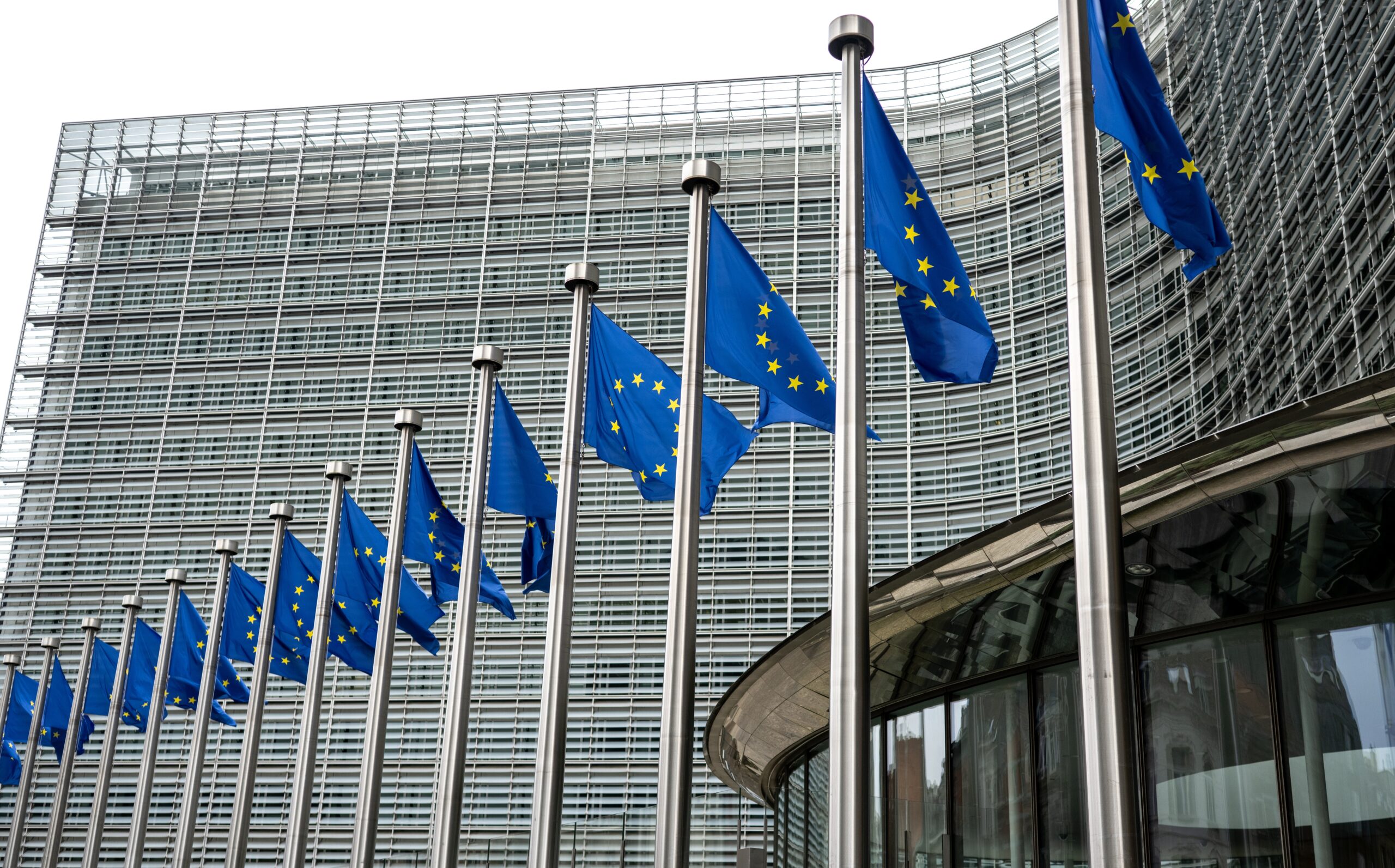
The nations that herded Jews into ghettoes, expelled them from their cities, and handed them over to Nazi death camps have now found a new cause: sanctioning Jews for the crime of living in Judea and Samaria. On Monday, the foreign ministers of all 27 European Union member states convened in Brussels and reached a political agreement to impose sanctions on Israeli settler leaders and organizations, equating them, in the same diplomatic breath, with Hamas terrorists.
The sanctions themselves consist of two specific measures: an asset freeze and a travel ban.
An asset freeze means any funds or economic resources owned or controlled by the sanctioned individuals or organizations within EU jurisdiction are locked; banks in EU member states cannot process transactions for them, and any property or holdings in Europe cannot be accessed or transferred.
A travel ban means the sanctioned individuals are barred from entering or transiting through any of the 27 EU member states. For someone like Daniella Weiss or Meir Deutsch, that means being stopped at the border or potentially detained in any European country.
The EU has not yet released a formal list of targets, and a committee will still need to finalize the draft list before the sanctions are officially imposed. So at this stage, Monday’s decision is a political agreement, not yet an enforceable legal instrument.
It is also worth noting what the sanctions are not. They are not criminal charges. They carry no fines, no prison terms, and no legal proceedings. They do not restrict the sanctioned individuals from living in, building in, or advocating for Jewish communities in Judea and Samaria. Regavim can still file petitions in Israeli courts. Nachala can still organize. Daniella Weiss is still free to speak. The EU has essentially told a handful of Israeli citizens they cannot vacation in Paris or bank in Frankfurt and called it a landmark human rights decision.
Regavim’s head, Meir Deutsch, put it plainly: the sanctions are not really designed to change the behavior of the individuals named. Their real purpose, in his assessment, is to pressure the State of Israel into accepting the framework of a Palestinian state. The names on the list are instruments, not targets.
Monday’s agreement in Brussels is a political decision, not yet legally binding. A committee must still finalize the draft list, and technical and legal work remains to be done before the EU executive formally imposes the sanctions. The package targets three Israeli individuals and four settler organizations, though their identities have not yet been officially disclosed by the EU. According to Israel’s extreme left-wing Haaretz newspaper and the anti-Israel Peace Now movement, sanctions will be leveled against Regavim and its head, Meir Deutsch, HaShomer Yosh and its former chief, Avichai Suissa, Nachala and its head, Daniella Weiss, and the Amana settlement organization.
The practical consequences for those sanctioned are significant: the measures impose a travel ban and freeze the assets of the targeted settlers and organizations. For Deutsch, that could mean being detained upon arrival in any EU capital. He acknowledged as much, saying he may no longer be able to travel to European cities without facing some form of detention order, while noting the full practical implications remain unclear. He suggested it may be worth testing exactly what the sanctions mean on the ground.
This is not the EU’s first round of settler sanctions, but it is the most expansive. In 2024, the bloc sanctioned five individuals and three entities described as responsible for serious human rights abuses against Palestinians, including one individual in the Jordan Valley cited for physical and verbal harassment that escalated after October 2023. The Biden administration had similarly sanctioned multiple settler leaders, settler groups, and outposts in 2024, but President Trump canceled those sanctions on his first day back in office in January 2025. The EU’s new package goes further than anything Brussels has previously approved, and those pushing hardest — Spain, Ireland, and Slovenia — have made clear they view Monday’s vote as a floor, not a ceiling.
The moral bankruptcy on display in Brussels was not lost on Israeli Foreign Minister Gideon Sa’ar. “Equally outrageous is the unacceptable comparison that the EU has chosen between Israeli citizens and Hamas terrorists,” Sa’ar posted on X. “This is a completely deviant moral commonality.” He called the sanctions “arbitrary and political,” and vowed that Israel “will continue to stand for the right of Jews to settle in the heart of our homeland.” Sa’ar added: “No other nation in the world has a documented and long-standing right to its land as the Jewish people have to the Land of Israel. This is a moral and historical right that has also been recognized by international law, and no actor can take it away from the Jews.”
One detail buried in the Brussels proceedings reveals the cynical political arithmetic behind the Hamas inclusion. An EU official confirmed that the decision on Hamas sanctions was not made simultaneously out of any principled equivalence, but was rather a condition demanded by some member states in exchange for their support for sanctions on settlers. In other words, Hamas terrorists were added to make the optics palatable enough to reach unanimity, which only underscores Sa’ar’s point that the moral equation being drawn is not an accident but a deliberate political construction.
The political mechanics of Monday’s vote deserve scrutiny. For years, Hungary’s Prime Minister Viktor Orbán blocked settler sanctions with a veto. His electoral defeat last month to Péter Magyar removed that shield. The EU’s foreign policy chief, Kaja Kallas, who has led the charge against Israel, declared it was “high time we move from deadlock to delivery.” What she means by delivery is the sanctioning of Jewish residents of the Biblical heartland, while the same bloc continues to fail to hold Hamas, an organization whose founding charter calls for the genocide of Jews, to any comparable standard. The EU did add Hamas leaders to Monday’s sanctions list, but the moral equation being drawn — settler organizations alongside Hamas terrorists — is a deliberate diplomatic signal, and Israel is right to reject it with fury.
By sanctioning Jews for living in Judea and Samaria, the EU nations are also rejecting the BIble in which God promised in unambiguous terms: “Lezar’acha etein et ha’aretz hazot” — “To your descendants I will give this land” (Genesis 12:7). Contrary to what the EU nations may believe, God did not promise a two-state solution.
The irony cuts deep as among the nations driving the hardest push against Israel are Spain, Ireland, and Slovenia. Spain expelled every Jew on its soil in 1492, forcing hundreds of thousands into exile under threat of death or forced conversion. France, whose foreign minister Jean-Noël Barrot spoke solemnly in Brussels about justice, deported 77,000 Jews to Nazi death camps, a figure his own government has formally acknowledged. The Netherlands, whose foreign minister called for action against Israel, was the site of the highest Jewish death rate in Western Europe during the Holocaust: over 70 percent of Dutch Jews were murdered. The grandchildren of Europe’s murdered Jews are the people now being sanctioned.
Regavim, one of the organizations now sanctioned by the EU, spent two decades filing legal petitions exposing that very funding. The EU’s response was to put Regavim on a sanctions list. Meir Deutsch, Regavim’s CEO, was direct about the absurdity: “They did not contact us before or after, even though the European Union knows Regavim’s lawyers as those who filed dozens of petitions against the European Union’s illegal activity in Judea and Samaria.”
Daniella Weiss, one of the sanctioned leaders and a driving force of the settlement movement, called the EU move “ridiculous” and said it would not stop the movement for a single day. Regavim issued a statement calling the sanctions “a badge of honor” and pledged to “continue working to restore governance and sovereignty throughout all parts of our homeland.” These are not the words of people who feel they have done something wrong. They are the words of people who know exactly what they are doing and why.
The EU stopped short of suspending the Association Agreement, the trade framework governing Israel-EU relations, and declined to ban settlement goods from European markets. Those battles are coming. Spain, Ireland, and Slovenia are waiting for their moment. Italy and Germany blocked them this time. That majority may not hold.
Europe has tried before to sever the Jewish people from their land through expulsion, inquisition, pogrom, and genocide. As Sa’ar put it plainly: “Israel has, is, and will continue to defend the right of Jews to settle in the heart of our homeland.” Europe would do well to remember that every previous attempt to uproot the Jewish people from their land ended not in European triumph, but in European shame.
The EU is sanctioning Jews for the “crime” of living in Judea and Samaria, the heartland of Jewish civilization, the region where Abraham walked, where David ruled, and where the Prophets delivered their warnings to kings. The EU calls these communities “settlements” and treats their residents as an obstacle to peace. Meanwhile, the EU has for years funneled millions of euros into illegal Arab construction in Area C, land that, under the Oslo Accords, remains under full Israeli civil and security control.
The EU sanctioning Jews for living in Judea and Samaria takes on a particularly sharp edge when set against what the Arab world has done and continues to do regarding Jews within its own borders. As of 2024, Algeria, Bangladesh, Brunei, Iran, Kuwait, Lebanon, Libya, Pakistan, Syria, and Yemen all imposed outright bans on Israeli nationals, including Israeli Arabs. These are not informal policies or bureaucratic inconveniences. They are official state prohibitions on the entry of Jews holding Israeli passports, and in some cases, extended to anyone whose passport shows evidence of travel to Israel. Dual nationals are also affected, as many nations extend the ban to anyone entering with an Israeli passport, regardless of additional citizenship. No EU foreign minister in Brussels on Monday thought to raise this. No resolution was drafted. No sanctions were proposed.
The reason Jews no longer live in significant numbers in Arab nations is not a mystery, and it is not a matter of voluntary migration. Between 800,000 and one million Jews were either forced from their homes or left Arab countries from 1948 until the early 1970s. More than 850,000 Jews were forced to leave their homes in Egypt, Lebanon, Syria, Iraq, Yemen, Libya, Morocco, and several other Arab countries in the twenty years following the 1948 Arab-Israeli war. These were not refugees fleeing a war zone. These were doctors, lawyers, engineers, merchants: communities rooted in those lands for centuries, in some cases millennia, predating the Arab conquest of the region entirely.
The methods used to expel them were systematic. In Syria, real estate purchase was prohibited to Jews in 1947, and Jews began to be discharged from public service positions. In Egypt, a long process of discrimination in the public service began in 1929, and by 1945-1948, Jews were excluded from public service entirely. From Morocco to Iraq, governments established laws meant to ostracize and disenfranchise their Jewish communities; constitutions were established that enshrined the Arab and Islamic characters of countries; property and assets were confiscated; Jews were arrested on suspicion of espionage based on trumped-up charges. In Iraq, it was worse than expulsion: in 1969, nine Iraqi Jews who had chosen to stay in the country after the mass flight of the early 1950s were convicted and executed behind closed doors.
The demographic collapse is staggering. In 1948, there were roughly 265,000 Jews in Morocco; today, just 2,500. The Jewish Agency for Israel estimated that the total number of Jews in Arab and Muslim countries in 2023 was 27,000, a remnant population scattered across nations that once hosted thriving, ancient Jewish communities. Iraq once had 150,000 Jews. Today: fewer than five. Yemen: zero. Libya: zero. Syria: a handful. The amount of land confiscated from Jews forced to flee Arab and Muslim countries amounted to 40,000 square miles, five times the size of Israel in 1948, with recent estimates valuing the pan-Arab confiscations at $250 billion. No UN agency was created to address their plight. No EU sanctions were ever discussed.
The Mizrahim, the Jews of the Middle East and North Africa, are not a footnote to this story. Today, the descendants of Jews who immigrated to Israel from other Middle Eastern lands constitute more than half of all Israelis. They are the living proof of what happens when Jews are expelled from lands where they have lived for thousands of years. Half the population of the Jewish state is there because the Arab world made clear that Jews were not welcome. And now that same Arab world, cheered on by European diplomats in Brussels, demands that Jews not be permitted to live in Judea and Samaria either.
The EU policy adds to these restrictions on where Jews are permitted to live, prohibiting Jews from living in areas conquered by Israel in its fight for existence.