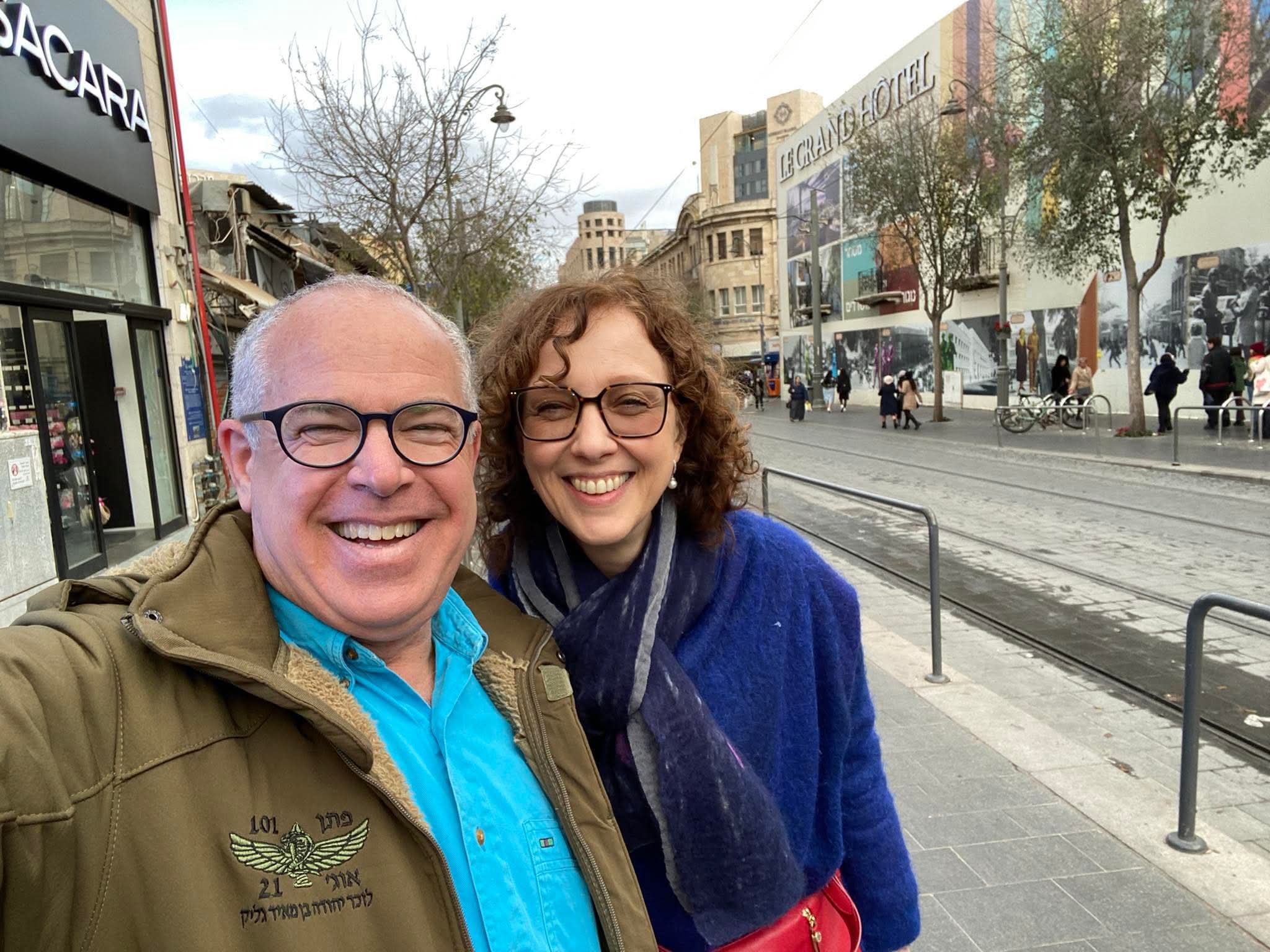
I visited with a friend recently who I had not seen in 40 years, but who has been my neighbor for the last 20. In 1985, Linda and I had planned to visit the Soviet Union together as part of our respective and collaborative activism on behalf of Jews in the USSR as young students. Other than catching up on our children, grandchildren, and careers, we reflected on how the movement among Western Jews like us to free Soviet Jews was in many ways the movement that strengthened us and our own identity in terms of commitment as Jews religiously, nationally and more.
There are few other events in our modern history that have brought us together as a people than the modern exodus of Jews from the USSR. While the original Exodus is chronicled in the Book that defines us as a people, perhaps no other historic event since then has brought us together as a people than the movement to free Soviet Jews spanning the 1960s-1990s.
Unlike the original Exodus, where God directed it, providing miracles and sustenance for 40 years, with a host of supporting actors led by Moses playing critical roles, the movement to free Soviet Jews was the product of selfless bravery and sacrifice among many Jewish leaders in the USSR, along with millions of people in the West. The Kremlin dismissively referred to us and other western activists as a bunch of “students and housewives.”
The Jewish people fled Egypt along with “mixed multitudes” (erev rav) of non-Jews who joined the Exodus, wanting to be part of the Jewish people and connected to the true God. Though the dominant names were those of Jewish leaders, the modern Exodus also included a mixed multitude of non-Jews, mostly Christians, who played an active role in the liberation of the Jews from the USSR.
As much as the movement to free Soviet Jews was a success, Linda and I reflected how that era changed us, and many others, as well. We embraced our religion and nationalism in a way that was more pronounced because we realized how Jews in the USSR were fighting and risking so much for the rights and opportunities that we took for granted.
When I visited the USSR first in 1985, and then again in 1987, I realized that the new friends who I was meeting must have found it ironic that a Jewish American in his 20s not only had the privilege to travel to the USSR, and leave, but the freedom to tell them where they should live (Israel), and then pick up and go back to the US, and yet able to visit Israel any time. Some were inspired by my encouragement, and some just wanted to have the freedom to live where they wanted as free Jews, as I did.
Unlike Soviet Jews who could be arrested at any moment, I also had the privilege to choose whether to be arrested or not. One time I conducted a one-man protest outside the Soviet embassy in Washington. In no time, DC police kindly but firmly warned that I was breaking the law and if I didn’t stop, they would have to arrest me. I had a ride to catch back to Atlanta, so I elected to pack up and go. Fortunately, the media I had tipped off in advance was there to document it all. My friends in Atlanta saw me on the evening news before I even got home, unfurling a blue and white paper chain from a 50-gallon plastic bag that I had intended to use to decorate the fence of the embassy, making my protest a success and my return home uninterrupted.
I also made the choice to engage in an act of possible civil disobedience that had a much more significant legal consequence than protesting in front of the Soviet embassy. As much as I planned and orchestrated my Washington DC protest, the bigger plan I concocted would have caused me much greater consequences as something bold, unprecedented, and premeditated.
On my first trip, I arrived in Moscow on a hot, humid July day. Immediately after settling in at my hotel adjacent to Red Square, I took my bag of US coins to find the pay phones far enough away from the hotel so as not to attract unwanted attention. My stash of American dimes precluded me from having to stand out further by trying to procure two kopek coins, as they were the same size and fit into the Soviet pay-phones.
I don’t recall how through letters (most intercepted by the KGB) I was able to communicate to my adopted family that I was arriving that day, but father Victor and daughter Katya were waiting for my call. I began corresponding with them in 1982. To me, they were my family behind the Iron Curtain. We had spoken by phone but never met. That was about to change.
We agreed to meet at the Rechnoy Vokzal metro station at a set time the following day. I realized that while I had taught myself to read Russian to get around as unobtrusively on my own as possible, I had no idea how long a trip it would be from the Red Square station next to my hotel to the northernmost station on one of the legs of the Moscow metro. On the folded map I kept discretely so as not to stand out, it didn’t seem far, but I had never been there and just didn’t know. There were no apps to estimate my travel time, and no cell phones to text that I was running late.
Even at the end of the line, the platform was crowded as I got out of the middle car and headed to the exit. I was late, and worried that maybe we wouldn’t find one another. Yet having only seen photos of Katya, I recognized her immediately facing the direction of the sea of people flowing by her. I have no idea how long she waited or how many trains unloaded with her having the same concern that we might miss each other. We embraced, but didn’t talk until we got to her family’s apartment. Speaking English in public would have attracted unwanted ears and eyes of people eager to report to the KGB an American in Moscow’s periphery.
At their home her father, Victor, waited eagerly. I carried with me bags of women’s clothes and other items that could be sold on the black market to help them financially. They called me Santa Claus with all the gifts I brought. Within 30 minutes of meeting, I announced my plan to get them all free from the USSR: I would marry Katya, she’d become an American citizen, and then use her being an American as an anchor to get the rest of the family out. It would take years. It was probably imprudent to make this “proposal” inside their home, assuming that KGB ears were listening to everything. She and I went for a walk in a park where she confided how unhappy she was and how much she wanted to leave, but couldn’t imagine leaving alone, without her family.
In a country where anything could be twisted into an illegal act of “cosmopolitanism” and “anti-Soviet agitation” and bring swift arrest and a harsh prison sentence, I knew that in the US, marrying someone for the purpose of getting American citizenship was also illegal: up to five years in federal prison and fines as much as $250,000 could also be imposed. It was interesting to me that through one act, I could violate a law in two different, adversarial, countries. But I was young, naïve, idealistic, and committed to do my part. Somehow, I didn’t think I would get caught in either country.
It was more of a practical proposal than a romantic one, and the idea was not to stay married, just to help free her and her family. In previous generations, I knew of similar stories in my family so, for me, it was a bit of a legacy too. “He who saves one life saves the world.” Katya didn’t say yes, but she also didn’t say no. I returned to the United States to set my plan in action. My second trip in 1987 was to begin that process, but earlier that year Katya and her family became four of fewer than 900 Soviet Jews permitted to leave the USSR, precluding the need for us to get married.
I reflected on all this having reconnected with Linda, and a series of recent conversations about others – Jews and Christians – who were also active in the Soviet Jewry movement. I am always grateful that at my children’s weddings, my oldest friends are people I met in Moscow in 1987. The Soviet Jewry movement was, and remains, a deep part of who I was and am today.
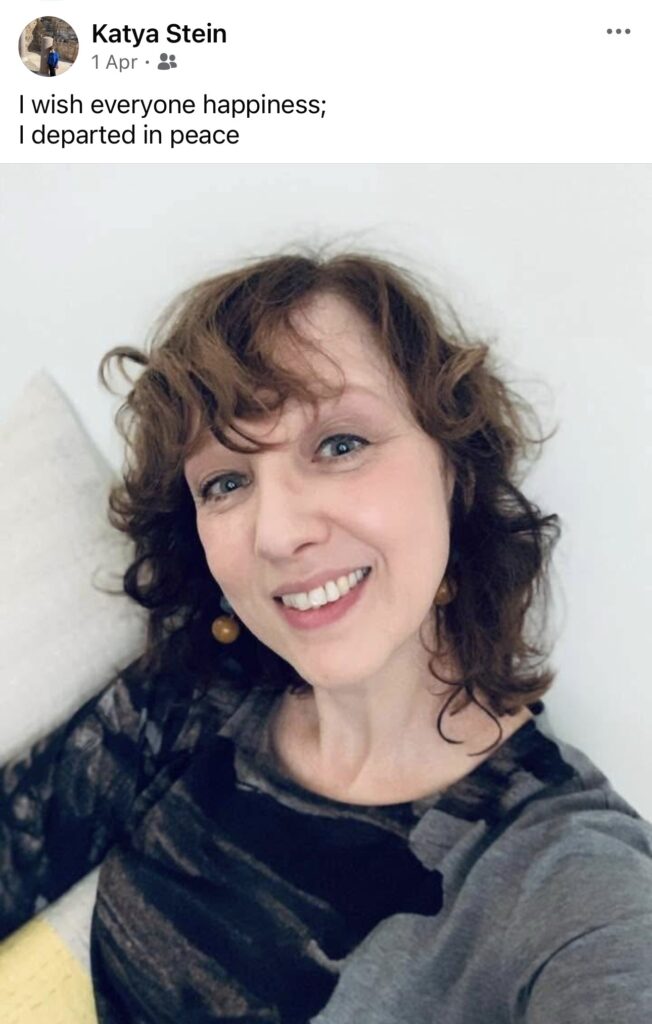
I also sadly reflect about my friend and once fake fiancé, Katya, as this week is her birthday. A month ago, she succumbed to pancreatic cancer. I knew she had been sick and was glad I got to visit her in December. She knew her diagnosis was serious, but she was hopeful. I woke up that morning a month ago to a post with her picture on Facebook with the words, “I wish everyone happiness; I departed in peace.”
As even the youngest among us who were involved in the Soviet Jewry movement, and those on whose behalf we advocated, are beginning the twilight or pre-retirement years, some being taken too soon like Katya, it’s important to compile stories of those in the West, who dedicated so much time and effort on behalf of Soviet Jews. What are your Soviet Jewry stories? Please share them at FirstPersonIsrael@gmail.com.