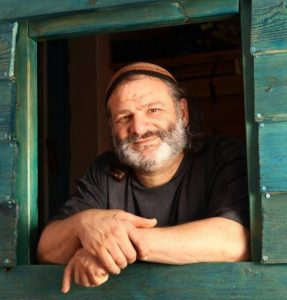
Rabbi Lavie writes that the current war has created a shift in Israel’s essential role, changing it from a post-Holocaust safe-haven and moving it towards its sacred purpose as a moral and spiritual leader of the nations.
When Prime Minister Benjamin Netanyahu launched Operation Sha’agat HaAri, “The Lion’s Roar”, against Iran, he broke with every standard script Israel has used to explain itself to the world for the past seventy years. He did not merely promise to eliminate the nuclear threat hanging over Israeli cities. He declared, before a watching world: “We will create conditions that will allow the brave Iranian people to throw off the yoke of this murderous regime.” Then he added four words that reverberated far beyond any military briefing room: “This is a campaign for humanity.”
According to Rabbi Danny Lavie, head of the Olamot Institute and a senior Torah teacher at the Yeshiva of Alon Moreh, this was a signal that something is shifting in the Jewish state’s very self-understanding, a shift that has been centuries in the making and whose implications run deeper than any single military operation.
“Providence,” Lavie writes in the Hebrew Language Karov Elecha(Close to You), “is leading us to a dramatic shift from a sense of defense to a sense of purpose.”
The Trap of the Safe Haven Narrative
For decades, Israel’s international case for its own existence has rested on a single, tragic foundation: the Holocaust. The argument goes like this: the Holocaust proved that without a state, the Jewish people are vulnerable to annihilation. Therefore, Israel must exist as a refuge. It is an argument rooted in history. It is also, Lavie argues, an argument that has spectacularly failed.
The evidence is everywhere. Within weeks of October 7, 2023, when Hamas terrorists massacred 1,200 men, women, and children in the worst slaughter of Jews since the Holocaust itself, the world’s international institutions were condemning Israel and voicing support for the perpetrators. Just six weeks after the attacks, UN experts declared that grave violations by Israel pointed to “a genocide in the making,” adding that Israel’s response could not “be justified in the name of self-defense after attacks by Hamas.” In doing so, the UN invoked the language of genocide against a nation that had just buried 1,200 of its citizens.
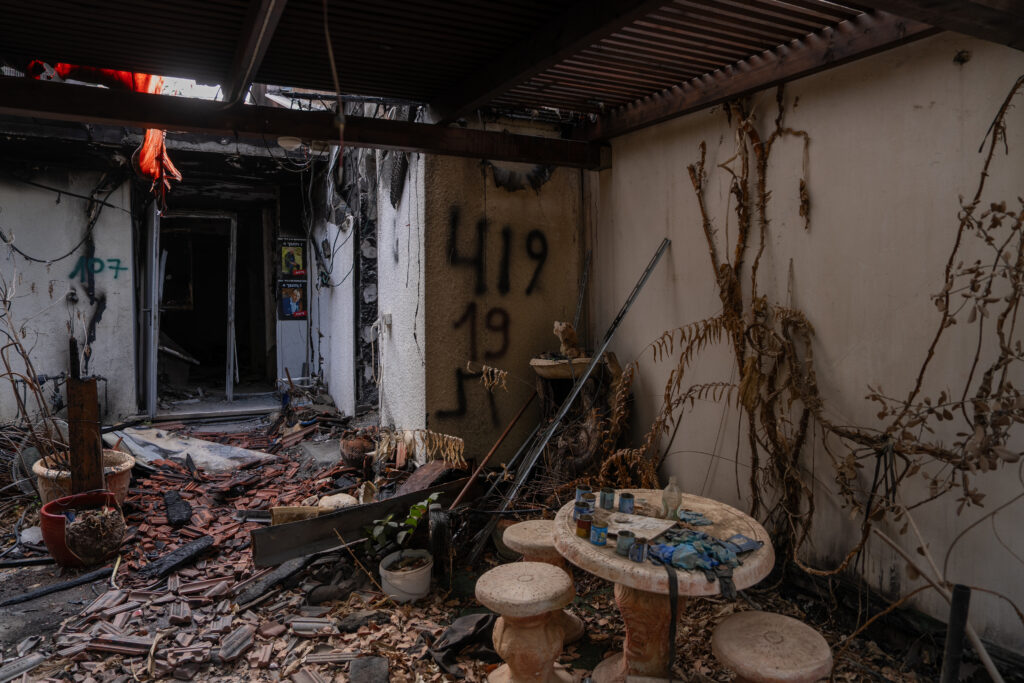
On October 27, 2023, the United Nations General Assembly passed a resolution calling for an immediate cessation of hostilities, adopted by a vote of 121 states to 14. No comparable resolution had been passed in the days after the Hamas massacre itself.
The legal assault escalated from there. On November 21, 2024, the International Criminal Court issued arrest warrants for Prime Minister Benjamin Netanyahu and Defense Minister Yoav Gallant, the first such warrants ever issued against the leader of a Western-backed democratic country. All 125 ICC member states, including France and the United Kingdom, are now required to arrest Netanyahu and Gallant if they enter their territory. The same court that took no action during the Hamas planning, preparation, and execution of October 7 moved swiftly to criminalize Israel’s response to it.
None of this shocked Lavie. He expected it. Not because the world is uniformly antisemitic, though that is certainly a factor, but because Israel has been making the wrong argument.
“The safe-haven language,” he writes, “is not only a tactical error, but a sharp betrayal of the foundation of the identity and existence of the Jewish people.”
The logic is as counterintuitive as it is piercing. When Israel argues that it needs a state to survive, to be, as Lavie puts it, “just another star on the American flag,” the world hears a purely self-interested claim. And a purely self-interested claim invites the world to weigh it against other claims it considers equally self-interested. The moment Israel reduces its existence to survival, it surrenders the higher ground on which its legitimacy actually rests.
Lavie recounts a story told by Prof. Ze’ev Tzachor, who was attacked in England by local intellectuals who questioned Israel’s right to exist. When he pressed them for their reasoning, their answer was startling in its directness: “We dreamed of a place where the new Book would be written, toward the redemption of the world, because you are a am segulah, a treasured people… There were expectations of you from the world. Look what you have done.”
The world, Lavie concludes, is not waiting for Israel to survive. It is waiting for Israel to say something.
The Mandate That Preceded the Nation
The question is whether that expectation has any real foundation in Jewish sources, or whether it is simply the projection of disappointed Gentile idealism.
Indeed, it has the deepest possible foundation in Judaism. Before there was a Jewish nation, before there was a Jewish land, God spoke to Abraham with a commission that was explicitly universal in scope: “Ve-nivrechu vecha kol mishpachot ha-adamah,” “And all the families of the earth shall be blessed through you” (Genesis 12:3). The Abrahamic mandate was never about Abraham alone. It was about every family on earth.
This universal purpose was then formalized at Sinai, on the eve of receiving the Torah, when God told the entire nation: “Ve-atem tihyu li mamlechet kohanim ve-goy kadosh,” “And you shall be for Me a kingdom of priests and a holy nation” (Exodus 19:6). Lavie draws out the full weight of this title. A kohen, a priest, does not exist for himself. His entire function is to serve as a living bridge between the people and the sacred, to bring the divine into the world on behalf of others. “So too are we,” Lavie writes, “designated to serve as the priests of humanity, to connect the entire world to the dimensions of holiness, morality, goodness, and justice.”
The prophet Isaiah gave this mandate its most famous formulation: “U-netaticha le-or goyim” — “I will make you a light unto the nations” (Isaiah 49:6). And the medieval philosopher Rabbi Yehuda HaLevi, in his Kuzari (2:36), expressed it through an organic metaphor that Lavie finds particularly apt: Israel among the nations is like the heart among the limbs. The heart’s function is to pump life through the entire body. Israel’s function, similarly, is to circulate something vital. moral and spiritual life, throughout humanity.
This is why, Lavie notes, the Sages ordained that every Jewish prayer service. three times daily. closes with the words “letaken olam be-malchut Shaddai,” “to repair/establish the world under the sovereignty of the Almighty.” The final word of Jewish prayer, day after day, century after century, is not about Jewish safety. It is about world transformation.
National Egoism and the Warning of Rav Kook
This is the point at which Rabbi Lavie’s analysis becomes most uncomfortable, and most necessary. If Israel’s national purpose is world-directed, what does that say about Israeli nationalism that is purely self-directed?
“Israeli nationalism,” Lavie writes, “draws its moral legitimacy solely from the ultimate goal of world improvement. If our nationalism were merely a framework designed to care for our own welfare, then we would be guilty of collective egoism.”
He draws directly on Rav Abraham Isaac Kook, the first Ashkenazi Chief Rabbi of pre-state Israel and the fountainhead of religious Zionist thought, who warned explicitly against exactly this corruption. Rav Kook wrote that nationalism disconnected from moral purpose is nothing but “ahavat atzmo gassa be-levush leumiyut,” “crude self-love dressed up in nationalist clothing” (Ein Ayah, Shabbat 1:49).
This is a critical distinction that must be made clearly. Lavie is not invoking the fashionable progressive concept of tikkun olam as it has been diluted in liberal Western Jewish circles, where it has become a synonym for left-wing political activism, detached from Torah, detached from halacha, detached from any specifically Jewish content. That version of tikkun olam could be performed equally well by a secular humanist from anywhere on earth. It requires nothing Jewish about it.
The tikkun olam Lavie is describing, the one rooted in Rav Kook, in the prayer Aleinu, in mamlechet kohanim, is inseparable from specific Jewish identity, from living Torah, from the land of Israel, from the entire structure of Jewish civilization. It is not “repair the world by voting for the right candidates.” It is “become, as a nation, what God intended you to be, and the world will be transformed by your becoming.” The two are not the same thing. They are not even in the same category.
The corruption Rav Kook identified, national egoism, is dangerous precisely because it mimics genuine patriotism while evacuating it of all moral content. The moment a nation exists only for itself, it loses the right to ask the world to care about it. And the moment Israel forgets that its nationhood was always intended to serve a purpose beyond itself, it becomes, in Lavie’s words, just another star on the flag of whoever is currently the dominant power.
The World’s Moral Vacuum and Israel’s Answer
Lavie surveys the current global landscape with clear eyes. He sees two poles, both dangerous.
On one side stands a post-Christian Europe that, in his reading, has lost the very ability to distinguish good from evil, and, with it, the will to resist it. He cites British journalist Douglas Murray’s The Strange Death of Europe as a description of a civilization being hollowed out from within by radical Islam, unable to summon the moral clarity to defend itself.
On the other side stands radical Islam, Iran being among its leading patrons, which does possess a vision of world order, but one enforced at swordpoint. Lavie does not flinch from calling it what it is: an imperialist theology that denies the right of any non-Muslim sovereign entity to exist and uses killing as its primary instrument of “repair.” He draws the comparison to the Crusades, armies marching under the banner of love, leaving rivers of blood in their wake.
Between these two poles stands Israel.
“We carry within us an ancient Jewish tradition of truth and faith that embraces all dimensions of reality,” Lavie writes. “But unlike Islam and Christianity, we have no aspiration to impose our truth by force of the sword or through missionary activity.”
He cites Rav Kook again on this precise point: “We were not commanded to bear sword and war and to call in God’s name to nations that do not know Him” (Ein Ayah, Berakhot 9:314). The Rambam, Maimonides, rules that the righteous of the nations of the world have a share in the world-to-come without converting (Hilchot Melachim 8:11). Judaism, Lavie notes, recognizes the worth and the rights of the non-Jew precisely as a non-Jew. This is not tolerance as a concession. It is a theological position: human diversity is legitimate le-chatchilah, from the outset.
This is what makes Israel’s war against the murderous Iranian regime different in kind from the wars of other nations. It is not merely an act of self-defense, and neither is it a wave of nationalist-fueled aggression intended to impose one set of beliefs on the entire world. Israel’s war against the Islamist regime is an act on behalf of the Iranian people themselves, and on behalf of a free world that has lost the capacity to act in its own defense.
The World Is Watching And Beginning to See
Lavie points to voices from across the world that are recognizing this, sometimes with more clarity than Israelis themselves. He quotes the German Chancellor, who declared that “Israel has the courage to do the dirty work for all of us.” He points to the Iranian people, those living under the regime’s boot, who have praised and thanked Israel with unmistakable emotion. He quotes a French journalist who said on live television: “I want to express support, respect, and admiration for the Israeli people… This people has extraordinary moral and spiritual strength… The Israelis are defending our values… they are protecting the security of the West and the security of Europe… You are on the right side of history, you are on the side of truth.”
And then Lavie brings the words of Jordan Peterson, delivered during a visit to Israel approximately four years ago, at the end of a speech in which the Canadian psychologist turned to his Israeli audience and said, with visible emotion:
“As Jews in Israel, are you telling the greatest story ever told? The answer depends on how you choose to live. For one reason or another, it isn’t easy to understand, everyone is looking here… at a small people in the middle of nowhere… You have an enormous moral responsibility, as you have had throughout history. For reasons that are difficult to understand, I think it’s accurate to say that the fate of the world depends on the people of Israel… This is how you become a light to the nations: you draw people here by what you are capable of doing. You show the world what the holy city can look like. Because we need it. We need it. And it is up to you to do it.”
This, Lavie argues, is the answer to one of the most painful questions facing Israel today. Why does the world, which condemned Hamas terrorism, then turn and condemn Israel for fighting back? Why does a country that just buried 1,200 murdered civilians have to justify its right to exist? Why, as Lavie asks with pointed irony, does no one feel the need to declare that Britain or Germany “has the right to defend itself”? That statement is absurd when applied to any other nation. Applied to Israel, it has become a diplomatic formula — and a condescending one.
The answer is that Israel is held to a standard no other nation is held to. But the reason for that standard is not only antisemitism. The deeper reason is that Israel actually has a mission that other nations do not have, and when Israel acts as though it does not, the world feels, on some level, cheated. “Contrary to the mistaken idea,” Lavie writes, “that if we just fight for our peace, the world will have mercy on us, and recognize our right to exist, the opposite is true. The world expects a moral gospel from us, and the more we speak this language, the more our international legitimacy will gradually grow.”
Yad Vashem or the Kotel?
Lavie closes with a gesture that is both practical and symbolic. He argues that when world leaders visit Israel, the first stop on their itinerary should not be Yad Vashem, the Holocaust memorial. Yad Vashem tells the story of persecution and defensive survival. It anchors Israel’s identity in victimhood. It is a story of what was done to us.
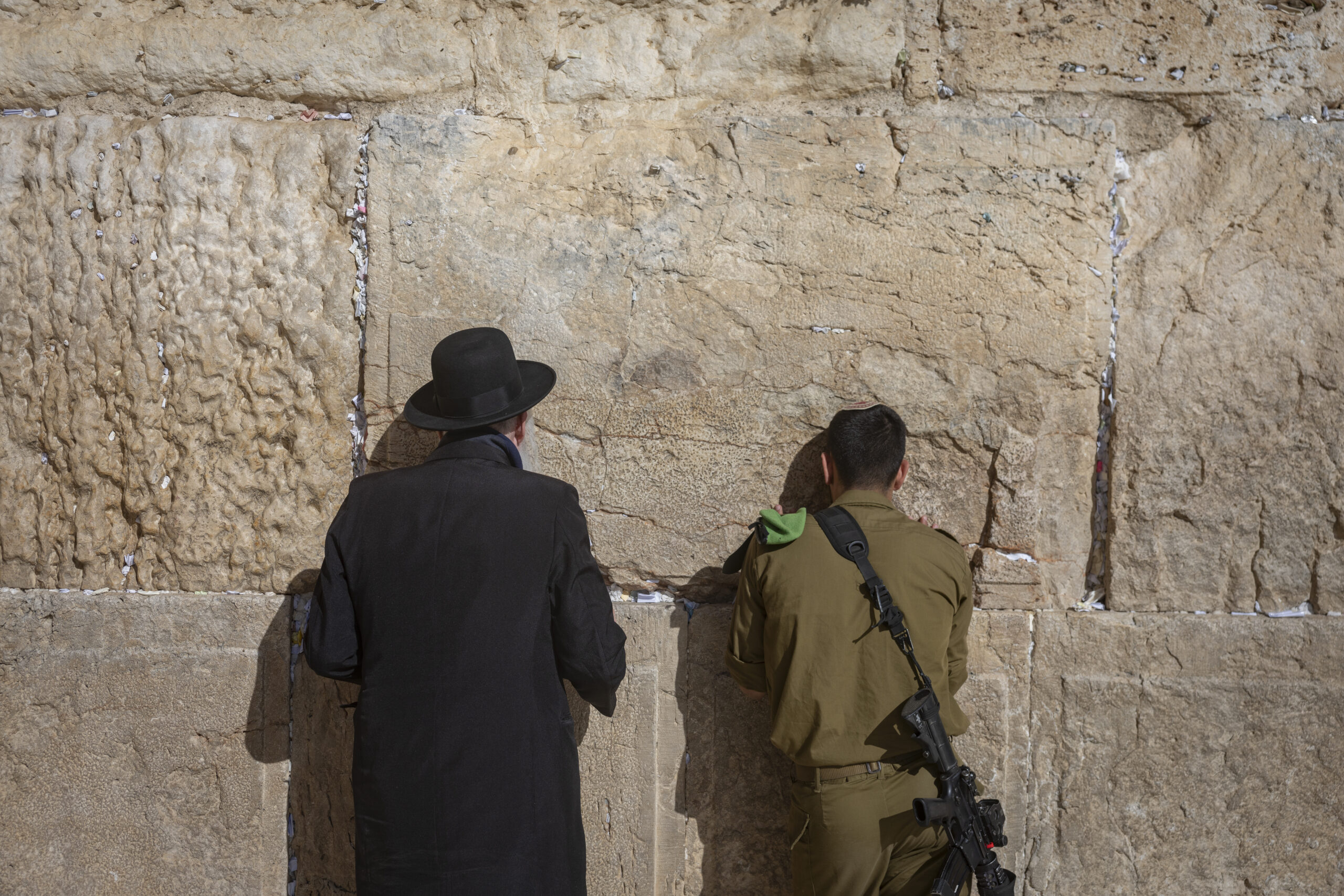
The Western Wall, the Kotel, tells a different story. It speaks of eternity, of purpose, of a people returning not merely to survive but to fulfill a mission that predates the Holocaust, predates the exile, predates even the first Temple whose ruins it touches. And beyond the Kotel, Lavie looks forward to the Beit HaMikdash, the Temple, as the ultimate symbol of what Israel is here to build in the world.
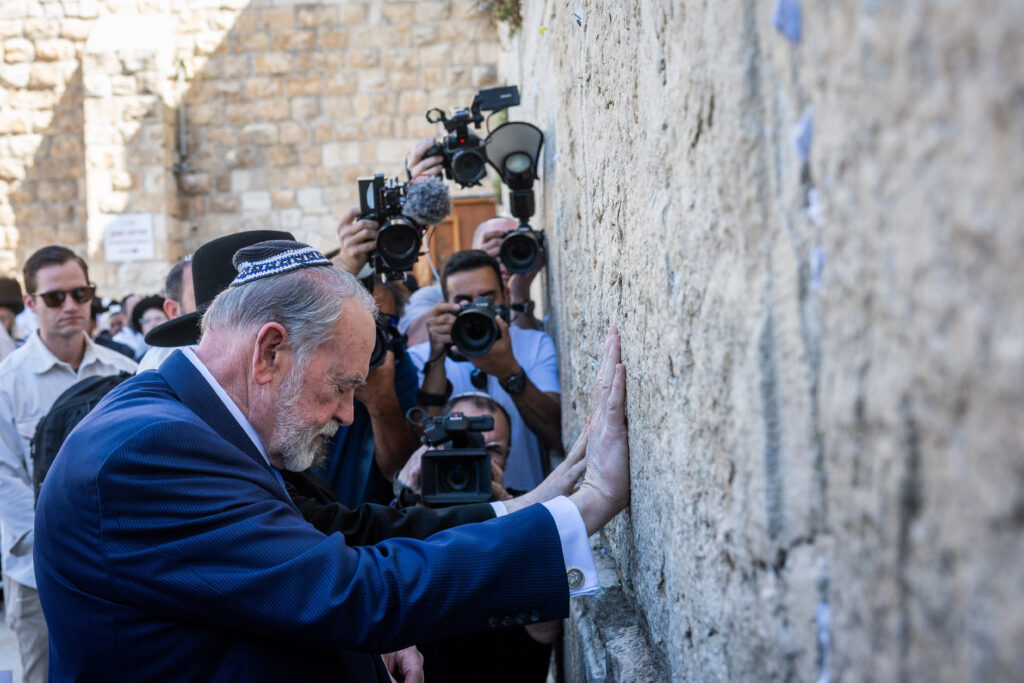
He draws on Rav Kook’s Orot to make the point: “We have begun to say something great, among ourselves and before the entire world, and we have not yet finished it. We stand in the middle of our speech, and we will not stop and cannot stop… To descend from the stage of history is possible only for a nation that has completed what it began… To begin and not to finish, that is something that simply does not function in reality.”
The roar of the lion has begun. The speech is not finished.
Israel was never meant to be a safe haven for a persecuted people. It was meant to be mamlechet kohanim, a kingdom of priests, and or la-goyim, a light unto the nations. The world does not know how to articulate this expectation, but it feels it. The proof is the double standard to which Israel is relentlessly held. No one expects Luxembourg to change the world. Everyone, at some level, expects Israel to.
The moment Israel stops apologizing for existing and starts declaring why it exists, the moment it walks off the defensive and into its purpose, it will find that the world’s hostility begins, slowly, to transform into something else. Not because the world becomes more righteous, but because a light, when it actually shines, is harder to condemn than a refugee.