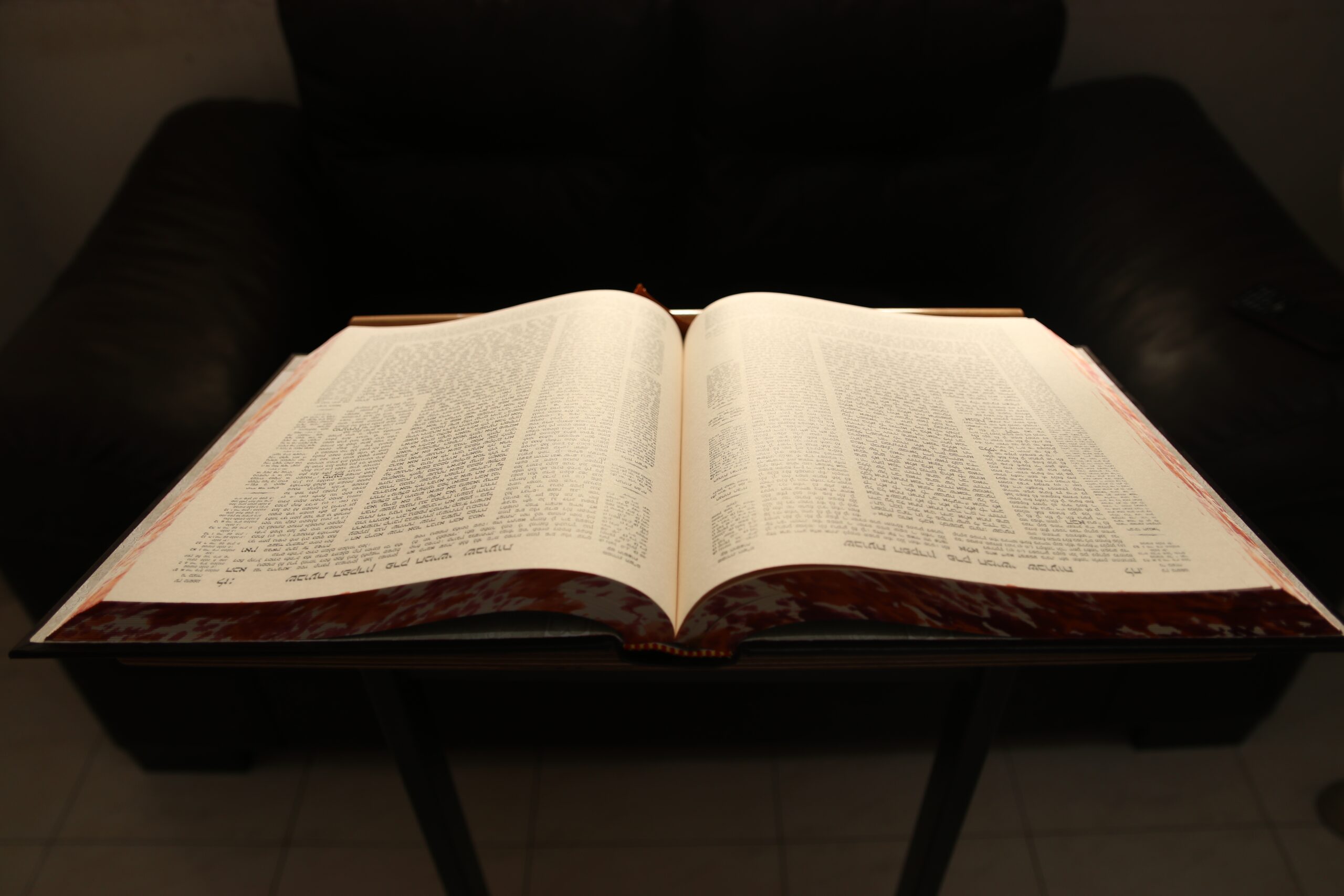
And the many peoples shall go and say: “Come, Let us go up to the Mount of Hashem, To the House of the God of Yaakov; That He may instruct us in His ways, And that we may walk in His paths.” For instruction shall come forth from Tzion, The word of Hashem from Yerushalayim. Isaiah 2:3
Let’s start with a story.
About eight years ago, I was speaking to a group of Torah-aware Christians from the US in a hotel meeting room in Jerusalem about the book Ten From The Nations: Torah Awakening Among Non-Jews, which I had recently published.
After my formal presentation, I shared an idea that had been percolating in my brain. I wanted their feedback to help shape my idea.
“What if,” I proposed, “there was an entire Shabbat experience at a kibbutz guest house in Israel, with full Shabbat meals and classes given throughout the day by Orthodox Jewish teachers? The entire Shabbat, including the Torah classes, would be specifically designed for Christians. Is that something you would be interested in attending?”
My idea generated some interest, but the most memorable moment happened when a woman in the back raised her hand and said, “That sounds like a great experience,” she said, “as long as you don’t teach any Talmud.”
Puzzled by her comment, and not yet aware of the perspective from which she was speaking, I innocently asked, “No Talmud? Why is that?”
“Because,” she explained, “the Talmud is full of demonic evil, witchcraft and immorality.”
I nearly fell off my chair.
I recovered from the initial shock of her statement, which I heard for the very first time back then, but I never forgot it.
I went on to publish two more books about the intersection of Christianity and Torah (and I have other related book projects in development). I have met hundreds of Christians who are on a walk with Torah in some capacity and I teach Torah in an online community to a group of remarkable Christian women.
I have learned a lot about ideas about Torah that are taught in some Christians circles. I’d like to restate three of those ideas and respond to them as an Orthodox Jew, in the hope that readers will come to appreciate Torah as a source of Godly wisdom and understand the correct alignment of Israel with the rest of the Nations.
Full disclosure: I am an Orthodox Jewish woman living in the Land of Israel. I am not an expert on Christian doctrine. I believe the Torah has infinite value for all of humanity and I’d like to clarify some of the mistaken ideas about Torah that I have seen commonly shared in Christian circles.
The Good News
My association with Israel365 began in 2014. Since then, I have spent a good deal of time thinking about the intersection of Christians and Torah. I have come to appreciate how revolutionary simply combining the words “Christians” and “Torah” in a single sentence is.
I am one of a handful of Jews here in Israel doing something that has never been done before. We are teaching Torah to interested Christians, distilling its universal wisdom for an entirely new audience.
This is game-changing. It’s transformative. It’s part of the process of redemption, in which the Jewish people share the universal wisdom of Torah with the entire world. That’s part of the messianic vision, as the prophet Isaiah foretold:
For instruction shall come forth from Tzion, The word of Hashem from Yerushalayim. (Isaiah 2:3)
And as the prophet Zechariah predicted:
Thus said the lord of Hosts: In those days, ten men from nations of every tongue will take hold—they will take hold of every Yehudi by a corner of his cloak and say, “Let us go with you, for we have heard that Hashem is with you.” (Zechariah 8:23)
The Bad News
Given my interest in these matters, I enthusiastically joined a Facebook group called “Christians Today Need Torah.” The group has over 46,000 members. And, as I later found out, a strict policy of steering clear of what the group rules refer to as “the doctrines of men that come from the YESHUA hating religion of Orthodox Judaism.”
In other words, this Facebook group includes tens of thousands of Christians who believe the Torah has something to offer them—but only on their own terms, filtered through English translations, and without any input from Orthodox Jews, who carry an unbroken 3,338-year tradition of transmission going back to Moses at Sinai.
This understanding of Torah is, by definition, deficient and subject to gross misinterpretation.
Oral Torah
I used to think that the main difference between Christians and Jews was what we believed about the divinity and/or messiahship of Jesus/Yeshua. However, the longer I spend with Christians who hold Hebrew scripture with reverence, the more differences I see. One of the most important is the relevance of the Oral Torah.
To a Torah-observant Jew, it is axiomatic that the Oral Torah was given by God to Moses on Mt. Sinai along with the Written Torah. In my book Lighting Up The Nations: Jewish Responsibility Towards the Nations Today and in the Messianic Era, I wrote a chapter called “The Oral Torah Dilemma” in which I made the case that it’s actually impossible to understand the written Torah without the Oral Torah.
For our purposes, let me give a few examples.
In Leviticus 23:40, there is a command related to the holiday of Sukkot. The Bible says:
On the first day you shall take the product of hadar trees, branches of palm trees, boughs of leafy trees, and willows of the brook, and you shall rejoice before Hashem your God seven days.
Those who dismiss the Oral Torah as merely “the doctrines of men,” and therefore unnecessary for understanding the Written Torah, encounter a serious difficulty: they are left without any clear way to identify what the phrase “the product of hadar trees” actually refers to.
Another example: There is a blue dye known as techelet. Techelet dye is used in the commandment of tzitzit, as it says in Numbers 15:38:
Speak to the Children of Israel and instruct them to make for themselves fringes on the corners of their garments throughout the ages; let them attach a cord of blue to the fringe at each corner.
Neither the source of this special blue dye nor how to produce it is defined in the Bible. For this, we need the Oral Torah. Without the Oral Torah, we also lack details about how to make the fringes. How many strings constitute a fringe? How long should they be? We are told one of the threads should be blue, but what color should the rest of them be? Do all the fringes need to be wool or only the blue thread? The Bible offers no specific instructions.
Another example: God instructs that Shabbat should be sanctified and that no labor should be performed on it. We read in Exodus 20:8-10:
Remember the Shabbat day and keep it holy. Six days you shall labor and do all your work, but the seventh day is a Shabbat of Hashem your God: you shall not do any work—you, your son or daughter, your male or female slave, or your cattle, or the stranger who is within your settlements.
What’s missing from the Bible is any explanation of what constitutes forbidden labor. What work is permitted and what work is forbidden on the Sabbath? For this, we need the Oral Torah.
The complete, authentic transmission from God to Moses contained a written component which we call the Bible, and an oral tradition that accompanied and elucidated it. They were given at the same time on Mt Sinai.
Without the Oral Torah (which was eventually also written down), many of the commandments God issued in the Bible simply cannot be understood, let alone fulfilled.
Ignoring the details provided by the Oral Torah, dismissing this part of Torah as mere “doctrines of men” or, even worse, misinterpreting statements quoted out of context and concluding that “the Talmud is full of demonic evil, witchcraft and immorality,” dooms the serious Christian who wants to pursue Torah, at best, to an incomplete understanding of the Torah.
Ironically, setting aside that interpretive tradition doesn’t remove the need for explanation—it just shifts it. Suddenly, every unclear verse demands a fresh interpretation, and each reader is left to fill in the gaps on their own. The result isn’t greater clarity, but a patchwork of explanations that can drift far from the Torah’s original context and intent.
Our Torah Obligations Differ
I am aware that there exists, among a subset of Christians, the idea that, as followers of Jesus, they must walk in obedience to Torah, as they understand Jesus and his early Jewish disciples did. From this desire, they conclude that they have the same Torah obligations as Jews.
There is absolutely no basis for this conclusion in Hebrew scripture.
God made an eternal covenant with the Nation of Israel that includes specific obligations. An individual who was not born into the Nation of Israel can choose to take on these obligations by converting to Judaism.
Sometimes the belief that Christians are obligated exactly as Jews are obligated by Torah is based on a mistranslation of a few similar verses:
There shall be one law for the citizen and for the stranger who dwells among you. (Exodus 12:49)
You shall have one standard for stranger and citizen alike: for I Hashem am your God. (Leviticus 24:22)
There shall be one law for you and for the resident stranger; it shall be a law for all time throughout the ages. You and the stranger shall be alike before Hashem. (Numbers 15:15-16)
In all these cases, the Hebrew word that is translated as “stranger” or “resident stranger” is ger. There are many nuances to this Hebrew word that lie far beyond the scope of this essay, but let me point out that, in the quotes from Exodus and Numbers, the reference is to a particular kind of ger, namely a ger tzedek, which is the Torah’s way of identifying a full convert. The message here, hidden in the Hebrew, is that the Torah obligates a native-born Jew and a full convert in exactly the same way.
The verse from Leviticus refers to a different kind of ger, namely a ger toshav, a non-Jew who lives in Israel among Jews and shares their Torah lifestyle (as is appropriate for them as a non-Jew). This verse does not teach that a ger toshav has an equal mitzvah obligation, but rather that a ger toshav is accorded equal legal protection and accountability under the law.
It is therefore an error to read these verses in English, or to combine them with a desire to live as Jesus lived, and conclude that Christians and Jews are equally obligated in Torah law. At the same time, it is certainly admirable when Christians take on mitzvot out of a genuine desire to come closer to God and walk in His ways. But that very sincerity makes clarity all the more important: these practices, however meaningful, are not binding upon them in the same covenantal sense that they are upon the Jewish people.
Hebrew scripture instead envisions a world in which Torah flows outward from Israel and uplifts all of humanity. Non-Jews are not expected to become Jews, but they are invited to learn God’s wisdom, walk in His ways, and draw closer to Him.
The Correct Alignment of Israel to the Nations
Finally, let’s look again at two pivotal verses from the prophets, who envision a future era in which the nations themselves seek to learn Torah from the Jewish people.
And the many peoples shall go and say: “Come, Let us go up to the Mount of Hashem, To the House of the God of Yaakov; That He may instruct us in His ways, And that we may walk in His paths.” For instruction shall come forth from Tzion, The word of Hashem from Yerushalayim (Isaiah 2:3)
Thus said the lord of Hosts: In those days, ten men from nations of every tongue will take hold—they will take hold of every Yehudi by a corner of his cloak and say, “Let us go with you, for we have heard that Hashem is with you.” (Zechariah 8:23)
Nowhere in Hebrew scripture does it suggest that Christians should try to figure out what God is asking of them based exclusively on their translation of Torah. Rather, the correct alignment of Israel to the Nations is to be teachers, representing God’s Word.
This goes all the way back to Abraham, history’s first monotheist, who taught the world to see a singular Creator and Sustainer of the universe.
In the Book of Exodus, the Nation of Israel is invested with the task of serving as spiritual guides for other Nations.
But you shall be to Me a kingdom of priests and a holy nation.’ These are the words that you shall speak to the children of Yisrael. (Exodus 19:6)
The role of the priests was to teach, model and facilitate connection to God. This is what the Jewish people have been tasked with.
In the Book of Deuteronomy, we are taught that the Nations are watching and that the Torah is meant to be modeled by the Nation of Israel.
See, I have imparted to you laws and rules, as Hashem my God has commanded me, for you to abide by in the land that you are about to enter and occupy.
Observe them faithfully, for that will be proof of your wisdom and discernment to other peoples, who on hearing of all these laws will say, “Surely, that great nation is a wise and discerning people.” (Deuteronomy 4:5-6)
For the past 2,000 years, the Jewish people have been preoccupied with shielding ourselves from vicious attempts to forcibly convert, banish or murder us. During these long and bloody centuries, it was neither safe nor smart to try to share any of the universal wisdom of Torah with the world.
Today, we are living in a revitalized era. We can feel the breath of redemption on the back of our necks. Now is when the Biblical realignment is happening. Now is when the universal wisdom of Torah, meant to uplift all humanity, can be shared.
The Torah-awakening among non-Jews is a new phase in redemption, and it comes with a degree of awkwardness. None of us has ever done this before.
I deeply believe that if the Jewish people take our responsibility to the Nations seriously, and if the Christian world accepts the spiritual guidance of the Jewish people when it comes to Torah (and ceases insisting that they understand the Torah better than the Jews do), the transition to redemption will flow much more smoothly.
Rivkah Lambert Adler is a freelance journalist and an expert on the non-Jewish awakening to Torah happening in our day. She is the editor of three books on the topic: Ten From The Nations, Lighting Up The Nations and Adrift Among The Nations. She can be reached at rivkah@kotevet.com.