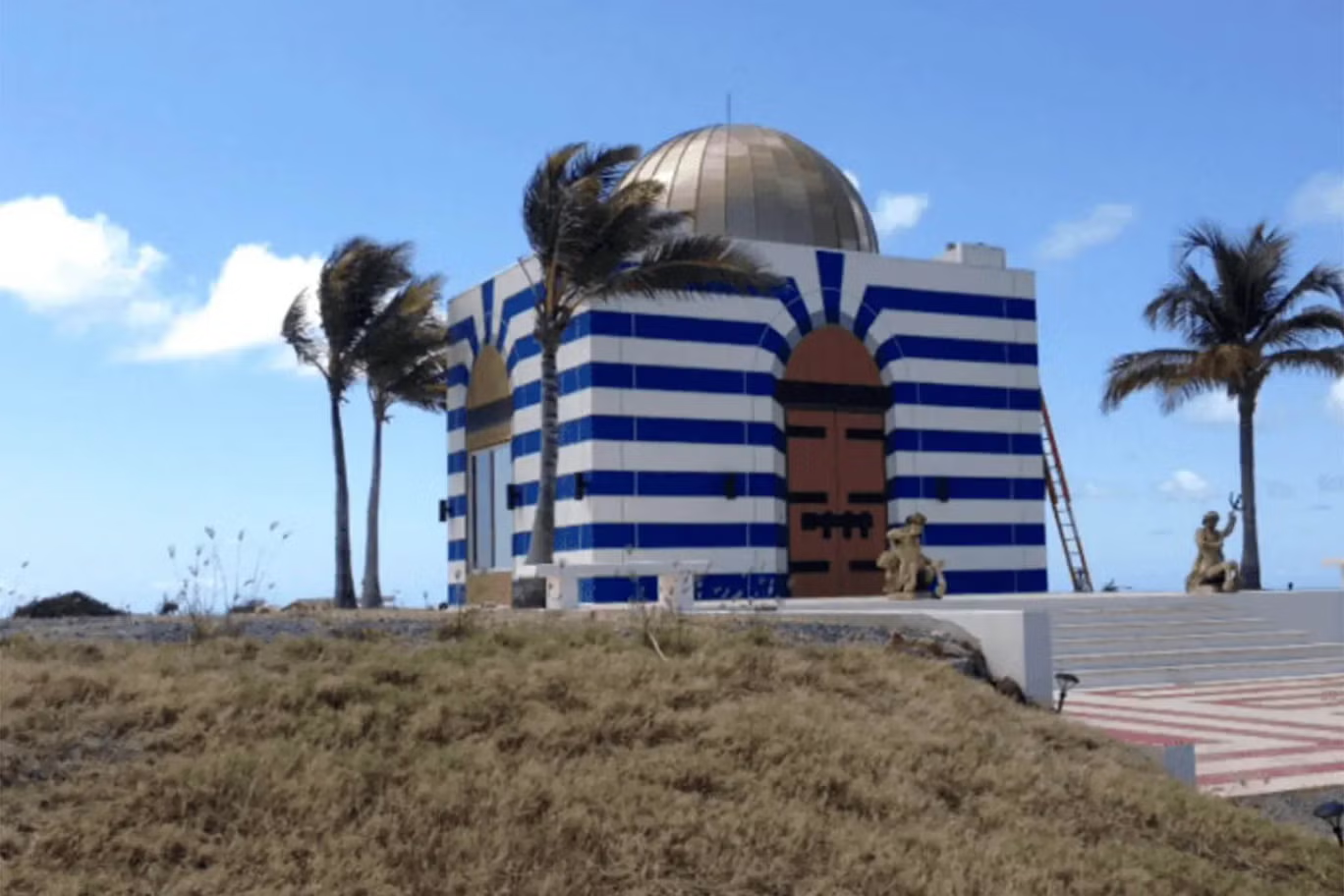
A blue-and-white striped building crowned with a golden dome sat atop Little Saint James, Jeffrey Epstein’s private Caribbean island—the same island that federal prosecutors identified as a base of operations for his sex trafficking network. For years, that mysterious structure was described variously as a music room, a pavilion, and even an occult temple. Newly released Justice Department documents, along with a New York Times investigation drawing on millions of pages of files, now make clear what Epstein, a secular man who was born Jewish, called his “mosque.” And the lengths he went to furnish it with the most sacred artifacts in Islam—including cloth taken directly from the Kaaba in Mecca—reveal a web of Middle Eastern connections that reached the Saudi royal court itself.
Epstein’s island empire—built on exploitation, insulated by wealth, and adorned with plundered holiness—ultimately collapsed. The documents he fought to suppress were released. The secrets are now public.
The paper trail begins as early as 2009, when Epstein—then serving time in a Palm Beach County jail after pleading guilty to soliciting prostitution—hired architects to design a hammam (a Turkish bathhouse) surrounded by what his correspondence called “Islamic gardening.” He scrapped that plan and began pursuing a permit for a “music room” in the building he designated “5 Palms,” emailing himself images of ancient Middle Eastern mosques as design inspiration. By 2011, he was writing to a contact in Uzbekistan to source authentic decorative tiles. “It will be for the inside walls,” Epstein wrote, “like a mosque.” Romanian artist Ion Nicola, hired to work on the project, confirmed to the New York Times that Epstein routinely called the building his “mosque” and asked Nicola to replace the Arabic word for God—Allah—with Epstein’s own initials. “Instead of allah,” Epstein wrote in his characteristically misspelled emails, “i thought j’s and e ‘s.”
His ambitions and access grew sharply around 2010 through his relationship with Terje Rod-Larsen, a Norwegian diplomat who connected Epstein to Raafat Al-Sabbagh, a consultant to the Saudi royal court, and to Al-Sabbagh’s associate, the UAE-linked businesswoman Aziza Al-Ahmadi. Through this network, Epstein sought direct access to Mohammed bin Salman—then the deputy crown prince—pitching himself as a financial adviser for the planned Saudi Aramco public offering. He brought with him what he called “radical ideas,” including a proposal for a new currency to be called “the shariah” for use in Muslim commerce. Epstein received the meeting. He later displayed a photograph of himself joking with the future crown prince at his New York townhouse.
The acquisition of the Kiswa was the culmination of this access. The Kiswa is the black, gold-embroidered cloth that drapes the Kaaba—the cube-shaped structure at the center of the Masjid al-Haram in Mecca, the holiest site in Islam, circumambulated by millions of pilgrims annually during Hajj. Each year, a new Kiswa is produced by hundreds of artisans in a royal workshop, consuming roughly 1,500 pounds of raw silk and 250 pounds of gold and silver thread, at a cost of approximately $5 million. When the old covering is removed, it is cut into sections and distributed to institutions, individuals, or charitable auctions.
In early 2017, as Epstein and Al-Ahmadi met in New York, their assistants coordinated a shipment from Saudi Arabia to his island. Epstein’s assistant informed a customs broker directly: “We are receiving 3 pieces from the Kaaba.” Documents show three distinct items: one piece used inside the Kaaba itself, one Kiswa that had covered the exterior of the shrine, and a third piece produced in the same Mecca factory but unused, listed on customs declarations as “artwork” to expedite the shipment. The items traveled by air freight from Saudi Arabia to Florida via British Airways, arranged by Al-Ahmadi and her associate, Abdullah Al-Maari.
Al-Ahmadi was not understating the weight of what she was sending. In an email to Epstein, she described the cloth’s significance: “The black piece was touched by minimum 10 million Muslims of different denominations, Sunni, Shia and others. They walk around the Kaaba seven rounds then every one tries as much as they can to touch it and they kept their prayers, wishes, tears and hopes on this piece.” She framed the shipment in almost devotional terms. The man receiving it had been convicted of soliciting minors for prostitution.
The documents do not show how Al-Ahmadi obtained the Kiswa pieces, and she did not respond to requests for comment. The Saudi government similarly offered no response. The items arrived at Epstein’s Florida residence in March 2017 and were destined for the island “mosque,” which also received tiles from a mosque in Uzbekistan and a golden metal dome modeled on a 15th-century bathhouse in Aleppo, Syria.
Hurricane Maria caused significant damage to the island in 2017, including to the “mosque.” By then, Mohammed bin Salman had consolidated power as crown prince and distanced himself from Epstein—a development that visibly rankled him. “The kingdom needs lots of expensive help now as they did not follow the jew directions,” Epstein texted Rod-Larsen, apparently referring to himself. When journalist Jamal Khashoggi was murdered inside the Saudi consulate in Istanbul in October 2018, Epstein raised it with Rod-Larsen, who replied: “Dark cloud over his head. And it won’t go away.”
Within weeks, a Miami Herald investigation exposed the secret terms of Epstein’s 2008 plea deal. He was arrested on new federal sex trafficking charges in July 2019, transferred ownership of his island to a private trust the following month, and was found dead in his Manhattan jail cell two days later.
The Kiswa he acquired—cloth stitched with prayers and touched by millions of believers, shipped across the world and declared as “artwork” to customs agents—ended up on an island that federal prosecutors describe as a crime scene. The building that houses it still stands. The dome still gleams. And the Justice Department documents that expose how it all came to be are now part of the public record—a monument, ultimately, not to any faith, but to the arrogance of a man who believed his wealth could acquire anything, sacred or profane, and that no ledger would ever catch up with him. It did.