
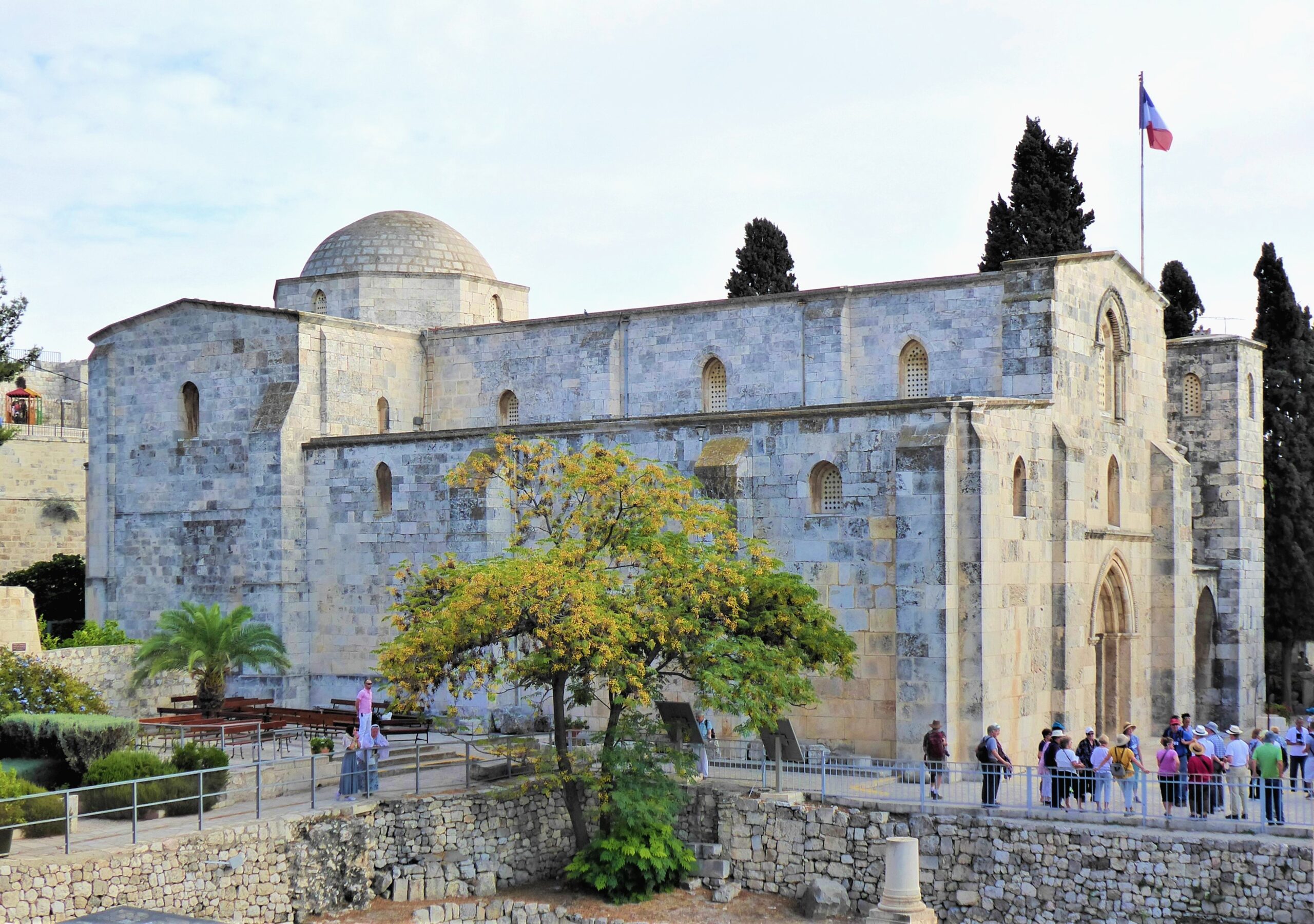
Somewhere beneath a 12th-century Crusader church in the heart of Jerusalem, a church flying the French flag and administered by the French consulate, a professor of numismatics once stood in a dark cellar staring at golden vessels he immediately recognized as the sacred utensils of the Holy Temple. He pinched himself. He rubbed his eyes. Then a monk’s thunderous voice shattered the silence: “It is forbidden for you to be here!” The professor was escorted out. The subject was never officially discussed again.
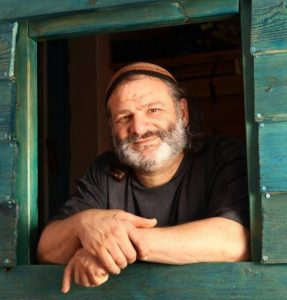
The story is documented in Rabbi Harry Moskoff’s new book, The Vatican and ME, and it is one of the most arresting accounts to emerge from the long and murky history of the Temple vessels’ whereabouts. Moskoff, a Remi Award-winning investigative archaeologist, journalist, and director of the Museum Heritage Project at the Vatican, has spent over 25 years tracking credible eyewitness accounts of people who claim to have seen Temple treasures in Rome, in Jerusalem, and in places no one is supposed to talk about.

After Israel’s miraculous victory returned the Old City of Jerusalem to Jewish hands, a professor named Dr. Yaakov, then Chair of the Archaeology Department and a numismatics professor at the Israel Museum, was invited to St. Anne’s Church in East Jerusalem to assess a large collection of Byzantine coins and icons. St. Anne’s Church is a French Catholic church and part of the French national domain in the Holy Land, located in the Muslim Quarter of the Old City of Jerusalem, near the Lions’ Gate. The monks had been corresponding with Dr. Yaakov for months about the collection, and the conclusion of the Six-Day War finally provided him with the opportunity to examine it in person.
He was welcomed warmly. Church officials led him to the room containing the coins, told him he would have approximately three hours to complete his work, and locked the door behind him, saying it was to keep out tourists. He sat down, examined the collection thoroughly, and finished ahead of schedule. He knocked on the locked door. No answer. He knocked again. Nothing.
With time to spare and no cell phone — this was the late 1960’s — Dr. Yaakov began walking the perimeter of the room looking for another exit. He found one: a hidden side door. He pulled the handle. It opened onto a dark, descending staircase.
At the bottom, he found himself in a large, dark cellar. As his eyes adjusted, his gaze fell on a table in the center of the room. On it were golden utensils — ash-collecting pans, incense shovels, and large cups used to throw sacrificial blood onto the altar. He drew closer. Some of the vessels bore Hebrew inscriptions.
“The Temple vessels are in Jerusalem,” he whispered to himself.
Seconds later, a door burst open. A monk’s voice boomed off the cellar walls: “It is forbidden for you to be here!” Dr. Yaakov was escorted out of the compound, firmly but politely, and the matter was closed, at least from the Church’s side.
What makes this account more than an unverifiable story is what came next. Some time after the visit, the coin collection at St. Anne’s was stolen. The police and the insurance company both needed Dr. Yaakov, the last professional to have seen and assessed the full collection, to file a report on its value. He agreed, on one condition. He would cooperate with the insurance investigation only if the Church allowed him back into that cellar.
The monks’ response was categorical: there was nothing down there to see. The professor’s response was equally blunt: they were, he said, the best bluffers around.
No deal was made. The professor never went back down. And the Church has never wavered from its position.
What is that cellar hiding? The question cuts right to the heart of one of history’s longest-running mysteries: where are the keilim of the Beit HaMikdash? The menorah, the shulchan (table), the mizrak (basin for blood), and the makhta (incense shovel) are not merely historical artifacts. They are sacred objects, fashioned for divine service, described in exacting detail in the Torah itself. “And you shall make its pans to receive its ashes, and its shovels, and its basins, and its forks, and its fire-pans: all its utensils you shall make of copper.” (Exodus 27:3)
The Sages have long taught that the most sacred of these vessels were hidden before the destruction of the Temple. Hidden, not lost. The Talmud (Tractate Yoma 54a) records that certain holy objects were genuzim, concealed deliberately. The Massekhet Kelim, a medieval Hebrew text, goes further, cataloging hidden treasures buried throughout the Land of Israel awaiting the time of redemption.
That sense of divine timing runs through every layer of this story. A second, no less gripping account, set at the turn of the 20th century, describes this aspect of divine timing. A Jewish farmer plowing a field near Jerusalem fell into a pit that suddenly opened beneath his feet. When his eyes adjusted to the darkness, he saw golden vessels and knew instantly what they were. He climbed out, filled the pit with earth, drew a map, and traveled to New York to see Rabbi Yaakov Yosef Herman.
Rabbi Herman, convinced of the account’s credibility, sent his son Reb Nochum Dovid with the map and a sealed letter to the greatest Torah authority of the generation, Rabbi Yisrael Meir Kagan, known as the Chofetz Chaim, who lived in Radin, Poland. The Chofetz Chaim listened very intently, then took some seforim (books) from his bookcase and became deeply engrossed in them. After a while, he said that according to the description of the discovery site, these golden vessels could very well be holy vessels from the Beit HaMikdash.
Then he lit a match and burned the map to ashes.
His only comment: “It’s not yet the time.”
Rabbi Herman passed on the story in detail to two people: his son and Rabbi Chaim Pinchas Scheinberg. The farmer lived out the rest of his days without ever speaking of what he had seen; the Chofetz Chaim had, with his formidable spiritual authority, seen to that.
Back to St. Anne’s. The political dimension of this story cannot be ignored. The compound containing the Pools of Bethesda and St. Anne’s Church is administered by the White Fathers. But the property’s ultimate authority is diplomatic. France does not recognize Israeli sovereignty over East Jerusalem, where St. Anne’s sits. During French President Jacques Chirac’s 1996 visit to Jerusalem, he refused to enter the church until Israeli soldiers who had accompanied him left, though Arab soldiers were apparently welcome to remain.
Moskoff has attempted repeatedly to get into the cellar. He attended as a tourist. He scheduled appointments with the French Consulate General, arriving with a press pass and a small delegation. Every time, the relevant diplomat had just stepped out, was on holiday, or would be in touch soon. The priests on site are equally airtight. Ask a simple question, such as “Father, where does this staircase lead?” and the answer will be either a lecture on the church’s Crusader architecture or an abrupt turn and exit. Every time.
The artifacts that Moskoff has been tracking in his Vatican work include ancient makhta (incense shovels) and khatzotzroth (silver trumpets), as well as other items used for sacrificial rites, precious objects that found their way to various institutions through inheritance and by way of gifts from Byzantine emperors. The pattern of concealment is consistent whether one looks at Rome or at a locked cellar in Jerusalem: the items exist, eyewitnesses attest to them, and the institutions guarding them are not talking.
The Six-Day War cracked open the Old City of Jerusalem and handed it back to the Jewish people. A professor stumbled into a dark room and saw what he recognized without any doubt. The insurance investigators needed him. The Church said there was nothing to see. The professor called them bluffers. And the cellar, with its hidden side-door and its bars and its staircase going down, sits today beneath a 12th-century Crusader church flying the flag of France, a country that does not recognize that Jerusalem is ours.
The question is not whether these vessels exist. The question is whether we are yet in the generation worthy of receiving them.
Rabbi Harry Moskoff’s books The A.R.K. Report and The Vatican and ME: Unlocking the Divine Treasures Inside are available on Amazon.