



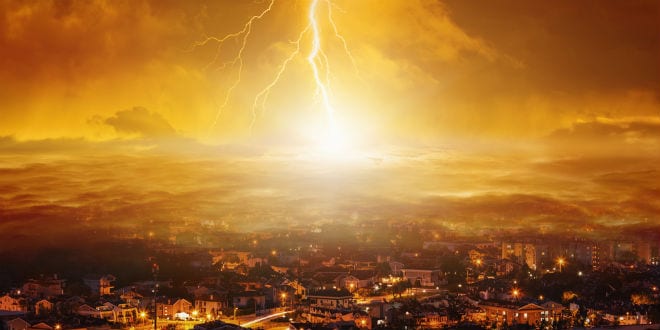
One third of Americans believe they will not live to see old age, not because of cancer or car accidents, but because they expect the world itself to end first. That is the finding of a peer-reviewed study published in March 2026 in the Journal of Personality and Social Psychology, based on a national sample of 1,409 Americans. The researchers, led by Dr. Matthew Billet of the University of California, Irvine, surveyed more than 3,400 people across the United States and Canada and found that apocalyptic belief has quietly migrated from church basements and prophecy charts into the American mainstream.
The Billet study reveals something the ancient prophecies anticipated: that the collapse of faith in the future is not random. It follows patterns. Among Christians, the Pew Research Center found in 2022 that 49% believe they are living in the end times. This figure climbs to 63% among evangelical Protestants and 76% among Black Protestants. These are tens of millions of Americans, many of them Israel’s most devoted supporters, who read global events through an explicitly prophetic lens.
The study identified five psychological dimensions through which people process apocalyptic belief: how close the end feels, whether humans or divine forces are responsible, how much personal control a person believes they have, and whether the end is dreaded or welcomed. These are not abstract philosophical categories. They translate directly into political behavior. The study found that those who believe humans are driving the world toward catastrophe perceive greater danger and support more extreme measures to prevent it. Those who believe Elohim, God, holds the timeline are far less moved by activist urgency. The difference between a climate alarmist and a prophecy-believing evangelical is not simply religious preference. It is a fundamentally different map of reality.
This matters enormously for Israel. The geopolitical pressures on the Jewish state — the war with Iran, the ongoing campaign to eliminate Hamas terrorism in Gaza, the drumbeat for a Palestinian state — do not exist in a vacuum. They exist inside a global culture increasingly saturated with apocalyptic expectation. When the U.S.-Israel military operation struck Iran and killed its supreme leader, “World War III” trended immediately on social media. The response was not analysis. It was prophecy-confirmation. Millions of people did not reach for a newspaper; they reached for the Book of Revelation or for Ezekiel 38.
The Sages were not naive about this dynamic. They understood that the nations would gather against Israel as history moved toward its culmination. The prophet Zechariah wrote plainly: “I will make Jerusalem a cup of trembling for all the surrounding peoples” (Zechariah 12:2). That word trembling is not a metaphor. It describes precisely the disorientation that grips the world when it cannot process what Jerusalem represents.
The Talmud records a teaching in tractate Sanhedrin (97a) that describes the period before the arrival of Mashiach, the Messiah, as one of particular moral and spiritual chaos. The Sages called this era Ikveta d’Meshicha, the “footsteps of the Messiah,” a time when the world would seem to unravel at its seams. They described a period in which truth would be scarce, arrogance would flourish, and young people would shame their elders. The Hebrew prophet Isaiah spoke in similar terms: “Behold, I will create new heavens and a new earth. The former things will not be remembered, nor will they come to mind.” (Isaiah 65:17) The world does not simply drift into redemption; it is torn apart and remade.
What Billet’s research captures, however imperfectly, is the shape of this disorientation in measurable form. Apocalyptic belief is not irrational noise. It is a coherent response to a world that genuinely looks like it is approaching some kind of threshold. Artificial intelligence is eliminating white-collar jobs faster than any previous technology. Debt levels in Western nations have reached historic highs. The Middle East is in open regional conflict. Trust in institutions has collapsed. The researchers themselves acknowledge that these beliefs, accurate or not, shape how populations respond to existential risk, and that dismissing them as irrational is a mistake.
For Jews and for Israel’s Christian allies, the question is not whether to engage this moment but how. The Hebrew Bible does not promise a comfortable approach to redemption. It promises a real one. The noise of apocalyptic expectation filling American culture is not something to manage or explain away. It is a signal that the world senses something is coming, even if it cannot yet name what that is. Those who have read the text carefully already know where to look.

