

He was right to ask for it back. He’s going to need it for the resurrection!
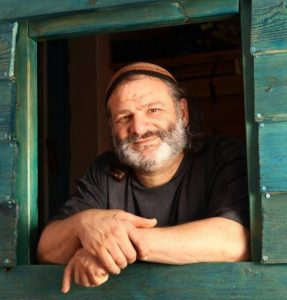
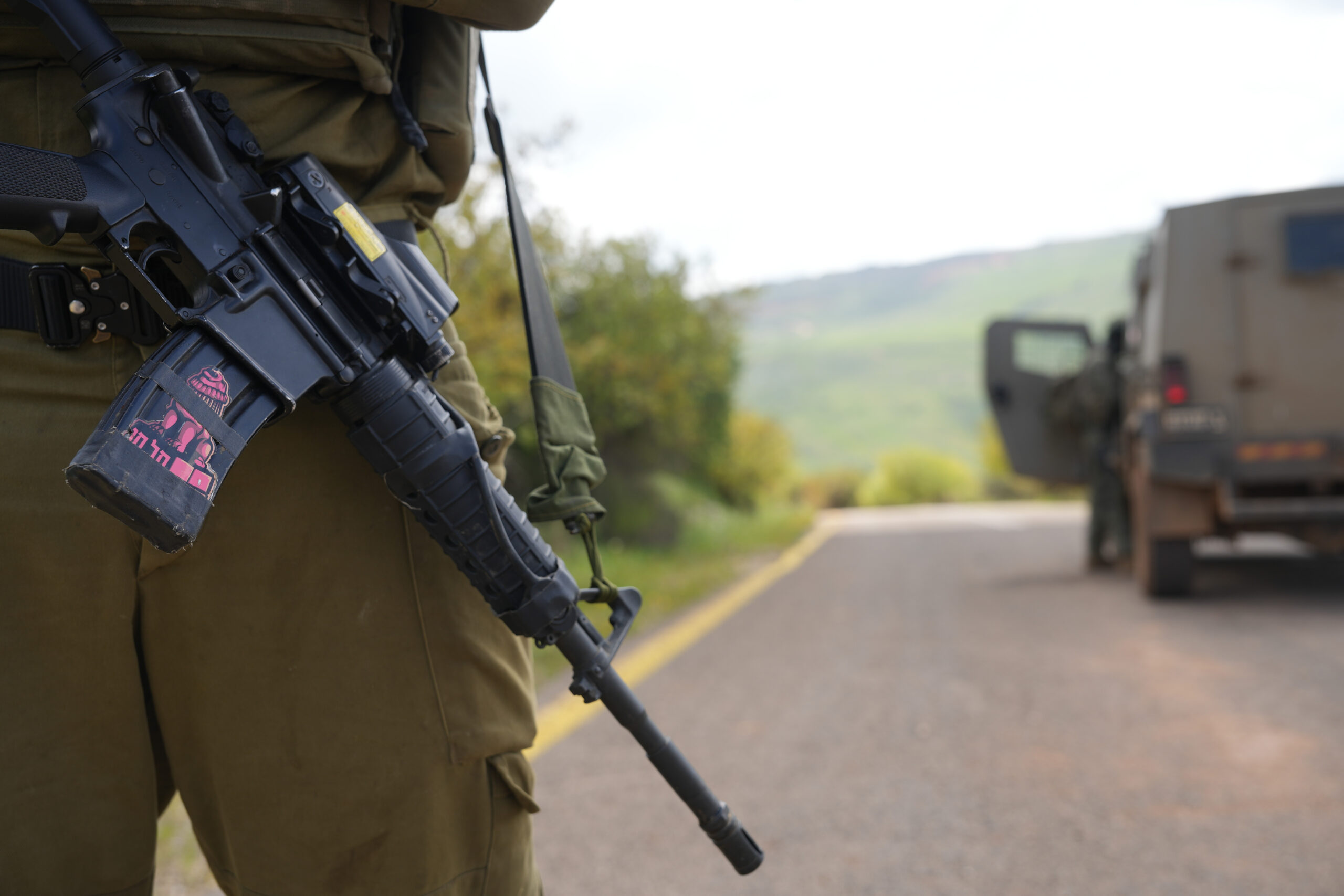
On November 2, 2023, IDF Commander Yonatan Benhamou was driving a D-9 armored bulldozer — the first to enter Gaza — when a rocket-propelled grenade exploded near his vehicle, setting it ablaze. Even as he felt heat searing through his legs, he forced himself through a narrow window and dropped to the ground. He then calmly pulled out his phone and filmed himself injecting morphine. His left leg was amputated below the knee. His right leg was shredded with shrapnel. And through all of it, Benhamou never stopped smiling.
Months later, recovering at the Sheba Medical Center at Tel HaShomer, he became the most famous patient in the physical therapy ward; Israelis lined up to take selfies with him. But it was something he said about his amputated leg, now buried in a Jewish grave for severed body parts, that cuts to something far deeper than battlefield heroism. On the show ALL CAPS , led by Nitsana Darshan-Leitner alongside Sarai Givaty, Titi Ayanaw, and India Naftali, Benhamou, with characteristic Israeli humor, demanded his leg back. He needed it, he insisted, for the techiyat ha-metim, the resurrection of the dead.
“When I saw my mother, and I asked her, where is my leg? She said, The rabbi of the hospital, take the leg and, you know, put it in a grave of limbs. I told her no, non, no. Cancel the contract. I want the leg back. A lot of the people asked, for what you need your leg back? So I told them I want to take the leg and buy a grave in my city, Ashkelon, and put the leg in the grave, and it will be waiting for me. And then, after I will finish my life, I will be there, and after Techiyat ha-metim (the resurrection of the dead), I will wake up with a full body.”
He lost his leg in Gaza, but refused to let that be the end of his story.
— Ynet Global (@ynetnews) April 25, 2026
Yonatan Benhamou , an IDF soldier severely wounded in combat, shares a moment that stays with you: waking up, asking for his leg, and making an extraordinary decision about what comes next. In the face of… pic.twitter.com/Rsvbbxsebn
It was a joke, but the theology behind it is actually correct.
What Jewish Law Says About Amputated Limbs
In halacha (Jewish law), an amputated limb is not medical waste. It was once part of a living human body, created in the image of God — and that status does not simply evaporate in an operating room. The principle governing its treatment is kavod ha-met (honor of the body), the same principle that demands rapid burial of the deceased and prohibits desecration of human remains.
The Shulchan Aruch (the Code of Jewish Law, Yoreh De’ah 362:1) rules that a severed limb should be buried, ideally in the grave already designated for the person from whom it came. If no grave has yet been purchased, the limb is temporarily interred in a special plot, precisely the kind of resting place where Benhamou’s leg now lies. The Noda B’Yehuda (Rabbi Yechezkel Landau, 18th century) and the Igrot Moshe (Rabbi Moshe Feinstein, 20th century) both weigh in on the matter, with the practical consensus being: bury it, treat it with dignity, and ideally reunite it with the body at death.
The Talmud records that when Yiftach suffered from a disease that caused his limbs to fall off one by one, he ensured that each limb was properly buried (Bereishit Rabbah 60:3). A remarkable story from later rabbinic tradition holds that Rabbi Yechezkel Landau himself appeared to his son in a dream after his death and instructed him to bury a tooth that had been left on a specific shelf. A parallel tradition holds that Maimonides, the Rambam, appeared to someone after his death and asked him to place an amputated toe in his grave in Tiberias. These are not legally binding obligations, but they tell us something about how seriously the tradition takes bodily wholeness.
The Resurrection: What Jewish Sources Actually Teach
Techiyat ha-metim, the resurrection of the dead, is not a minor footnote in Jewish theology. It is the twelfth of Maimonides’ Thirteen Principles of Faith, the foundational creed of Jewish belief. The Talmud in tractate Sanhedrin (90a) states flatly: “One who says there is no resurrection of the dead derived from the Torah has no share in the World to Come.” This is a foundational tenet of the Jewish faith.
The Talmud Yerushalmi (Ketubot 12:3) records a tradition that the resurrection will begin in the Land of Israel, with the dead of the Diaspora then rolling through underground passages to be revived there. The prophet Daniel articulates it directly: “And many of those who sleep in the dust of the earth shall awaken, some to everlasting life and some to reproach and everlasting contempt” (Daniel 12:2).
The question Benhamou’s joke raises — what happens to an amputee at resurrection? — is one the Sages addressed head-on. The predominant view in classical rabbinic literature is that the resurrected body will be restored to shleimut (wholeness). The Midrash (Bereishit Rabbah 95:1) teaches that the dead will rise with their physical defects and ailments, and only afterward will they be healed, so that it will be unmistakably clear it is the same person who died, and not a substitute. The blind will rise blind and then see. The lame will rise lame, and then walk. This two-stage process is not intended to be cruel, but as proof of identity.
The Talmud in Sanhedrin (91b) offers a stunning parable on this point. A blind man and a lame man conspired to steal from an orchard. The blind one carried the lame one on his shoulders. When the king came to judge them, each blamed the other: the blind man said he could not see the fruit, the lame man said he could not reach it. So the king judged them together, placing the lame man upon the blind man, and ruled on them as one. The Talmud draws the lesson: at the resurrection, body and soul will be reunited and judged together as the single entity that performed good and evil in this life. The body cannot be replaced or improved beyond recognition; it must be the same body.
Does Benhamou Need His Leg Back?
Here is where the theology gets genuinely interesting. The dominant view among the Sages is that God’s power at the resurrection is not constrained by whether all body parts were properly preserved and buried. The Rambam himself, in his Mishneh Torah (Hilchot Teshuvah 8:2), makes clear that the mechanics of resurrection are miraculous; they are not dependent on the physical condition in which a person’s remains were kept. Martyrs burned alive, sailors lost at sea, soldiers blown apart in battle — none of this puts them beyond the reach of techiyat ha-metim.
Rabbi Yona Reiss of the Chicago Rabbinical Council has explained that under Jewish tradition, body parts that have been severed are preserved or buried for the day when it is believed bodies will be resurrected. But, this is a mitzvah of kavod, of respect, not a precondition for divine action. God does not need the leg in the grave to restore it. He created the leg from nothing in the first place.
So Yonatan Benhamou’s leg will be there on the day of resurrection. The Almighty is not going to send him hobbling through eternity. But burying the leg with care and kavod is still the right thing to do. It honors the body that fought for the Jewish people. It affirms that flesh and bone matter; that the physical world is not an obstacle to holiness but a vessel for it.
The Deeper Point
There is something about an Israeli soldier, leg blown off in Gaza, cracking jokes about the resurrection of the dead, that captures something essential about the Jewish people. This is not morbid humor, but rather emunah (faith) expressed in the only language a combat soldier has left after morphine and trauma: dark, wry, and absolutely certain that the story does not end here.
The prophet Isaiah declared: “Your dead shall live; their corpses shall rise. Awake and sing, you who dwell in the dust, for your dew is as the dew of light, and the earth shall bring out the shades” (Isaiah 26:19). Benhamou’s leg is in a grave somewhere in Israel. And on the day that verse comes to pass, on the day the land itself wakes up and gives back what it has held, that leg will be returned to the soldier who lost it fighting for the soil of his fathers.
He was right to ask for it back. He’s going to need it.