

Last week, President Trump took part in the America Reads the Bible event, a marathon reading of the Bible in an America 250-themed event encouraging a “return to the spiritual foundation that has shaped our country” that was livestreamed from the Museum of the Bible in Washington and other locations.
Trump sat at his Oval Office desk last week, hands folded over an open Bible, and read aloud the prayer God answered at the dedication of Solomon’s Temple in Jerusalem. While most Americans heard a patriotic gesture tied to the nation’s 250th birthday, students of Bible prophecy heard something else entirely.
Trump read from 2 Chronicles 7:14, the divine address God delivered to Solomon after fire descended from heaven and the Shekhinah — the divine presence — filled the newly completed Beit HaMikdash, the Holy Temple in Jerusalem: “If my people, which are called by my name, shall humble themselves, and pray, and seek my face, and turn from their wicked ways; then will I hear from heaven, and will forgive their sin, and will heal their land.” The verse was delivered not to America, not to the Church, but to Am Yisrael — the people of Israel — standing at the foot of their Temple on Har HaBayit, the Temple Mount, in Jerusalem.
NOW: President Trump took part in America Reads the Bible this evening, reading 2 Chronicles 7:11–22. pic.twitter.com/SqxvhRtCBu
— Donald J Trump Posts TruthSocial (@TruthTrumpPost) April 22, 2026
The passage Trump read is part of a covenant address that runs through 2 Chronicles 7:11-22, in which God appears to Solomon and makes a series of binding promises about the Temple, the land, and the people. God tells Solomon: “Now mine eyes shall be open, and mine ears attent unto the prayer that is made in this place. For now have I chosen and sanctified this house, that my name may be there forever: and mine eyes and mine heart shall be there perpetually.” (2 Chronicles 7:15-16). The Sages of the Talmud, in tractate Yoma, teach that even after the Temple’s destruction, the Shekhinah never fully departed from the Western Wall — the last remaining structure of the Temple complex — because of this promise.
The same chapter contains God’s warning of exile if Israel abandons His commandments, and the implicit promise embedded in that warning: that teshuvah — repentance and return — would reverse the exile and restore the land. Modern Israel is the proof that this promise and the covenant are still in effect. The people were exiled, and the Temple was destroyed. And now, after nearly 2,000 years, the Jewish people have returned to their land in one of history’s most documented fulfillments of biblical prophecy and are preparing to rebuild Solomon’s Temple..
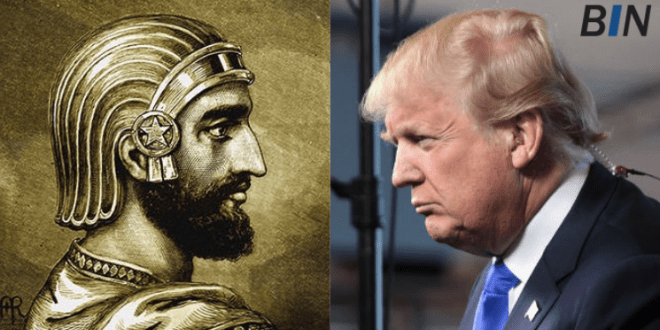
In 2018, the nascent Sanhedrin — the reconvening body of Jewish legal authority — struck a commemorative coin bearing the profiles of Trump and Cyrus side by side. Netanyahu made the comparison explicitly from the podium. Cyrus the Great, King of Persia, issued the decree recorded in Ezra 1:2 that authorized the Jewish people to return to Jerusalem and rebuild the Temple. He did it without converting to Judaism, without being part of the covenant people — he was a gentile king whom God called by name in the book of Isaiah, laebeling him “Messiah”, more than a century before his birth, raised up specifically to serve the purposes of Israel’s God.
The Cyrus parallel has taken on geopolitical overtones. Cyrus’s empire encompassed Persia, which is modern-day Iran. The cedar wood for Solomon’s original Temple was sourced from Lebanon, supplied by Hiram, King of Tyre. Trump is currently mediating between Israel and Iran, and Lebanon sits at the center of a post-Hezbollah regional realignment that his administration is actively shaping. Reza Pahlavi, heir to the Iranian throne and a prominent voice for a secular, pro-Israel Iran, has put forward what he calls the Cyrus Accords — a framework explicitly invoking the legacy of the Persian king who sent the Jews home to build their Temple — as a foundation for a new relationship between Iran and Israel.
Trump is set to visit the region in May. His administration has brokered a ceasefire in Lebanon and is in active negotiations with Iran over its nuclear program. The nations whose ancient kings supplied the labor, the timber, and the authorization for Israel’s Temple are once again in play — and the American president who is engaging all of them just read, from the Oval Office, the prayer that God answered when the Temple stood.
The Metzudat David, the classical 18th-century Bible commentary, explains that God’s promise in 2 Chronicles 7 — that His eyes and heart would remain on the Temple perpetually — is unconditional. The Temple was destroyed, but the promise was not canceled but, rather deferred. The Third Temple, the Beit HaMikdash HaShlishi, is the destination toward which the entire arc of biblical prophecy points, discussed in explicit architectural detail in the book of Ezekiel, chapters 40-48.