




A massive granite statue, broken but unmistakable, has emerged from the soil of Egypt’s eastern Nile Delta, offering a striking glimpse into the power and reach of one of history’s most formidable rulers. Egyptian authorities announced that the upper portion of a colossal statue believed to depict Ramses II was uncovered at Tel al-Faraoun in Sharqia Governorate, a site already known for its deep historical layers. Weighing up to six tons and standing more than two meters tall even in its damaged state, the statue was found missing its lower half, yet its royal features remain clear.
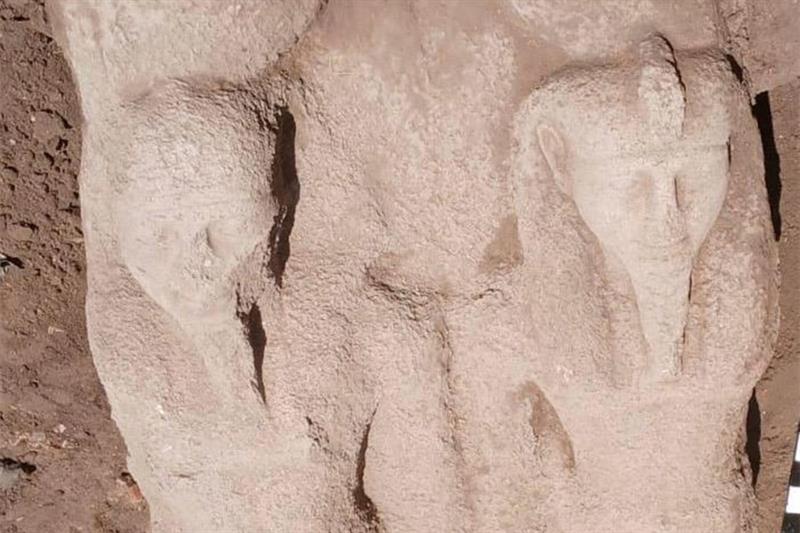
Officials from Egypt’s Supreme Council of Antiquities said the discovery was made during archaeological work near the ancient site of Imet, not far from Per-Ramses, the royal capital established by the pharaoh himself. Dr. Hisham El-Leithy, Secretary-General of the council, described the find as a significant addition to understanding the eastern Delta, emphasizing that it demonstrates how regional centers were closely linked to royal authority. “This find provides valuable evidence of how statues were relocated and repurposed during the New Kingdom,” he said.
Early analysis suggests the statue did not originate at the site where it was found. Researchers believe it was originally erected in Per-Ramses and later transported to Tel al-Faraoun for reuse within a religious complex. This was a common Egyptian practice, reflecting both the durability of royal monuments and their continued symbolic importance. The statue may have originally been part of a triad, a grouping of three figures often used in temple settings to depict a king alongside deities.
Mohamed Abdel Badi, head of the Egyptian Antiquities Sector, noted that despite the statue’s damaged condition, surviving artistic elements clearly point to Ramses II. The pharaoh, who ruled from 1279 to 1213 BCE, is widely regarded as one of ancient Egypt’s most powerful kings, known for massive building projects and military campaigns. His legacy dominates the archaeological record of the period.
The statue has been transferred to a secure facility in San El-Hagar, where specialists are preparing detailed restoration work under strict scientific standards. The discovery follows another recent find in the region: a stone stela bearing a new version of the Canopus Decree issued by Ptolemy III in 238 BCE, further underscoring the area’s long-standing religious and political significance.
Ramses II was the third king of the 19th dynasty (1292–1190 BCE) of ancient Egypt whose reign (1279–13 BCE) was the second longest in Egyptian history. He lived to be ninety-six years old, had over 200 wives and concubines, ninety-six sons and sixty daughters, most of whom he outlived. He is often regarded as the greatest, most celebrated, and most powerful pharaoh of the New Kingdom, itself the most powerful period of Ancient Egypt. The 66-year reign of Ramses II marks the last peak of Egypt’s imperial power. On his death, he was buried in a tomb in the Valley of the Kings but his body was later moved to a royal cache where it was discovered in 1881.
Though there are no archeological records identifying the Pharaoh of the Exodus and there is much debate over the identity of the Egyptian king who oversaw the Exodus of the Jews and was, as a result, killed in the splitting of the Red Sea, many scholars believe it was Ramses II and he is one of the more popular candidates. He is known for his extensive building programs and for the many colossal statues of him found all over Egypt, leading to associating him with the Biblical reference to the Hebrews constructing the supply city named Ramses (Exodus 1:11). No record of the exodus of the Jews has been found in any Egyptian tablets but a reference to “Israel” appears on the Victory Stela of Pharaoh Merneptah, one of Ramses’ sons.
An in-depth analysis of the identity of the Pharaoh of Exodus can be found on The Israel Bible website.
The statue now lies broken, its lower half lost, its original placement long forgotten. The empire it represented has vanished. The message of the verse stands in stark contrast: human rulers carve their images in stone, but their dominance does not endure. The God of Israel does not require monuments to assert His authority.
This latest discovery reinforces a reality written clearly in the Bible and confirmed by history. The might of kings like Ramses once seemed absolute. Today, their statues are unearthed in fragments, studied by archaeologists, and placed in storage.
