




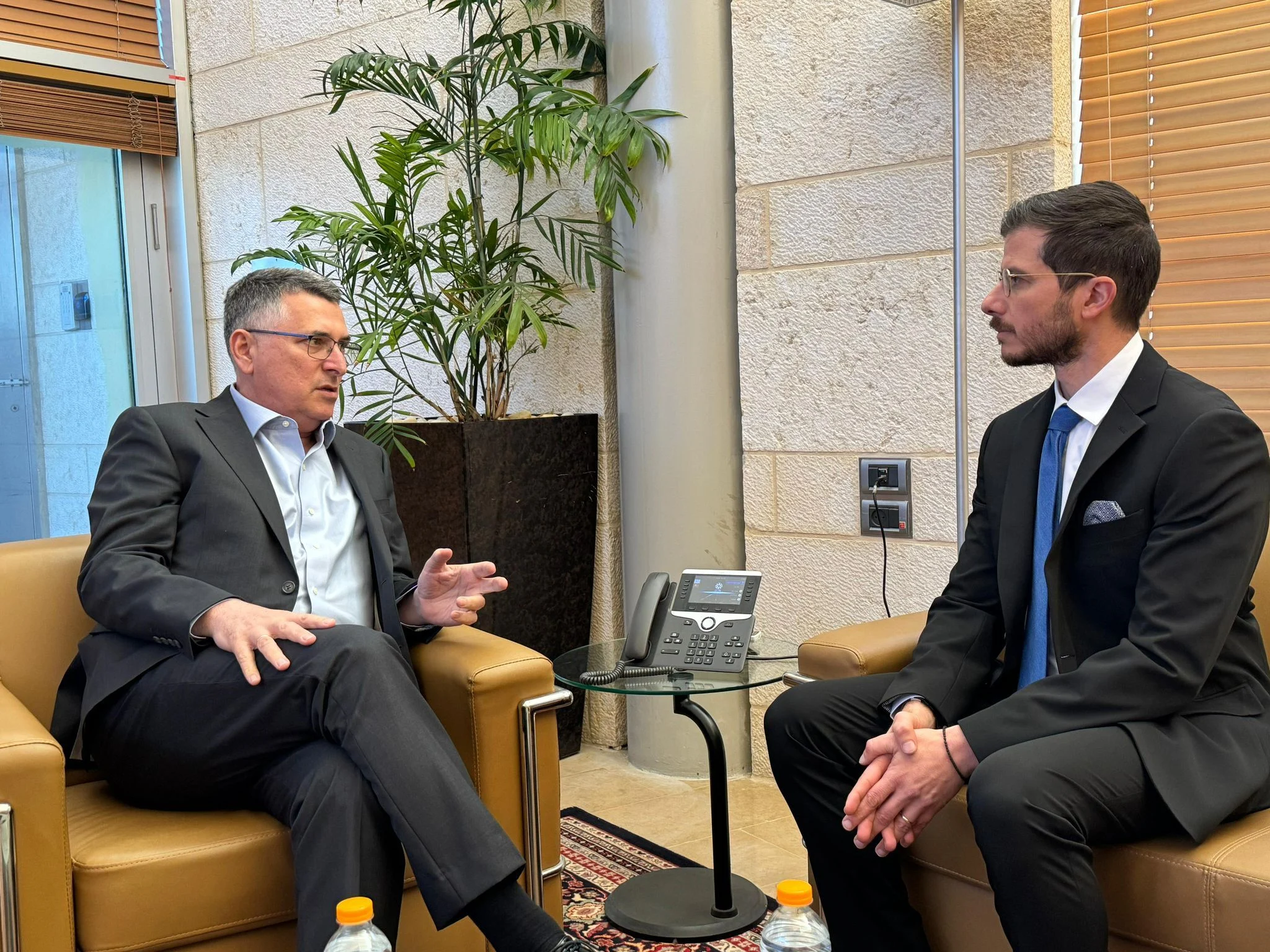
Foreign Minister Gideon Sa’ar moved this week to shore up one of Israel’s most important international relationships by appointing veteran diplomat George Deek as Special Envoy to the Christian World, a newly created role aimed at strengthening ties with Christian communities amid growing tension and scrutiny.
I am honored by the trust placed in me by Minister @gidonsaar. I accept this responsibility with gratitude, humility, and a deep sense of duty.
— George Deek (@GeorgeDeek) April 23, 2026
Today, I feel I am closing a circle. From the Sundays of my childhood sitting beside my father in church to this new diplomatic role, I… https://t.co/Lz9zl1lMcI
The Foreign Ministry announced Thursday that the appointment is intended “to deepen Israel’s ties with Christian communities around the world,” as a series of recent incidents involving Christians has drawn criticism and raised questions about Israel’s handling of sensitive religious issues during wartime.
“The State of Israel attaches great importance to its relations with the Christian world and with its Christian friends around the world,” Sa’ar said. “I am confident that George, a respected and experienced diplomat, will greatly contribute to the friendship and strengthening of the ties between the State of Israel and the Christian world.”
Deek, a seasoned diplomat with nearly two decades of experience, most recently served as Israel’s ambassador to Azerbaijan, becoming the first Christian in Israel’s history to hold the rank of ambassador. A native of Jaffa and a member of the Arab Christian community, Deek grew up in a mixed neighborhood of Jews, Muslims, and Christians. His father, Youssef Deek, served for years as chairman of the Orthodox Christian community in Jaffa and across Israel.
The appointment places Israel among a very small group of countries that have created a formal governmental structure focused on relations with the global Christian community. Hungary, through its State Secretariat for the Aid of Persecuted Christians, remains the only other country with a dedicated governmental body specifically tasked with assisting persecuted Christians worldwide. By contrast, countries such as Denmark, Greece, and Costa Rica maintain historic or official ties to Christianity but handle these relationships through traditional foreign ministry frameworks rather than appointing a designated envoy to the Christian world.
The timing of Deek’s appointment is not incidental. In recent months, Israel has faced a series of incidents that have strained relations with Christian leaders and communities, including restrictions placed on worship at the Church of the Holy Sepulcher during the war and reports of harassment against clergy in Jerusalem’s Old City. These developments have raised concerns not only among local Christian leaders but also among Evangelical Christians abroad, who remain among Israel’s strongest supporters.
Deek’s appointment reflects an attempt to bring order and intention to a relationship that has often been handled inconsistently. As an Arab Christian who represents Israel on the world stage, he brings a voice that can speak directly to Christian audiences in their own language and cultural framework, while presenting Israel’s case with credibility grounded in personal experience.
International Christian leaders welcomed the move. David Parsons of the International Christian Embassy Jerusalem called the appointment “very timely and much-needed,” noting that “it will definitely help to have an Israeli Arab Christian telling the truth about Israel’s democratic values worldwide.” David Rosen, former international director of interreligious affairs at the American Jewish Committee, said the step could lead to better coordination among government bodies that deal with Christian communities.
At the same time, the backdrop to this appointment remains difficult. According to a 2024 report by the Rossing Center for Education and Dialogue, there were 111 reported incidents involving Christians in Israel, including physical assaults, vandalism of church property, and harassment of clergy. While Israel’s Christian population—numbering approximately 184,200—continues to grow and enjoys full legal protection, these incidents have created friction that cannot be ignored.
The urgency of restoring trust was underscored last week by an incident in southern Lebanon. An IDF soldier was filmed smashing a statue of Jesus with a sledgehammer in the village of Debel. The footage spread quickly, prompting condemnation from Christian leaders and swift disciplinary action by the military. The soldier involved, along with another who documented the act, was removed from combat duty and sentenced to jail following an investigation.
Israeli leaders moved quickly to distance the state from the act. Prime Minister Benjamin Netanyahu condemned the incident, stating that Israel remains the only country in the region where the Christian population is growing and where freedom of worship is protected for all faiths.
That assertion reflects a measurable reality, but the events of recent months have shown that policy alone is not enough. The creation of a Special Envoy to the Christian World signals that Israel understands the stakes. The relationship between the Jewish state and the Christian world is not peripheral. It is strategic, historic, and, as the prophet Isaiah made clear, bound up with Israel’s role among the nations.
The appointment of George Deek is a clear statement that Israel intends to address that relationship directly, with focus and accountability. Whether it succeeds will depend not on declarations, but on consistent action.
Deek brings to the role a rare combination of personal history and diplomatic experience rooted in Israel’s Christian community. A native of Jaffa’s Ajami neighborhood, he was raised in an Eastern Orthodox family in a mixed building of Jews, Muslims, and Christians. His father, Youssef Deek, led the Orthodox Christian community in Jaffa and nationally for many years, placing Deek at the center of communal leadership from a young age.
His family story reflects the upheaval of Israel’s founding. His grandparents fled to Lebanon during the 1947–1949 war after being warned of impending massacres, but returned to Jaffa after the war, rejecting life as refugees. His grandfather was briefly jailed for reentering illegally before being released with the help of Jewish colleagues. Other relatives who left did not return and remain scattered abroad. On his father’s side, Deek also traces Armenian roots; his great-grandmother survived the Armenian Genocide.
Professionally, Deek has spent 18 years in Israel’s Foreign Ministry, joining in 2008 after earning a law degree from IDC Herzliya and studying international law and diplomacy at Georgetown University on a Fulbright fellowship. He served in Nigeria and Norway, including as acting ambassador during the 2014 Gaza conflict, before being appointed in 2018 as Israel’s ambassador to Azerbaijan at age 34—the first Israeli Arab Christian to reach ambassadorial rank. He later received the Foreign Ministry Director General’s Award for Excellence.

