




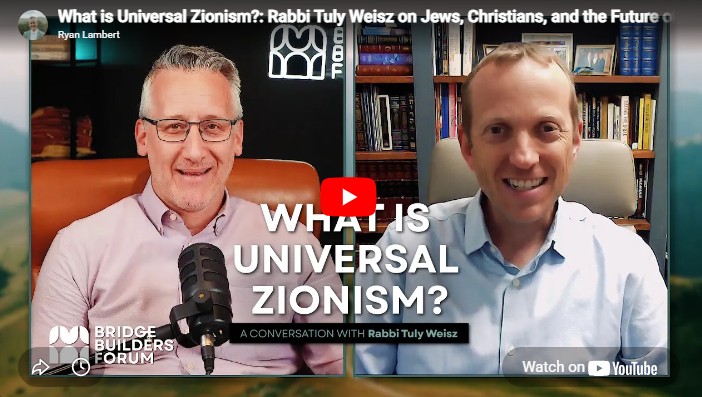
When Ryan Lambert invited Rabbi Tuly Weisz onto the Bridge Builders Forum podcast last week, the conversation quickly moved beyond a standard book interview. What unfolded was a candid, urgent exchange between two men who have dedicated themselves to one of the most consequential relationships in the world today: the alliance between Jews and Christians.
Lambert, whose Bridge Builders Forum is built around the conviction that Jewish-Christian understanding must be rooted in genuine relationship and not just shared talking points, pressed Rabbi Weisz on the bold claims of his new book, Universal Zionism and the rabbi didn’t shy away from any of them.
“I’m not sure I was bold enough,” Rabbi Weisz said, speaking from Israel amid ongoing rocket sirens and the country’s widening conflict with Iran. “The stakes really could not be higher.”
A Partnership Built on More Than Ideas
Lambert was quick to point out what he sees as the special value of Israel365’s work — and of this conversation itself. “One of the things I really appreciate,” he said, “is that you’re providing Jewish introductions to Israel and the Bible, specifically tailored for Christians. It’s so important that Christians understand Jewish ideas on Jewish terms, from Jewish sources — not only through Christian summaries.”
It’s a distinction Lambert and his team emphasize at Bridge Builders Forum as well. For both organizations, Jewish-Christian relations cannot be built on vague goodwill alone. They have to be grounded in honest engagement with what each faith actually believes and values.
Rabbi Weisz agreed wholeheartedly — and extended the point. “It’s not just about content,” he said. “It’s really about the relationship. There’s not enough Jews and Christians who have real relationships. We need to build fellowship and friendship together so that we can fight for what’s important to us.”
Lambert brought up a recent example: the Bridge Builders Forum had attended the National Religious Broadcasters conference in Nashville, where Israel365 hosted an immersive Shabbat experience led by Rabbi Elie Mischel. Lambert, who participated, described it as exactly the kind of relational moment both organizations are working toward. “It was very relational,” he said. “That’s two sides of the same coin — ideas and relationships together.”
From Columbus, Ohio to the Front Lines
For listeners unfamiliar with Rabbi Weisz’s background, Lambert took time to walk through his remarkable journey — from an Orthodox Jewish upbringing in Columbus, Ohio, where his grandfather had served as community rabbi for nearly 50 years, to Yeshiva University, to the pulpit of his grandfather’s shul, to making aliyah with his family in 2011 and founding Israel365.
Growing up in Columbus, Rabbi Weisz had almost no meaningful contact with Christians. “If anything, the only things I had heard were kind of negative,” he said. It was only as a young rabbi that he discovered, through interfaith work, that Christians genuinely loved Israel and shared a reverence for the same Hebrew Bible. “It was so eye-opening,” he recalled. “I didn’t realize that Christians also love Israel.”
That discovery set the course for everything that followed. Israel365 was founded to teach Christians about Israel from a Jewish perspective — a niche, Rabbi Weisz noted, that was almost entirely underserved fifteen years ago. “There were a lot of Christians talking about their love for Israel, but it wasn’t from a Jewish perspective,” he said. “What I found was that the more I got to know Christians, the more I appreciated my own Jewish faith. And it was vice versa.”
Lambert has watched that growth firsthand. “Israel365 has become a huge voice in this world of Christian Zionism,” he said, “and it’s really been neat to see how it’s grown.”
What Does “Universal Zionism” Actually Mean?
Turning to the book itself, Lambert didn’t waste time getting to its most provocative claims. He read directly from the text: “Universal Zionism is outward facing and is meant as much for non-Jews as for Jews, calling for Jews to build meaningful relationships with Christians.” And then, a few pages later: “This is why Universal Zionism matters as much to a Christian in Kentucky as to a Jew in Jerusalem, maybe more.”
Lambert called those “very bold claims” — and asked Rabbi Weisz to defend them.
The rabbi pointed to what is unfolding right now. America and Israel are fighting shoulder to shoulder against a nuclear-armed Iran, he noted, while the rest of the world either looks away or actively opposes them. “The only capable ally the United States has in fighting against radical Islamic terror is little tiny Israel,” he said. “You have Jews and Christians, America and Israel, literally holding up all of civilization right now.”
In that context, the claim that Universal Zionism matters as much — maybe more — to a Christian in Kentucky isn’t hyperbole. It’s a description of reality.
Lambert pushed further, noting that the moment isn’t only geopolitical but spiritual. “God put it in the Bible,” he said, “that there is a role for everyone in the world to support the people of Israel.” Rabbi Weisz agreed, and added something Lambert clearly found compelling: Israel, now strong militarily and economically even in wartime, needs to stop asking what others can do for it — and start asking what it can do for the world.
“The tables have turned,” Rabbi Weisz said. “It’s time for Israel to start saying: how can we help you?”
What Keeps Him Up at Night
When Lambert asked about his greatest concerns, Rabbi Weisz turned the spotlight in an unexpected direction — not toward Israel’s enemies, but toward the Christian community itself. Church attendance is declining. Bible literacy is falling. Christian Zionism is not being passed down to younger generations. And, he added, some of the most prominent voices supposedly speaking for young Americans may not be as representative as social media makes them appear.
“My hope is that my concerns are somewhat inflated because they’re mainly coming from social media,” he said. “I do hope there’s a silent majority of people who have their head on straight, are going to church and reading the Bible.”
Lambert — who works daily on exactly these questions from the American side — clearly resonated with the concern. For both men, the stakes of that cultural moment extend far beyond religious statistics.
A Bridge That Needs Both Sides
As the conversation drew to a close, both host and guest reflected on what their partnership represents. Lambert thanked Rabbi Weisz for being a genuine bridge builder — not just in rhetoric but in practice. Rabbi Weisz returned the compliment with characteristic directness.
“You can’t have a bridge only on one side,” he said. “You need a two-way relationship. You’re our partner over in America. We’re so grateful for everything that you’re doing.”
That mutual gratitude — and the vision behind it — is perhaps the most honest summary of what Universal Zionism is trying to build: not one side supporting the other, but Jews and Christians standing together, each strengthened by the relationship, as partners in what Rabbi Weisz believes is history’s most important hour.
