

In a decision that blended legal reasoning with a detailed halachic framework, Judge Shmuel Herbst ruled that an attempt to bring a goat for a Korban Pesach (Passover sacrifice) constituted a legitimate form of protest, not a criminal act.
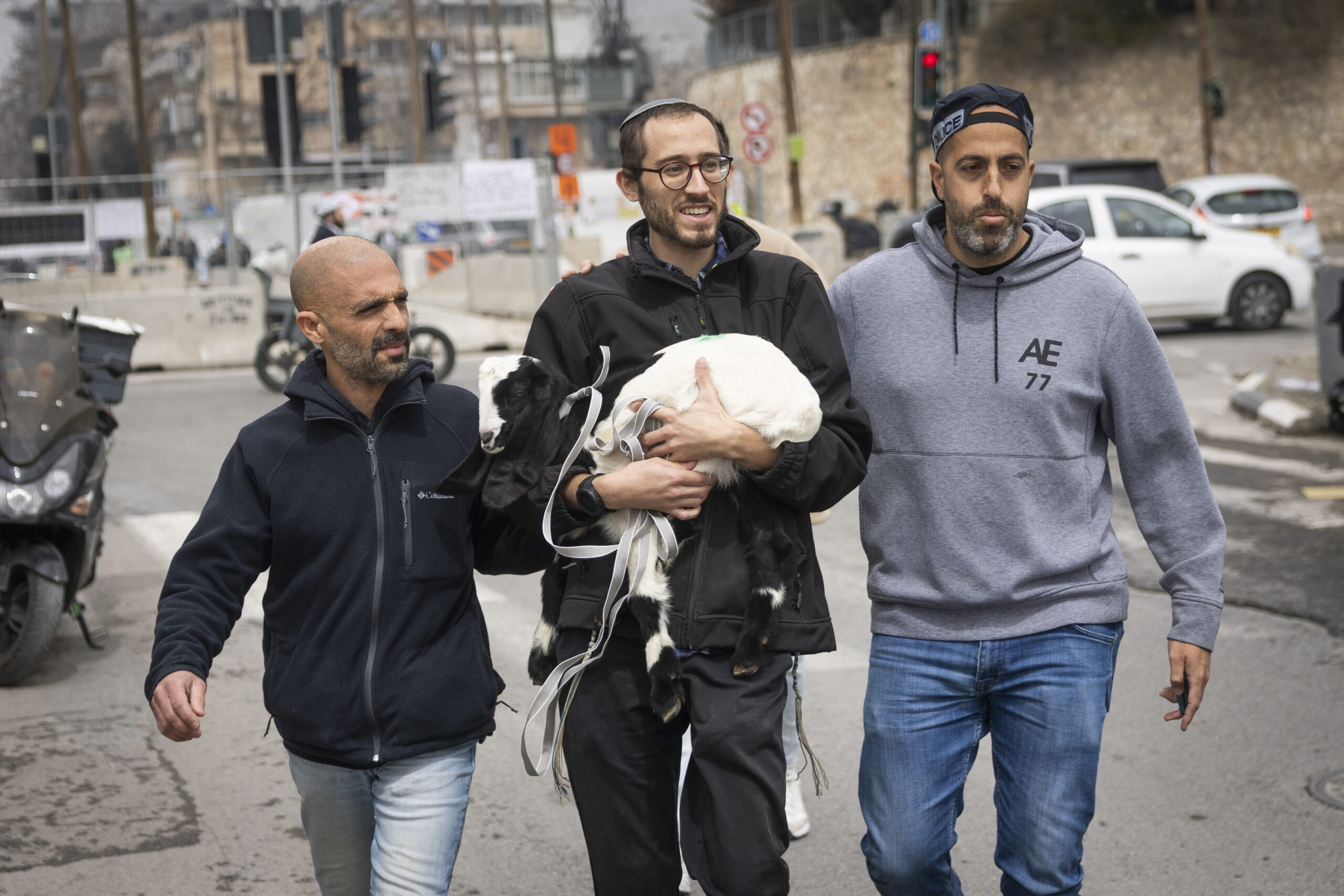
The case centered on journalist Arnon Segal and his son, who were detained after Segal documented his son leading a young goat near the Old City ahead of Passover. Police sought to ban the two from the Old City for 45 days, claiming animal abuse and warning of a volatile security situation. The court rejected both arguments outright.
“I did not find that a reasonable suspicion exists,” Herbst wrote. Addressing the accusation of animal cruelty, he added, “We all love animals, but most of us also eat them. It cannot be said that every animal destined for slaughter makes the person slaughtering it an abuser.”
Herbst went further, framing the act itself as a protest against the current restrictions on Har HaBayit (Temple Mount). He emphasized that the timing of the Korban Pesach is strictly defined, noting that “its time has passed and its sacrifice is null,” underscoring that the act in question could not even be construed as an actual offering under halacha.
In an unusual move, the judge opened his ruling with a detailed explanation of the commandment itself. The Korban Pesach, he wrote, stands at the center of the Exodus narrative, marking the Israelites’ transformation from slavery to freedom. The offering, brought on the 14th of Nisan and eaten on the night of the Seder, is explicitly commanded in the Bible:
מעצר מביאי טלה לקרבן פסח. ישראל הדמוקרטית pic.twitter.com/URbEnO3ldt
— ארנון סגל (@arnonsegal1) April 1, 2026
“And you shall say, ‘It is the sacrifice of the Lord’s Passover, who passed over the houses of the children of Israel in Egypt, when He smote the Egyptians and delivered our houses.’” (Exodus 12:27)
The judge’s inclusion of this verse anchored Segal’s act in a binding biblical commandment, even as he clarified that, in the absence of the Temple, the mitzvah cannot currently be fulfilled in practice.
Police arguments regarding security risks were also dismissed. “Claims of danger and volatility require proof, and such proof was not brought before me,” Herbst stated. He warned against reliance on broad, unsubstantiated claims, adding that widely accepted “security axioms” must be reexamined rather than accepted at face value.
The court ultimately rejected the request to bar Segal and his son from the Old City, noting that they live in the City of David, adjacent to the area. Herbst ruled that such a restriction would constitute a severe and unjustified infringement on their freedom of movement. Instead, he imposed a limited restriction barring them only from the Temple Mount area for the duration of the holiday, a measure with little practical effect, since the site is already closed to visitors during that period.
Attorney Nati Rom of Honenu praised the decision. “There are real judges in Jerusalem. A ruling that respects the deep yearning of the people of Israel is one that honors the judicial system. I hope the police will draw conclusions.”
Segal echoed that sentiment, pointing to the court’s clear rejection of the police request and its emphasis on the centrality of the Korban Pesach. “There are real judges in Jerusalem,” he said.
The ruling cuts through two core claims, criminality and security risk, and finds neither supported by evidence. More than that, it establishes something broader: that an act rooted in the commandments of the Bible, even when carried out today as a demonstration, cannot be casually dismissed as illegitimate. The court recognized what many prefer to ignore: the desire to restore the Korban Pesach is not fringe. It is grounded in the text, in halacha, and in the enduring identity of the Jewish people.