

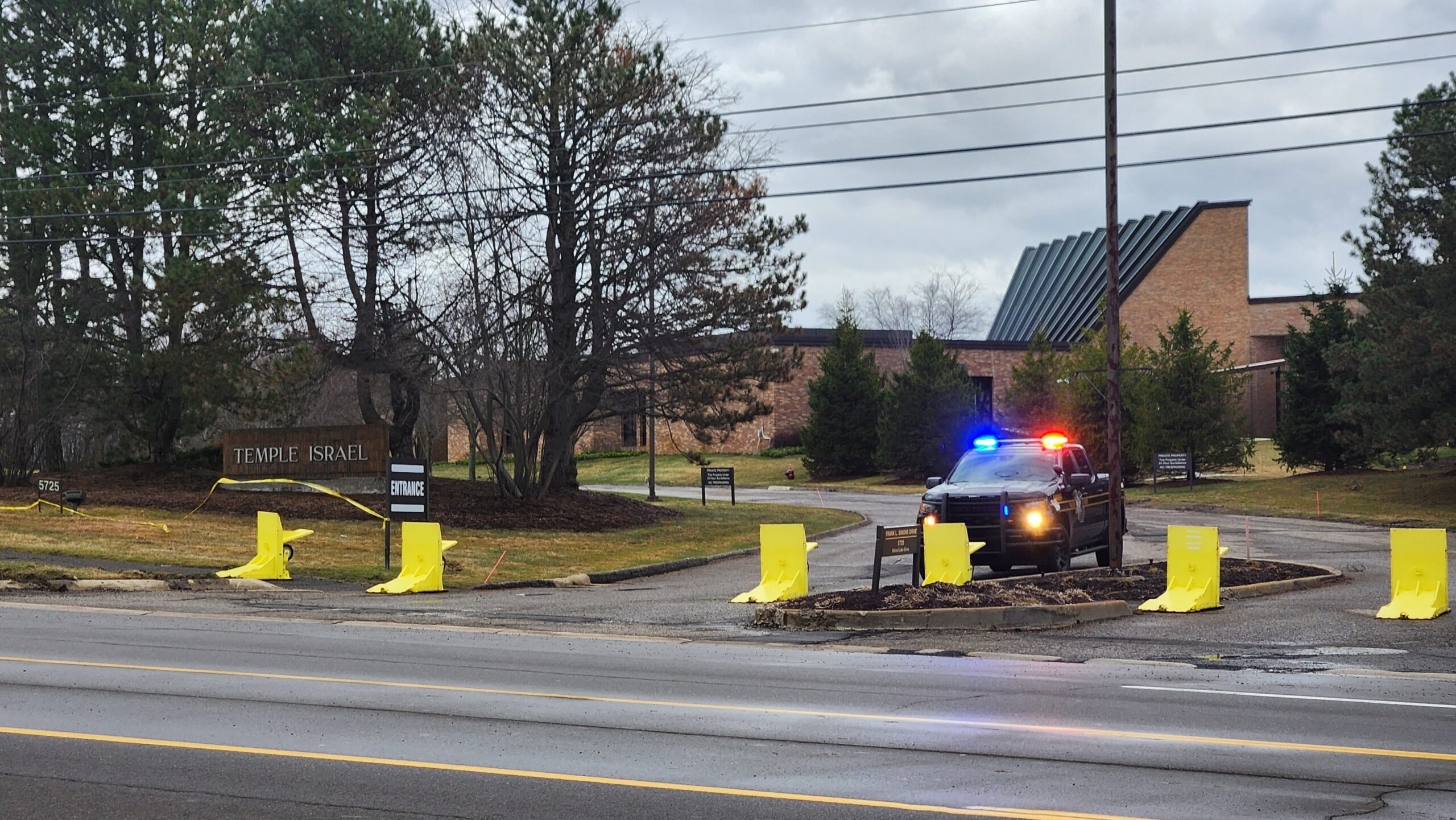
When Ayman Mohamad Ghazali drove a truck loaded with fireworks and gasoline into the Jewish preschool at Temple Israel in West Bloomfield, Michigan, on March 12, more than 140 young children were inside. Ghazali died at the scene after a firefight with a security guard.
Following a comprehensive investigation, the FBI confirmed on March 30, 2026, that the attack was a “Hezbollah-inspired act of terrorism”. Authorities found his online activity showed searches for pro-Hezbollah news and large Jewish gatherings in Michigan. As a reminder, Hezbollah is an Iran-backed terrorist organization. Ayman Mohamad Ghazali’s brother, Ibrahim Muhammad Ghazali, was a Hezbollah commander responsible for launching rockets at Israeli civilians.
Displaying a warped sense of journalistic curiosity, NPR’s followed up the event by sending a reporter 6,000 miles away to Lebanon to interview the terrorist’s neighbors. None of NPR’s coverage of the horrifying attack quoted a single rabbi, congregant, or parent from Temple Israel.
The backlash was immediate. NPR’s own public editor was forced to respond, and what followed was a masterclass in damage control dressed up as accountability.
On March 14, just two days after the attack, NPR aired a segment on All Things Considered titled “In a small Lebanese town, grief and fear follow the Michigan synagogue attack.” Reporter Hadeel Al-Shalchi traveled to Mashghara, Lebanon, Ghazali’s hometown, to interview his uncle and neighbors. The NPR article described Israeli strikes on Lebanon as “relentless bombing” and noted that many residents “support the Iranian-backed militant group Hezbollah.” What it did not mention was that Hezbollah is classified as a terrorist organization by a significant number of countries and international bodies, or that the “support” its members provide includes firing rockets at Israeli cities, or that the attacker’s own brother was a Hezbollah commander responsible for doing exactly that.
FBI confirms the Michigan synagogue attack was Hezbollah-inspired, raising urgent national security concerns. pic.twitter.com/tWZAqlznOQ
— D. Scott @eclipsethis2003 (@eclipsethis2003) March 31, 2026
NPR did interview a soccer coach from the village named Ibrahim Zeih, who dismissed any suggestion that the attack was antisemitic. “We’re not against Jews as Jews,” Zeih told NPR. “We are against the Israelis who are killing us daily.”
The FBI’s investigation made it clear that the soccer coach’s statement was grossly inaccurate, yet it made it into the broadcast. Not a single voice from Temple Israel did.
The reaction to NPR’s coverage was swift. Batya Ungar-Sargon captured the absurdity in a Substack post that spread widely. “NPR found the real victim of an attack on 140 Jewish American babies,” she wrote, “and it’s the Hezbollah-infested town in Lebanon that raised a family of terrorists.” Richard Wilkins wrote directly to NPR’s public editor, Kelly McBride, accusing NPR of deliberate distortion. “NPR’s reaction?” he wrote. “Sympathized understanding for the subsequent ‘grief and fear’ in his former hometown. Concealment of then public knowledge that those two brothers were Hezbollah terrorists, in a town full of Hezbollah sympathizers.”
McBride’s April 2 editorial response opened not with accountability but with a framing designed to discredit the critics before addressing their criticism. She positioned those objecting to NPR’s coverage alongside President Trump and Defense Secretary Pete Hegseth, who had suggested some newsrooms were “rooting for the U.S. to lose the war”, and declared that “news consumers don’t want or need a patriotic press cheerleading the government.” The implication was unmistakable: people upset that NPR humanized a Hezbollah-connected terrorist’s family while ignoring his Jewish victims were in the same camp as politicians trying to muzzle the free press.
When McBride did address the Lebanon segment directly, she defended it. “The journalistic purpose of the story was to explore the connection between the terror attack on the Michigan synagogue and the family that was killed on the other side of the world,” she wrote. “Simply documenting that relationship and humanizing the family does not imply that Ghazali’s attempt to kill more than a hundred children was justified.”
She did acknowledge, carefully and narrowly, that Temple Israel’s voices were missing. “In all of that coverage, voices from Temple Israel are absent. I couldn’t find any stories that quote rabbis, congregation members, or the families of the children who had to flee the building.” She added: “NPR or Michigan Public Radio pulled away from the story at Temple Israel too soon.”
But McBride never called it a failure. She never said it was wrong. She framed the missing Jewish voices as an unfortunate gap in an otherwise defensible body of coverage, and not as evidence of the institutional bias critics have been documenting for years. The closest she came to a reckoning was this: “When important voices are missing from coverage, it distorts the audience’s perception of everything else.” A true statement, offered without any apparent recognition that she had just described exactly what NPR did.
McBride also revealed, apparently without recognizing the significance, that NPR had mischaracterized its own report. She described the Lebanon segment as having opened by calling Mashghara “a Hezbollah stronghold.” It did not. Al-Shalchi wrote only that many residents “support” Hezbollah, language that transforms a Hezbollah-controlled village into something that sounds closer to a community with complicated sympathies. The IDF had confirmed that the attacker’s brother was a Hezbollah commander. That fact was absent from the original broadcast and added only after the story aired, when the IDF press office belatedly followed up.
NPR’s coverage of Israel has drawn serious criticism in the past. In April 2024, Uri Berliner, a veteran NPR editor with 25 years at the network, resigned and published a searing critique in the Free Press. He described a newsroom that had abandoned what he called “an open-minded, curious culture.” “Today, those who listen to NPR or read its coverage online find something different,” Berliner wrote: “the distilled worldview of a very small segment of the US population.” He described NPR’s current audience as “overwhelmingly white and progressive, and clustered around coastal cities and college towns,” and warned: “An open-minded spirit no longer exists within NPR, and now, predictably, we don’t have an audience that reflects America.”
My resignation letter to NPR CEO @krmaher pic.twitter.com/0hafVbcZAK
— Uri Berliner (@uberliner) April 17, 2024
Regarding Israel specifically, Berliner accused NPR of approaching the Israel-Hamas war through an “intersectional” framework. He charged that this meant “oppressor versus oppressed,” leading to coverage that was “highlighting the suffering of Palestinians at almost every turn while downplaying the atrocities of October 7, overlooking how Hamas intentionally puts Palestinian civilians in peril, and giving little weight to the explosion of antisemitic hate around the world.” He described an “unspoken consensus” at NPR about which stories to tell and how: “It’s frictionless — one story after another about instances of supposed racism, transphobia, signs of the climate apocalypse, Israel doing something bad, and the dire threat of Republican policies. It’s almost like an assembly line.”
JNS.org has separately raised the issue of NPR’s reliance on casualty figures from the Hamas-run Gaza Health Ministry, a source with a direct interest in inflating numbers and zero independent accountability.
NPR is publicly funded. American taxpayers, including American Jews, pay for it. The children who fled that Michigan preschool in terror deserved to have their story told. Their parents deserved to be asked how they felt. Their rabbis deserved to be quoted. Instead, NPR sent a reporter to Lebanon to document the grief of a Hezbollah commander’s family — and called it journalism. Even NPR’s own public editor now admits that was wrong. The question is whether NPR will treat it as a mistake or whether the assembly line keeps running.
